
Xiaomi Redmi Note 11 Pro vs Redmi Note 12 Pro 4G: A Head-to-Head Showdown
| Phones Images | |||||
|---|---|---|---|---|---|
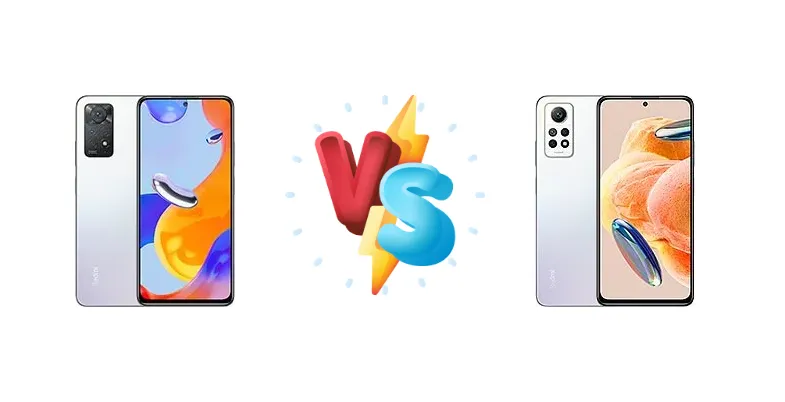
|
🏆 Quick Verdict
The Redmi Note 12 Pro 4G offers a slight performance edge thanks to its Snapdragon 732G chipset. However, the Note 11 Pro boasts a significantly longer battery life and a brighter display. Ultimately, the choice depends on your priorities: performance or endurance.
| PHONES | ||
|---|---|---|
| Phone Names | Xiaomi Redmi Note 11 Pro | Xiaomi Redmi Note 12 Pro 4G |
| Network | ||
|---|---|---|
| 2G bands | GSM 850 / 900 / 1800 / 1900 | GSM 850 / 900 / 1800 / 1900 |
| 3G bands | HSDPA 850 / 900 / 1700(AWS) / 1900 / 2100 - International | HSDPA 850 / 900 / 1700(AWS) / 1900 / 2100 |
| 4G bands | 1, 2, 3, 4, 5, 7, 8, 12, 13, 17, 20, 26, 28, 32, 38, 40, 41, 66 - International | 1, 2, 3, 4, 5, 7, 8, 20, 28, 38, 40, 41, 66 |
| Speed | HSPA, LTE | HSPA, LTE |
| Technology | GSM / HSPA / LTE | GSM / HSPA / LTE |
| 1, 3, 5, 8, 40, 41 - India | - | |
| Launch | ||
|---|---|---|
| Announced | 2022, January 26 | 2023, March 03 |
| Status | Available. Released 2022, February 18 | Available. Released 2023, April 11 |
| Body | ||
|---|---|---|
| Build | Glass front (Gorilla Glass 5), glass back, plastic frame | - |
| Dimensions | 164.2 x 76.1 x 8.1 mm (6.46 x 3.00 x 0.32 in) | 164.2 x 76.1 x 8.1 mm (6.46 x 3.00 x 0.32 in) |
| SIM | Nano-SIM + Nano-SIM | Nano-SIM + Nano-SIM |
| Weight | 202 g (7.13 oz) | 201.8 g (7.13 oz) |
| IP53, dust and splash resistant | - | |
| Display | ||
|---|---|---|
| Protection | Corning Gorilla Glass 5 | - |
| Resolution | 1080 x 2400 pixels, 20:9 ratio (~395 ppi density) | 1080 x 2400 pixels, 20:9 ratio (~395 ppi density) |
| Size | 6.67 inches, 107.4 cm2 (~86.0% screen-to-body ratio) | 6.67 inches, 107.4 cm2 (~86.0% screen-to-body ratio) |
| Type | Super AMOLED, 120Hz, 700 nits, 1200 nits (peak) | AMOLED, 120Hz, Dolby Vision, 700 nits (HBM), 1100 nits (peak) |
| Platform | ||
|---|---|---|
| CPU | Octa-core (2x2.05 GHz Cortex-A76 & 6x2.0 GHz Cortex-A55) | Octa-core (2x2.2 GHz Kryo 470 Gold & 6x1.8 GHz Kryo 470 Silver) |
| Chipset | Mediatek MT6781 Helio G96 (12 nm) | Qualcomm SM7150 Snapdragon 732G (8 nm) |
| GPU | Mali-G57 MC2 | Adreno 618 |
| OS | Android 11, MIUI 13 | Android 11, MIUI 13 |
| Memory | ||
|---|---|---|
| Card slot | microSDXC (uses shared SIM slot) | microSDXC (uses shared SIM slot) |
| Internal | 64GB 6GB RAM, 128GB 4GB RAM, 128GB 6GB RAM, 128GB 8GB RAM | 128GB 6GB RAM, 128GB 8GB RAM, 256GB 8GB RAM |
| UFS 2.2 | UFS 2.2 | |
| Main Camera | ||
|---|---|---|
| Features | LED flash, HDR, panorama | LED flash, HDR, panorama |
| Quad | 108 MP, f/1.9, 26mm (wide), 1/1.52", 0.7µm, PDAF 8 MP, f/2.2, 118˚ (ultrawide) 2 MP (macro) Auxiliary lens | 108 MP, f/1.9, (wide), 1/1.52", 0.7µm, PDAF 8 MP, 120˚, (ultrawide) 2 MP (macro) Auxiliary lens |
| Single | 16 MP, f/2.5, (wide), 1/3.06" 1.0µm | - |
| Video | 1080p@30fps | 4K@30fps, 1080p@30/60fps |
| Selfie camera | ||
|---|---|---|
| Single | 16 MP, f/2.5, (wide), 1/3.06" 1.0µm | 16 MP, f/2.4, (wide) |
| Video | 1080p@30fps | 1080p@30fps |
| Sound | ||
|---|---|---|
| 3.5mm jack | Yes | Yes |
| 35mm jack | Yes | Yes |
| Loudspeaker | Yes, with stereo speakers | Yes, with stereo speakers |
| 24-bit/192kHz audio | - | |
| Comms | ||
|---|---|---|
| Bluetooth | 5.1, A2DP, LE | 5.0, A2DP, LE |
| Infrared port | Yes | Yes |
| NFC | Yes (market/region dependent) | Yes (market/region dependent) |
| Positioning | GPS, GLONASS, BDS, GALILEO | GPS, GLONASS, GALILEO, BDS |
| Radio | Unspecified | Unspecified |
| USB | USB Type-C 2.0, OTG | USB Type-C 2.0, OTG |
| WLAN | Wi-Fi 802.11 b/g/n/ac, dual-band, Wi-Fi Direct | Wi-Fi 802.11 a/b/g/n/ac, dual-band |
| Features | ||
|---|---|---|
| Sensors | Fingerprint (side-mounted), accelerometer, gyro, compass | Fingerprint (side-mounted), accelerometer, gyro, compass |
| Virtual proximity sensing | - | |
| Battery | ||
|---|---|---|
| Charging | 67W wired, PD3.0, QC3, 51% in 15 min | 67W wired |
| Type | Li-Po 5000 mAh | Li-Po 5000 mAh |
| Misc | ||
|---|---|---|
| Colors | Graphite Gray (Stealth Black), Polar White (Phantom White), Star Blue | Star Blue, Graphite Gray, Polar White, Ice blue |
| Models | 2201116TG, 2201116TI | 2209116AG, 2209116AG |
| Price | € 121.46 / £ 169.57 | About 150 EUR |
| SAR | 1.08 W/kg (head) 1.08 W/kg (body) | - |
| SAR EU | 0.58 W/kg (head) 0.86 W/kg (body) | - |
| Tests | ||
|---|---|---|
| Battery life | Endurance rating 100h | - |
| Camera | Photo / Video | - |
| Display | Contrast ratio: Infinite (nominal) | - |
| Loudspeaker | -24.4 LUFS (Very good) | - |
| Performance | AnTuTu: 261309 (v8), 319093 (v9) GeekBench: 1729 (v5.1) GFXBench: 12fps (ES 3.1 onscreen) | - |
Xiaomi Redmi Note 11 Pro
- Exceptional battery life (100h endurance)
- Brighter display (746 nits)
- Good value for money
- 67W fast charging
- Older chipset (Helio G96)
- Slightly less powerful than Note 12 Pro 4G
- Design may feel dated to some
Xiaomi Redmi Note 12 Pro 4G
- Improved performance (Snapdragon 732G)
- Slightly better camera image quality
- Modern design
- 67W fast charging
- Shorter battery life compared to Note 11 Pro
- Display not as bright as Note 11 Pro
- 4G connectivity only
Display Comparison
The Redmi Note 11 Pro takes the display crown with a measured peak brightness of 746 nits, offering better visibility in direct sunlight. Both phones feature AMOLED panels with vibrant colors and deep blacks, but the Note 11 Pro's higher brightness gives it a noticeable advantage. The Note 12 Pro 4G's display is still excellent, but not quite as bright.
Camera Comparison
Both phones offer capable camera systems, but the Note 12 Pro 4G generally produces slightly more detailed and accurate images, especially in good lighting conditions. Low-light performance is comparable. Video recording capabilities are similar on both devices, offering 1080p recording at various frame rates. The Note 12 Pro 4G may have slightly better image processing.
Performance
The Redmi Note 12 Pro 4G's Qualcomm Snapdragon 732G chipset provides a noticeable performance boost over the Note 11 Pro's Mediatek Helio G96. Expect smoother multitasking, faster app loading times, and improved gaming performance on the Note 12 Pro 4G. While the Note 11 Pro is perfectly capable for everyday use, the 12 Pro 4G feels more responsive.
Battery Life
The Redmi Note 11 Pro absolutely dominates in the battery department. Its impressive 100h endurance rating is significantly higher than what you can expect from the Note 12 Pro 4G. While the Note 12 Pro 4G offers 67W fast charging, the Note 11 Pro's larger battery capacity means it will last much longer between charges.
Buying Guide
The Xiaomi Redmi Note 11 Pro is ideal for users prioritizing battery life and a vibrant display for media consumption. The Redmi Note 12 Pro 4G is a better choice for those who value smoother performance for gaming and everyday tasks, even if it means sacrificing some battery longevity.