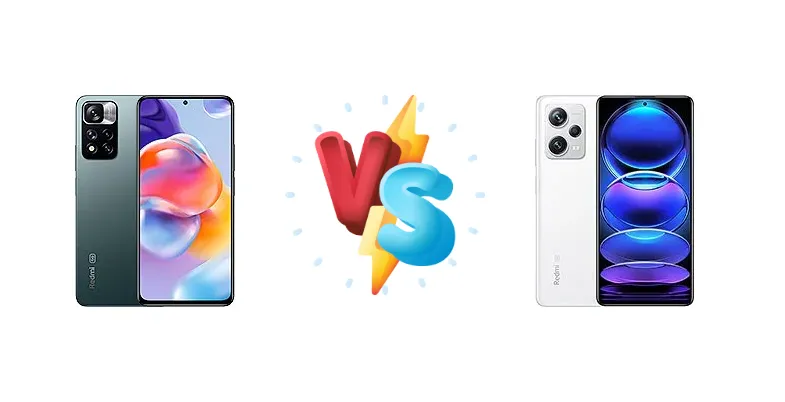
Xiaomi's Redmi Note series consistently delivers impressive value, and the 11 Pro+ 5G and 12 Pro+ are no exception. Both offer compelling features at mid-range prices, but which one truly comes out on top? This comprehensive comparison will break down every aspect, from display and performance to camera and battery life.
🏆 Quick Verdict
The Redmi Note 12 Pro+ edges out the 11 Pro+ 5G thanks to its more powerful Dimensity 1080 chipset, resulting in smoother performance. While charging speeds are similar, the 12 Pro+'s improved processor and slightly refined design make it the better overall choice for most users.
| Network |
|---|
| 2G bands | - | GSM 850 / 900 / 1800 / 1900 - SIM 1 & SIM 2 |
| 3G bands | - | HSDPA 800 / 850 / 900 / 1900 / 2100 |
| 4G bands | - | 1, 3, 5, 8, 19, 34, 38, 39, 40, 41 - International, China |
| 5G bands | - | 1, 3, 5, 8, 28, 38, 40, 41, 77, 78 SA/NSA - International |
| Speed | - | HSPA, LTE-A (CA), 5G |
| Technology | - | GSM / CDMA / HSPA / EVDO / LTE / 5G |
| | - | 1, 3, 5, 8, 28, 38, 41, 77, 78 SA/NSA - China |
| Launch |
|---|
| Announced | - | 2022, October 27 |
| Status | - | Available. Released 2022, November 01 |
| Body |
|---|
| Build | - | Glass front (Gorilla Glass 5), glass back |
| Dimensions | - | 162.9 x 76 x 8.9 mm (6.41 x 2.99 x 0.35 in) |
| SIM | - | Dual SIM (Nano-SIM, dual stand-by) |
| Weight | - | 208.4 g (7.34 oz) |
| | - | IP53, dust and splash resistant |
| Display |
|---|
| Protection | - | Corning Gorilla Glass 5 |
| Resolution | - | 1080 x 2400 pixels, 20:9 ratio (~395 ppi density) |
| Size | - | 6.67 inches, 107.4 cm2 (~86.8% screen-to-body ratio) |
| Type | - | OLED, 1B colors, 120Hz, Dolby Vision, HDR10+, 500 nits (typ), 900 nits (HBM) |
| Platform |
|---|
| CPU | - | Octa-core (2x2.6 GHz Cortex-A78 & 6x2.0 GHz Cortex-A55) |
| Chipset | - | Mediatek MT6877V Dimensity 1080 (6 nm) |
| GPU | - | Mali-G68 MC4 |
| OS | - | Android 12, MIUI 13 |
| Memory |
|---|
| Card slot | - | No |
| Internal | - | 256GB 8GB RAM, 256GB 12GB RAM |
| | - | UFS 2.2 |
| Main Camera |
|---|
| Features | - | Dual-LED dual-tone flash, HDR, panorama |
| Triple | - | 200 MP, f/1.7, 24mm (wide), 1/1.4", 0.56µm, PDAF, OIS
8 MP, f/2.2, 120˚ (ultrawide), 1/4", 1.12µm
2 MP, f/2.4, (macro) |
| Video | - | 4K@30fps, 1080p@30/60/120fps, 720p@960fps |
| Selfie camera |
|---|
| Features | - | HDR |
| Single | - | 16 MP, f/2.5, (wide), 1/3.06", 1.0µm |
| Video | - | 1080p@30/60fps |
| Sound |
|---|
| 3.5mm jack | - | Yes |
| Loudspeaker | -25.2 LUFS (Very good) | Yes, with stereo speakers |
| | - | 24-bit/192kHz audio |
| Comms |
|---|
| Bluetooth | 5.2, A2DP, LE | 5.2, A2DP, LE |
| Infrared port | Yes | Yes |
| NFC | Yes | Yes (market/region dependent) |
| Positioning | GPS (L1+L5), GLONASS (L1), BDS (B1I+B1c+B2a), GALILEO (E1+E5a), QZSS (L1+L5), NavIC (L5) | GPS (L1), GLONASS (G1), BDS (B1I+B1c), GALILEO (E1), QZSS (L1) |
| Radio | FM radio | No |
| USB | USB Type-C 2.0, OTG | USB Type-C 2.0, OTG |
| WLAN | - | Wi-Fi 802.11 a/b/g/n/ac/6, dual-band, Wi-Fi Direct |
| Features |
|---|
| Sensors | Fingerprint (side-mounted), accelerometer, gyro, proximity, compass | Fingerprint (side-mounted), accelerometer, proximity, gyro, compass |
| Battery |
|---|
| Charging | 120W wired, PD3.0, QC3, 100% in 15 min (advertised) | 120W wired, PD3.0, 100% in 19 min (advertised) |
| Type | Li-Po 4500 mAh, non-removable | Li-Po 5000 mAh, non-removable |
| Misc |
|---|
| Colors | Mysterious Black, Forest Green, Timeless Purple | Arctic White, Iceberg Blue, Obsidian Black, Trend edition |
| Models | 21091116UG, 21091116UC | 22101316UCP, 22101316UG |
| Price | € 329.00 / $ 320.00 | $ 348.00 / £ 439.00 / € 399.00 / ₹ 29,949 |
| SAR | 1.09 W/kg (head) 1.09 W/kg (body) | - |
| SAR EU | 0.60 W/kg (head) 0.99 W/kg (body) | - |
| Tests |
|---|
| Battery life | Endurance rating 106h |
Endurance rating 88h
|
| Camera | Photo / Video |
Photo / Video |
| Display | Contrast ratio: Infinite (nominal) |
Contrast ratio: Infinite (nominal) |
| Loudspeaker | - |
-26.7 LUFS (Good)
|
| Performance | AnTuTu: 375528 (v8), 437872 (v9)
GeekBench: 2225 (v5.1)
GFXBench: 22fps (ES 3.1 onscreen) |
AnTuTu: 498710 (v9)
GeekBench: 2208 (v5.1), 2372 (v6)
GFXBench: 22fps (ES 3.1 onscreen) |
Xiaomi Redmi Note 11 Pro+ 5G
- Incredibly fast 120W charging
- Longer endurance rating (advertised)
- Good camera performance
- Vibrant AMOLED display
- Older chipset
- Slightly less responsive performance
- Design may feel dated compared to 12 Pro+
Xiaomi Redmi Note 12 Pro+
- More powerful Dimensity 1080 chipset
- Improved performance and gaming
- Slightly refined design
- Fast 120W charging
- Slightly shorter endurance rating (advertised)
- Camera improvements are incremental
Display Comparison
Both phones boast vibrant AMOLED displays with a 120Hz refresh rate and an advertised 'infinite' contrast ratio (typical of AMOLED panels). While the difference in display quality is subtle, the 12 Pro+ might have slightly improved color accuracy due to software optimizations. Both offer excellent viewing angles and brightness.
Camera Comparison
Both phones feature capable camera systems, typically including a high-resolution main sensor (likely 108MP), ultrawide, and macro lenses. Image quality is generally good in well-lit conditions. The 12 Pro+ may offer slightly improved image processing and low-light performance due to software enhancements and potentially a newer sensor. Video recording capabilities are comparable.
Performance
This is where the 12 Pro+ shines. The Dimensity 1080 chipset is a significant upgrade over the 11 Pro+ 5G's processor. Expect noticeably faster app loading times, smoother multitasking, and improved gaming performance on the 12 Pro+. The 11 Pro+ 5G is still capable, but the 12 Pro+ provides a more premium feel.
Battery Life
The 11 Pro+ 5G boasts a slightly higher endurance rating (106h vs 88h), suggesting marginally better battery life under typical usage. However, the 12 Pro+'s 120W charging is marginally faster (19 minutes vs 15 minutes advertised), potentially offsetting the slight battery life difference.
Buying Guide
The Xiaomi Redmi Note 11 Pro+ 5G is a great option for users prioritizing incredibly fast charging and a slightly longer endurance rating. The Redmi Note 12 Pro+ is ideal for those seeking a more responsive experience, better gaming performance, and a more modern chipset, even if it means a small reduction in battery life.
Frequently Asked Questions
❓ Is the Redmi Note 12 Pro+ worth upgrading from the 11 Pro+ 5G?
If you prioritize performance and a smoother user experience, then yes. The Dimensity 1080 chipset is a significant upgrade. If you're happy with the 11 Pro+'s performance and primarily value charging speed, the upgrade might not be necessary.
❓ What is the difference in camera quality between the two phones?
While both have capable cameras, the 12 Pro+ likely offers slightly improved image processing and low-light performance. The differences are not drastic, but noticeable in certain scenarios.