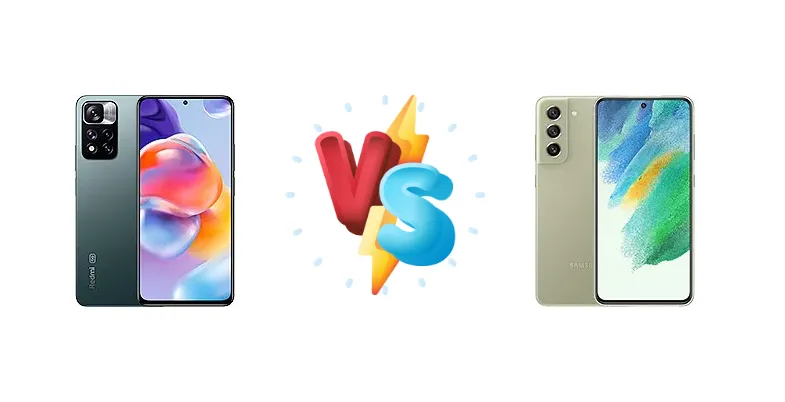
The Xiaomi Redmi Note 11 Pro+ 5G and Samsung Galaxy S21 FE 5G represent compelling options in a crowded smartphone market. The Redmi Note 11 Pro+ aggressively targets charging speed and camera resolution, while the S21 FE offers a taste of Samsung’s flagship experience with a powerful, albeit older, processor. This comparison dissects their strengths and weaknesses to determine which device delivers the best overall value.
🏆 Quick Verdict
For the average user prioritizing rapid charging and a high-resolution camera, the Xiaomi Redmi Note 11 Pro+ 5G is the clear winner. Its 120W charging is a game-changer, and the 106-hour endurance rating provides peace of mind. However, the S21 FE remains a strong contender for those who value raw processing power and Samsung’s refined software experience.
| Network |
|---|
| 2G bands | - | GSM 850 / 900 / 1800 / 1900 |
| 3G bands | - | HSDPA 850 / 900 / 1700(AWS) / 1900 / 2100 |
| 4G bands | - | 1, 2, 3, 4, 5, 7, 8, 12, 17, 20, 26, 28, 32, 38, 40, 41, 66 - International |
| 5G bands | - | 1, 3, 5, 8, 20, 28, 38, 40, 41, 66, 78 SA/NSA/Sub6 - International |
| Speed | - | HSPA 42.2/5.76 Mbps, LTE (5CA) Cat19 1600/200 Mbps, 5G |
| Technology | - | GSM / CDMA / HSPA / EVDO / LTE / 5G |
| | - | 41, 66, 71, 260, 261 SA/NSA/Sub6/mmWave - USA |
| Launch |
|---|
| Announced | - | 2022, January 04 |
| Status | - | Available. Released 2022, January 07 |
| Body |
|---|
| Build | - | Glass front (Gorilla Glass Victus), plastic back, aluminum frame |
| Dimensions | - | 155.7 x 74.5 x 7.9 mm (6.13 x 2.93 x 0.31 in) |
| SIM | - | · Nano-SIM· Nano-SIM + Nano-SIM |
| Weight | - | 177 g (6.24 oz) |
| | - | IP68 dust/water resistant (up to 1.5m for 30 min) |
| Display |
|---|
| Protection | - | Corning Gorilla Glass Victus |
| Resolution | - | 1080 x 2340 pixels, 19.5:9 ratio (~403 ppi density) |
| Size | - | 6.4 inches, 100.5 cm2 (~86.7% screen-to-body ratio) |
| Type | - | Dynamic AMOLED 2X, 120Hz, HDR10+ |
| | - | Always-on display |
| Platform |
|---|
| CPU | - | Octa-core (1x2.84 GHz Cortex-X1 & 3x2.42 GHz Cortex-A78 & 4x1.80 GHz Cortex-A55) - Version 1Octa-core (1x2.9 GHz Cortex-X1 & 3x2.80 GHz Cortex-A78 & 4x2.2 GHz Cortex-A55) - Version 2 |
| Chipset | - | Qualcomm SM8350 Snapdragon 888 5G (5 nm) - Version 1Exynos 2100 (5 nm) - Version 2 |
| GPU | - | Adreno 660 - Version 1Mali-G78 MP14 - Version 2 |
| OS | - | Android 12, up to 4 major Android upgrades, One UI 8 |
| Memory |
|---|
| Card slot | - | No |
| Internal | - | 128GB 6GB RAM, 128GB 8GB RAM, 256GB 6GB RAM, 256GB 8GB RAM |
| Main Camera |
|---|
| Features | - | LED flash, auto-HDR, panorama |
| Single | - | 32 MP, f/2.2, 26mm (wide), 1/2.74", 0.8µm |
| Triple | - | 12 MP, f/1.8, 26mm (wide), 1/1.76", 1.8µm, dual pixel PDAF, OIS
8 MP, f/2.4, 76mm (telephoto), 1/4.5", 1.0µm, PDAF, OIS, 3x optical zoom
12 MP, f/2.2, 13mm, 123˚ (ultrawide), 1/3.0", 1.12µm |
| Video | - | 4K@30/60fps, 1080p@30/60/120/240fps, HDR10+, gyro-EIS |
| Selfie camera |
|---|
| Features | - | HDR |
| Single | - | 32 MP, f/2.2, 26mm (wide), 1/2.74", 0.8µm |
| Video | - | 4K@30/60fps, 1080p@30/60fps, gyro-EIS |
| Sound |
|---|
| 3.5mm jack | - | No |
| 35mm jack | - | No |
| Loudspeaker | -25.2 LUFS (Very good) | Yes, with stereo speakers |
| | - | 32-bit/384kHz audio |
| Comms |
|---|
| Bluetooth | 5.2, A2DP, LE | 5.0, A2DP, LE |
| Infrared port | Yes | - |
| NFC | Yes | Yes |
| Positioning | GPS (L1+L5), GLONASS (L1), BDS (B1I+B1c+B2a), GALILEO (E1+E5a), QZSS (L1+L5), NavIC (L5) | GPS, GLONASS, BDS, GALILEO |
| Radio | FM radio | Unspecified |
| USB | USB Type-C 2.0, OTG | USB Type-C, OTG |
| WLAN | - | Wi-Fi 802.11 a/b/g/n/ac/6, dual-band, Wi-Fi Direct |
| Features |
|---|
| Sensors | Fingerprint (side-mounted), accelerometer, gyro, proximity, compass | Fingerprint (under display, optical), accelerometer, gyro, proximity, compass |
| | - | Bixby natural language commands and dictation
Samsung Pay (Visa, MasterCard certified)
Samsung DeX (desktop experience support) |
| Battery |
|---|
| Charging | 120W wired, PD3.0, QC3, 100% in 15 min (advertised) | 25W wired, PD3.0, 50% in 30 min
15W wireless
Reverse wireless |
| Type | Li-Po 4500 mAh, non-removable | Li-Ion 4500 mAh |
| Misc |
|---|
| Colors | Mysterious Black, Forest Green, Timeless Purple | White, Graphite, Lavender, Olive |
| Models | 21091116UG, 21091116UC | SM-G990B, SM-G990B/DS, SM-G990U, SM-G990U1, SM-G990W, SM-G990E, SM-G9900, SM-G990B2, SM-G990U2, SM-G990W2, SM-G990U3 |
| Price | € 329.00 / $ 320.00 | € 199.00 / $ 143.95 / £ 154.99 / ₹ 29,990 |
| SAR | 1.09 W/kg (head) 1.09 W/kg (body) | 0.77 W/kg (head) 0.90 W/kg (body) |
| SAR EU | 0.60 W/kg (head) 0.99 W/kg (body) | 0.95 W/kg (head) 1.48 W/kg (body) |
| Tests |
|---|
| Battery life | Endurance rating 106h |
Endurance rating 92h
|
| Camera | Photo / Video |
Photo / Video |
| Display | Contrast ratio: Infinite (nominal) |
Contrast ratio: Infinite (nominal) |
| Loudspeaker | - |
-26.9 LUFS (Good)
|
| Performance | AnTuTu: 375528 (v8), 437872 (v9)
GeekBench: 2225 (v5.1)
GFXBench: 22fps (ES 3.1 onscreen) |
AnTuTu: 566529 (v8), 719696 (v9)
GeekBench: 3049 (v5.1)
GFXBench: 56fps (ES 3.1 onscreen) |
Xiaomi Redmi Note 11 Pro+ 5G
- Incredibly fast 120W charging
- Excellent battery endurance (106h)
- Potentially higher PWM dimming frequency for eye comfort
- Processor performance lags behind the S21 FE
- Camera details are limited, making image quality assessment difficult
Samsung Galaxy S21 FE 5G
- Powerful Snapdragon 888 or Exynos 2100 processor
- High peak display brightness (792 nits)
- Refined Samsung software experience
- Significantly slower 25W charging
- Lower battery endurance (92h)
- Potential for thermal throttling with the Snapdragon 888
Display Comparison
Both devices feature displays with an 'Infinite' contrast ratio, suggesting typical OLED characteristics. However, the Samsung Galaxy S21 FE boasts a measured peak brightness of 792 nits, a significant advantage over the Redmi Note 11 Pro+ 5G, which lacks a published brightness figure. This translates to better visibility in direct sunlight for the S21 FE. While both likely employ PWM dimming for brightness control, the Redmi Note 11 Pro+ may offer a higher frequency, potentially reducing eye strain for sensitive users. Bezels appear comparable based on available imagery, but the S21 FE’s smaller overall size might offer a slightly more immersive experience.
Camera Comparison
Both phones offer photo and video capabilities, but the Redmi Note 11 Pro+ 5G’s camera system is likely focused on high megapixel counts, though the sensor size is unknown. The S21 FE’s camera specs are not provided, but Samsung’s image processing is generally known for its vibrant colors and detail. The absence of specific sensor details for the Redmi Note 11 Pro+ makes a direct comparison difficult, but a higher megapixel count doesn’t automatically equate to better image quality. Optical Image Stabilization (OIS) is crucial for low-light performance and video stabilization, and its presence in either device would be a significant advantage. The 2MP macro camera on the Redmi Note 11 Pro+ is likely a marketing feature with limited real-world utility.
Performance
The Samsung Galaxy S21 FE’s chipset is the key differentiator here. It comes in two variants: one with the Qualcomm Snapdragon 888 5G (5nm) and another with the Exynos 2100 (5nm). Both are significantly more powerful than the processor found in the Redmi Note 11 Pro+ 5G (details unspecified in provided data). The Snapdragon 888’s Cortex-X1 prime core, clocked at 2.84 GHz (or 2.9 GHz in the second version), provides a substantial performance boost for demanding tasks like gaming and video editing. The Exynos 2100 is comparable. The S21 FE’s LPDDR5 RAM further enhances responsiveness. While the Redmi Note 11 Pro+ likely handles everyday tasks adequately, the S21 FE excels in resource-intensive applications. The Snapdragon 888 is known to generate heat, and the Exynos 2100 can also throttle under sustained load, a potential drawback compared to the likely more thermally efficient chipset in the Redmi Note 11 Pro+.
Battery Life
The Xiaomi Redmi Note 11 Pro+ 5G boasts a remarkable 120W wired charging capability, promising a full charge in just 15 minutes. This is a massive advantage over the Samsung Galaxy S21 FE’s 25W charging, which takes 30 minutes to reach 50%. The Redmi Note 11 Pro+ also supports PD3.0 and QC3, offering compatibility with a wider range of chargers. Despite the S21 FE offering 15W wireless and reverse wireless charging, the Redmi Note 11 Pro+’s charging speed is a game-changer. The Redmi Note 11 Pro+ achieves an endurance rating of 106 hours, while the S21 FE manages 92 hours. This suggests the Redmi Note 11 Pro+ offers superior battery life despite potentially having a smaller battery capacity, thanks to its efficient charging and power management.
Buying Guide
Buy the Xiaomi Redmi Note 11 Pro+ 5G if you need blazing-fast charging, long battery life, and a versatile camera system. It’s ideal for users who frequently capture photos and videos and dislike waiting for their phone to recharge. Buy the Samsung Galaxy S21 FE 5G if you prioritize gaming performance, a more polished software experience, and don’t mind slower charging speeds. It’s best suited for power users and those invested in the Samsung ecosystem.
Frequently Asked Questions
❓ Does the Exynos 2100 chip in the Galaxy S21 FE overheat during prolonged gaming sessions?
The Exynos 2100 variant of the Galaxy S21 FE is known to generate more heat than the Snapdragon 888 version, potentially leading to thermal throttling during extended gaming. While Samsung implemented cooling solutions, demanding games may still experience performance drops after prolonged use. The Redmi Note 11 Pro+ 5G, with its less powerful processor, is less likely to suffer from significant throttling.
❓ Is the 2MP macro camera on the Redmi Note 11 Pro+ 5G actually useful for taking detailed close-up photos?
Generally, 2MP macro cameras offer limited image quality due to their small sensor size and low resolution. While they can capture close-up shots, the resulting images often lack detail and sharpness. It's primarily a marketing feature and shouldn't be a deciding factor in your purchase.
❓ Does the Samsung Galaxy S21 FE support 90fps or 120fps frame rates in popular games like PUBG Mobile?
The Samsung Galaxy S21 FE supports high frame rates in many games, including PUBG Mobile. However, achieving 90fps or 120fps depends on the game's settings and the device's thermal conditions. You may need to lower graphics settings to maintain consistently high frame rates, especially during extended gaming sessions.
❓ How does the 120W charging of the Redmi Note 11 Pro+ 5G affect battery health over the long term?
While 120W charging is incredibly fast, concerns about long-term battery health are valid. Xiaomi likely employs sophisticated charging algorithms and temperature control mechanisms to mitigate potential degradation. However, consistently using ultra-fast charging *may* contribute to slightly faster battery wear compared to slower charging methods. The impact is likely minimal for most users.