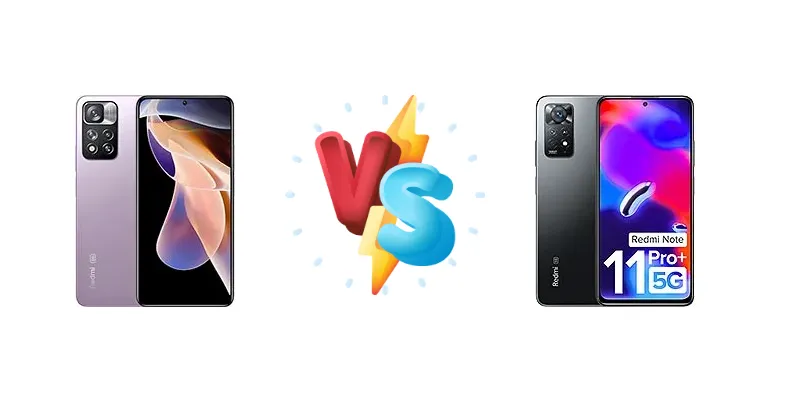
Xiaomi’s Redmi Note 11 Pro series presents a curious case of regional divergence. While visually similar, the China and India variants – the Redmi Note 11 Pro and Redmi Note 11 Pro+ 5G respectively – diverge significantly under the hood, primarily in their chipset choices. This comparison dissects these differences to determine which model offers the best value and performance for your needs.
🏆 Quick Verdict
For the average user prioritizing raw performance and future-proofing, the Redmi Note 11 Pro (China) with its Dimensity 920 chipset is the superior choice. While the Redmi Note 11 Pro+ 5G (India) offers comparable charging speeds, the Snapdragon 695 falls behind in CPU and GPU capabilities, impacting demanding tasks and gaming.
| Network |
|---|
| 2G bands | GSM 850 / 900 / 1800 / 1900 | GSM 850 / 900 / 1800 / 1900 |
| 3G bands | HSDPA 800 / 850 / 900 / 1900 / 2100 | HSDPA 850 / 900 / 1900 / 2100 |
| 4G bands | 1, 2, 3, 5, 8, 19, 34, 38, 39, 40, 41, 42 | 1, 3, 5, 8, 40, 41 |
| 5G bands | 1, 3, 5, 8, 28, 38, 41, 77, 78 SA/NSA | 1, 3, 5, 8, 28, 40, 78 SA/NSA |
| Speed | HSPA, LTE, 5G | HSPA, LTE, 5G |
| Technology | GSM / CDMA / HSPA / EVDO / LTE / 5G | GSM / HSPA / LTE / 5G |
| | CDMA2000 1xEV-DO | - |
| Launch |
|---|
| Announced | 2021, October 28 | 2022, March 09 |
| Status | Available. Released 2021, November 01 | Available. Released 2022, March 15 |
| Body |
|---|
| Build | Glass front (Gorilla Glass 5), glass back, plastic frame | Glass front (Gorilla Glass 5), glass back |
| Dimensions | 163.7 x 76.2 x 8.3 mm (6.44 x 3.00 x 0.33 in) | 164.2 x 76.1 x 8.1 mm (6.46 x 3.00 x 0.32 in) |
| SIM | Nano-SIM + Nano-SIM | Nano-SIM + Nano-SIM |
| Weight | 207 g (7.30 oz) | 202 g (7.13 oz) |
| Display |
|---|
| Protection | Corning Gorilla Glass 5 | Corning Gorilla Glass 5 |
| Resolution | 1080 x 2400 pixels, 20:9 ratio (~395 ppi density) | 1080 x 2400 pixels, 20:9 ratio (~395 ppi density) |
| Size | 6.67 inches, 107.4 cm2 (~86.1% screen-to-body ratio) | 6.67 inches, 107.4 cm2 (~86.0% screen-to-body ratio) |
| Type | Super AMOLED, 120Hz, 700 nits, 1200 nits (peak) | Super AMOLED, 120Hz, 700 nits, 1200 nits (peak) |
| Platform |
|---|
| CPU | Octa-core (2x2.5 GHz Cortex-A78 & 6x2.0 GHz Cortex-A55) | Octa-core (2x2.2 GHz Kryo 660 Gold & 6x1.7 GHz Kryo 660 Silver) |
| Chipset | Mediatek Dimensity 920 (6 nm) | Qualcomm SM6375 Snapdragon 695 5G (6 nm) |
| GPU | Mali-G68 MC4 | Adreno 619 |
| OS | Android 11, MIUI 12.5 | Android 11, MIUI 13 |
| Memory |
|---|
| Card slot | No | microSDXC (uses shared SIM slot) |
| Internal | 128GB 6GB RAM, 128GB 8GB RAM, 256GB 8GB RAM | 64GB 6GB RAM, 128GB 6GB RAM, 128GB 8GB RAM, 256GB 8GB RAM |
| | UFS 2.2 | - |
| Main Camera |
|---|
| Features | LED flash, HDR, panorama | LED flash, HDR, panorama |
| Single | 16 MP, f/2.5, (wide), 1/3.06" 1.0µm | - |
| Triple | 108 MP, f/1.9, 26mm (wide), 1/1.52", 0.7µm, PDAF
8 MP, 120˚ (ultrawide)
2 MP, f/2.4, 50mm (telephoto macro) | 108 MP, f/1.9, 26mm (wide), 1/1.52", 0.7µm, PDAF
8 MP, f/2.2, 118˚ (ultrawide)
2 MP (macro) |
| Video | 4K@30fps, 1080p@30/60/120fps, 720p@960fps | 1080p@30fps |
| Selfie camera |
|---|
| Single | 16 MP, f/2.5, (wide), 1/3.06" 1.0µm | 16 MP, f/2.5, (wide), 1/3.06" 1.0µm |
| Video | 1080p@30/60fps | 1080p@30fps |
| Sound |
|---|
| 3.5mm jack | Yes | - |
| 35mm jack | Yes | Yes |
| Loudspeaker | Yes, with stereo speakers | Yes, with stereo speakers |
| | 24-bit/192kHz audio
Tuned by JBL | - |
| Comms |
|---|
| Bluetooth | 5.2, A2DP, LE | 5.1, A2DP, LE |
| Infrared port | Yes | Yes |
| NFC | Yes | No |
| Positioning | GPS (L1+L5), GLONASS (L1), BDS (B1I+B1c+B2a), GALILEO (E1+E5a), QZSS (L1+L5), NavIC (L5) | GPS, GLONASS, BDS, GALILEO |
| Radio | Unspecified | Unspecified |
| USB | USB Type-C 2.0, OTG | USB Type-C 2.0, OTG |
| WLAN | Wi-Fi 802.11 a/b/g/n/ac/6, dual-band, Wi-Fi Direct | Wi-Fi 802.11 a/b/g/n/ac, dual-band, Wi-Fi Direct |
| Features |
|---|
| Sensors | Fingerprint (side-mounted), accelerometer, gyro, compass | Fingerprint (side-mounted), accelerometer, gyro, proximity, compass |
| | Virtual proximity sensing | - |
| Battery |
|---|
| Charging | 67W wired, PD3.0, QC3, 100% in 43 min | 67W wired, PD3.0, QC3, 50% in 15 min, 100% in 42 min |
| Type | Li-Po 5160 mAh | Li-Po 5000 mAh |
| Misc |
|---|
| Colors | Mysterious Black, Forest Green, Timeless Purple, Milky Way Blue | Mirage Blue, Phantom White, Stealth Black |
| Models | 21091116C | 2201116SI |
| Price | About 220 EUR | About 250 EUR |
Xiaomi Redmi Note 11 Pro (China)
- More powerful Dimensity 920 chipset for superior performance.
- Potentially better image processing due to the Dimensity 920’s ISP.
- Stronger CPU performance for demanding applications.
- May lack 5G connectivity depending on regional bands.
- Potentially less readily available outside of China.
Xiaomi Redmi Note 11 Pro+ 5G (India)
- Integrated 5G connectivity for faster data speeds.
- Slightly faster initial charging speed (0-50%).
- Wider availability in India and potentially other regions.
- Less powerful Snapdragon 695 chipset.
- Lower CPU and GPU performance compared to the Dimensity 920.
- Potentially less refined image processing.
Display Comparison
Both devices are expected to feature similar 6.67-inch AMOLED displays, but detailed specifications like peak brightness and color gamut coverage are not provided. However, given the Redmi Note series’ positioning, we can anticipate a 120Hz refresh rate on both. The absence of LTPO technology suggests neither phone will dynamically adjust refresh rates for optimal power saving. Bezels are likely comparable, and color accuracy will depend on Xiaomi’s software calibration.
Camera Comparison
Without detailed camera specifications beyond the presence of 67W charging, a direct comparison is limited. However, the chipset’s image signal processor (ISP) plays a crucial role in image processing. The Dimensity 920’s ISP is generally more capable than the Snapdragon 695’s, potentially leading to better dynamic range and noise reduction in photos and videos. The absence of information regarding sensor size and OIS makes a definitive camera assessment impossible, but the chipset advantage leans towards the China variant.
Performance
The core difference lies in the chipsets. The Redmi Note 11 Pro (China) boasts the Mediatek Dimensity 920 (6nm), featuring a more powerful CPU configuration – 2x2.5 GHz Cortex-A78 and 6x2.0 GHz Cortex-A55 cores – compared to the Qualcomm Snapdragon 695 5G (6nm) in the India variant, which has 2x2.2 GHz Kryo 660 Gold and 6x1.7 GHz Kryo 660 Silver cores. This translates to a noticeable performance advantage for the Dimensity 920 in CPU-intensive tasks and gaming. While both are 6nm chips, the Dimensity 920’s architecture provides a performance edge. The Snapdragon 695 prioritizes 5G connectivity, but sacrifices some processing power.
Battery Life
Both phones feature 67W wired charging, supporting PD3.0 and QC3. The Redmi Note 11 Pro (China) reaches 100% charge in 43 minutes, while the Redmi Note 11 Pro+ 5G (India) achieves 100% in 42 minutes – a negligible difference. The India variant claims 50% charge in 15 minutes, suggesting a potentially more aggressive charging curve initially. Battery capacity is not specified, but the similar charging speeds suggest comparable battery sizes. The Dimensity 920’s potentially better power efficiency could offset any minor battery capacity differences.
Buying Guide
Buy the Xiaomi Redmi Note 11 Pro (China) if you need a phone capable of handling demanding applications, enjoy mobile gaming, and value a more powerful processor for long-term usability. Buy the Xiaomi Redmi Note 11 Pro+ 5G (India) if you prioritize 5G connectivity and are primarily focused on everyday tasks like social media, browsing, and light multimedia consumption, and are less concerned with peak performance.
Frequently Asked Questions
❓ Will the Snapdragon 695 in the Redmi Note 11 Pro+ 5G struggle with graphically intensive games like Genshin Impact?
Yes, the Snapdragon 695 is a mid-range chipset and will likely require significant graphics settings reductions to achieve playable frame rates in demanding titles like Genshin Impact. The Dimensity 920 in the Redmi Note 11 Pro (China) offers a considerably smoother gaming experience.
❓ Does the difference in charging speed (42 minutes vs 43 minutes) between the two phones actually matter in real-world use?
No, the one-minute difference in full charge time is negligible and unlikely to be noticeable in everyday use. Both phones offer exceptionally fast 67W charging, providing a full charge in under an hour.
❓ Is the 5G connectivity on the Redmi Note 11 Pro+ 5G useful if my carrier doesn't have widespread 5G coverage?
Not particularly. While the 5G modem is present, its benefits are limited without robust 5G infrastructure. You won't see a significant speed improvement over 4G LTE in areas with limited 5G coverage.