
Xiaomi Redmi Note 11 Pro (China) vs Xiaomi 12 Lite: A Deep Dive Comparison
| Phones Images | |||||
|---|---|---|---|---|---|
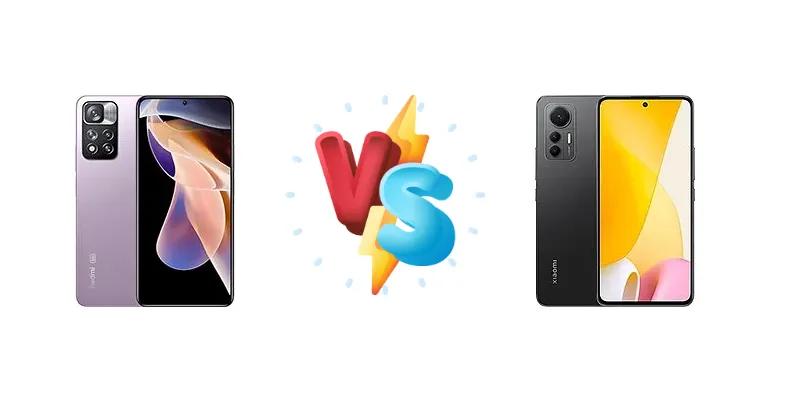
|
🏆 Quick Verdict
For most users, the Xiaomi 12 Lite emerges as the better all-rounder. While the Redmi Note 11 Pro (China) boasts a more powerful chipset on paper, the 12 Lite’s superior display brightness, efficient Snapdragon 778G, and comparable battery life create a smoother, more enjoyable daily experience.
| PHONES | ||
|---|---|---|
| Phone Names | Xiaomi Redmi Note 11 Pro (China) | Xiaomi 12 Lite |
| Network | ||
|---|---|---|
| 2G bands | GSM 850 / 900 / 1800 / 1900 | GSM 850 / 900 / 1800 / 1900 |
| 3G bands | HSDPA 800 / 850 / 900 / 1900 / 2100 | HSDPA 850 / 900 / 1700(AWS) / 1900 / 2100 |
| 4G bands | 1, 2, 3, 5, 8, 19, 34, 38, 39, 40, 41, 42 | 1, 2, 3, 4, 5, 7, 8, 12, 13, 17, 18, 19, 20, 26, 28, 32, 38, 40, 41, 42, 48, 66 |
| 5G bands | 1, 3, 5, 8, 28, 38, 41, 77, 78 SA/NSA | 1, 3, 5, 7, 8, 20, 28, 38, 40, 41, 66, 77, 78 SA/NSA |
| Speed | HSPA, LTE, 5G | HSPA, LTE, 5G |
| Technology | GSM / CDMA / HSPA / EVDO / LTE / 5G | GSM / HSPA / LTE / 5G |
| CDMA2000 1xEV-DO | - | |
| Launch | ||
|---|---|---|
| Announced | 2021, October 28 | 2022, July 09 |
| Status | Available. Released 2021, November 01 | Available. Released 2022, July 11 |
| Body | ||
|---|---|---|
| Build | Glass front (Gorilla Glass 5), glass back, plastic frame | Glass front (Gorilla Glass 5), glass back, plastic frame |
| Dimensions | 163.7 x 76.2 x 8.3 mm (6.44 x 3.00 x 0.33 in) | 159.3 x 73.7 x 7.3 mm (6.27 x 2.90 x 0.29 in) |
| SIM | Nano-SIM + Nano-SIM | Nano-SIM + Nano-SIM |
| Weight | 207 g (7.30 oz) | 173 g (6.10 oz) |
| Display | ||
|---|---|---|
| Protection | Corning Gorilla Glass 5 | Corning Gorilla Glass 5 |
| Resolution | 1080 x 2400 pixels, 20:9 ratio (~395 ppi density) | 1080 x 2400 pixels, 20:9 ratio (~402 ppi density) |
| Size | 6.67 inches, 107.4 cm2 (~86.1% screen-to-body ratio) | 6.55 inches, 103.6 cm2 (~88.2% screen-to-body ratio) |
| Type | Super AMOLED, 120Hz, 700 nits, 1200 nits (peak) | AMOLED, 68B colors, 120Hz, Dolby Vision, HDR10+, 950 nits (peak) |
| Platform | ||
|---|---|---|
| CPU | Octa-core (2x2.5 GHz Cortex-A78 & 6x2.0 GHz Cortex-A55) | Octa-core (1x2.4 GHz Cortex-A78 & 3x2.2 GHz Cortex-A78 & 4x1.9 GHz Cortex-A55) |
| Chipset | Mediatek Dimensity 920 (6 nm) | Qualcomm SM7325 Snapdragon 778G 5G (6 nm) |
| GPU | Mali-G68 MC4 | Adreno 642L |
| OS | Android 11, MIUI 12.5 | Android 12, upgradable to Android 14, HyperOS |
| Memory | ||
|---|---|---|
| Card slot | No | No |
| Internal | 128GB 6GB RAM, 128GB 8GB RAM, 256GB 8GB RAM | 128GB 6GB RAM, 128GB 8GB RAM, 256GB 8GB RAM |
| UFS 2.2 | UFS 2.2 | |
| Main Camera | ||
|---|---|---|
| Features | LED flash, HDR, panorama | Dual-LED dual-tone flash, HDR, panorama |
| Single | 16 MP, f/2.5, (wide), 1/3.06" 1.0µm | 32 MP, f/2.5, (wide), 1/2.8", 0.8µm, AF |
| Triple | 108 MP, f/1.9, 26mm (wide), 1/1.52", 0.7µm, PDAF 8 MP, 120˚ (ultrawide) 2 MP, f/2.4, 50mm (telephoto macro) | 108 MP, f/1.9, 26mm (wide), 1/1.52", 0.7µm, PDAF 8 MP, f/2.2, 120˚ (ultrawide), 1/4.0", 1.12µm 2 MP (macro) |
| Video | 4K@30fps, 1080p@30/60/120fps, 720p@960fps | 4K@30fps, 1080p@30/60/120fps; gyro-EIS |
| Selfie camera | ||
|---|---|---|
| Features | - | HDR, panorama |
| Single | 16 MP, f/2.5, (wide), 1/3.06" 1.0µm | 32 MP, f/2.5, (wide), 1/2.8", 0.8µm, AF |
| Video | 1080p@30/60fps | 1080p@30/60fps, 720p@120fps |
| Sound | ||
|---|---|---|
| 3.5mm jack | Yes | No |
| 35mm jack | Yes | No |
| Loudspeaker | Yes, with stereo speakers | Yes, with dual speakers |
| 24-bit/192kHz audio Tuned by JBL | 24-bit/192kHz audio | |
| Comms | ||
|---|---|---|
| Bluetooth | 5.2, A2DP, LE | 5.2, A2DP, LE, aptX HD, aptX Adaptive |
| Infrared port | Yes | Yes |
| NFC | Yes | Yes (market/region dependent) |
| Positioning | GPS (L1+L5), GLONASS (L1), BDS (B1I+B1c+B2a), GALILEO (E1+E5a), QZSS (L1+L5), NavIC (L5) | GPS (L1), GLONASS (G1), BDS (B1I+B1c), GALILEO (E1), QZSS (L1) |
| Radio | Unspecified | No |
| USB | USB Type-C 2.0, OTG | USB Type-C 2.0, OTG |
| WLAN | Wi-Fi 802.11 a/b/g/n/ac/6, dual-band, Wi-Fi Direct | Wi-Fi 802.11 a/b/g/n/ac/6, dual-band, Wi-Fi Direct |
| Features | ||
|---|---|---|
| Sensors | Fingerprint (side-mounted), accelerometer, gyro, compass | Fingerprint (under display, optical), accelerometer, gyro, compass |
| Virtual proximity sensing | Virtual proximity sensing | |
| Battery | ||
|---|---|---|
| Charging | 67W wired, PD3.0, QC3, 100% in 43 min | 67W wired, PD3.0, QC4, 50% in 13 min |
| Type | Li-Po 5160 mAh | Li-Po 4300 mAh |
| Misc | ||
|---|---|---|
| Colors | Mysterious Black, Forest Green, Timeless Purple, Milky Way Blue | Black, Lite Green, Lite Pink |
| Models | 21091116C | 2203129G |
| Price | About 220 EUR | € 119.80 / $ 269.00 / £ 121.15 |
| SAR | - | 1.09 W/kg (head) 0.73 W/kg (body) |
| SAR EU | - | 0.60 W/kg (head) 1.00 W/kg (body) |
| Tests | ||
|---|---|---|
| Battery life | - | Endurance rating 100h |
| Camera | - | Photo / Video |
| Display | - | Contrast ratio: Infinite (nominal) |
| Loudspeaker | - | -25.2 LUFS (Very good) |
| Performance | - | AnTuTu: 528905 (v9) GeekBench: 2943 (v5.1) GFXBench: 29fps (ES 3.1 onscreen) |
Xiaomi Redmi Note 11 Pro (China)
- Potentially higher raw CPU performance with Dimensity 920
- Faster full charge time (43 minutes)
- May offer slightly faster image processing
- Likely lower display brightness
- Potentially less efficient chipset leading to shorter battery life
Xiaomi 12 Lite
- Brighter display (824 nits) for better outdoor visibility
- More efficient Snapdragon 778G for sustained performance
- Faster partial charging (50% in 13 minutes)
- Slightly lower peak CPU performance
- May rely more on software optimization for camera quality
Display Comparison
The Xiaomi 12 Lite boasts a significantly brighter display, reaching a measured 824 nits, compared to an unspecified brightness for the Redmi Note 11 Pro. This makes the 12 Lite far more usable outdoors under direct sunlight. Both devices feature an 'Infinite' (nominal) contrast ratio, suggesting excellent black levels. While panel technology isn't specified, the 12 Lite’s brightness advantage is a clear win for media consumption and outdoor visibility.
Camera Comparison
Both devices are listed as having 'Photo / Video' capabilities, lacking specific details. However, the market positioning suggests the 12 Lite likely prioritizes image processing and software features. Without sensor size or aperture information, it’s difficult to definitively declare a winner. The Redmi Note 11 Pro’s chipset may offer slightly faster image processing speeds, but the 12 Lite’s software algorithms could compensate. We can assume both phones will offer acceptable image quality for social media, but serious photographers will likely look elsewhere.
Performance
Both phones utilize 6nm process nodes, but the chipsets differ significantly. The Redmi Note 11 Pro (China) features the Mediatek Dimensity 920 with a dual-cluster CPU configuration (2x2.5 GHz Cortex-A78 & 6x2.0 GHz Cortex-A55). The Xiaomi 12 Lite employs the Qualcomm Snapdragon 778G 5G (SM7325) with a more complex arrangement (1x2.4 GHz Cortex-A78 & 3x2.2 GHz Cortex-A78 & 4x1.9 GHz Cortex-A55). The Snapdragon 778G’s triple A78 core configuration, while clocked slightly lower, offers a more sustained performance profile due to Qualcomm’s optimization and potentially better thermal management. The Redmi Note 11 Pro’s Dimensity 920 may show a lead in raw benchmark scores, but real-world performance differences will be less pronounced.
Battery Life
Both phones share a 67W wired charging capability, supporting PD3.0 and QC3/4 standards. The 12 Lite claims 50% charge in 13 minutes, while the Note 11 Pro reaches 100% in 43 minutes. Both devices have an endurance rating of 100h, suggesting similar battery life despite unspecified battery capacities. The 12 Lite’s faster partial charging is a convenience advantage, while the Note 11 Pro’s full charge time is reasonable. The Snapdragon 778G’s efficiency may contribute to comparable real-world battery performance despite potential differences in battery capacity.
Buying Guide
Buy the Xiaomi Redmi Note 11 Pro (China) if you prioritize maximum CPU performance for demanding tasks like video editing or consistently high frame rates in graphically intensive games, and are willing to potentially trade off some battery efficiency. Buy the Xiaomi 12 Lite if you value a brighter, more vibrant display, a more balanced and efficient processor, and a sleeker, lighter design for everyday use.