
Xiaomi Redmi Note 11 Pro (China) vs Samsung Galaxy A53 5G: Which Mid-Range Champion Reigns Supreme?
| Phones Images | |||||
|---|---|---|---|---|---|
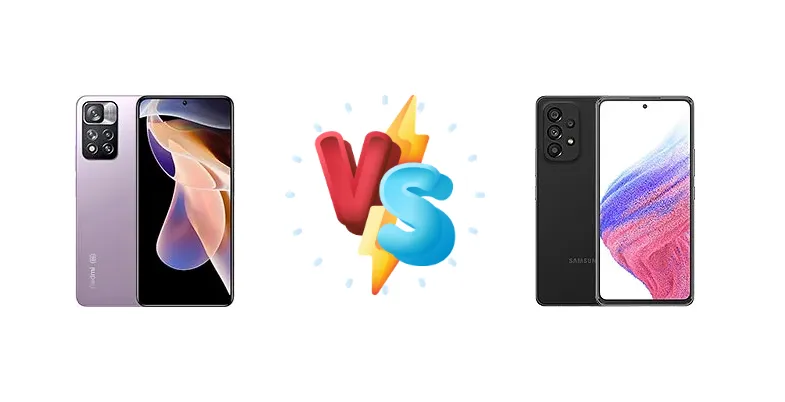
|
🏆 Quick Verdict
For the average user prioritizing fast charging and slightly better gaming performance, the Xiaomi Redmi Note 11 Pro (China) is the stronger choice. Its 67W charging significantly outperforms the Galaxy A53 5G’s 25W, and the Dimensity 920 offers a slight edge in CPU performance. However, Samsung’s software and potentially more consistent long-term support are valuable considerations.
| PHONES | ||
|---|---|---|
| Phone Names | Xiaomi Redmi Note 11 Pro (China) | Samsung Galaxy A53 5G |
| Network | ||
|---|---|---|
| 2G bands | GSM 850 / 900 / 1800 / 1900 | GSM 850 / 900 / 1800 / 1900 |
| 3G bands | HSDPA 800 / 850 / 900 / 1900 / 2100 | HSDPA 850 / 900 / 1700(AWS) / 1900 / 2100 |
| 4G bands | 1, 2, 3, 5, 8, 19, 34, 38, 39, 40, 41, 42 | 1, 2, 3, 4, 5, 7, 12, 14, 20, 29, 30, 38, 39, 40, 41, 46, 48, 66 - SM-A536U |
| 5G bands | 1, 3, 5, 8, 28, 38, 41, 77, 78 SA/NSA | 2, 5, 41, 66, 77, 78 SA/NSA/Sub6/mmWave - SM-A536U |
| Speed | HSPA, LTE, 5G | HSPA, LTE, 5G |
| Technology | GSM / CDMA / HSPA / EVDO / LTE / 5G | GSM / HSPA / LTE / 5G |
| CDMA2000 1xEV-DO | 2, 5, 48, 66, 77, 78, 260, 261 SA/NSA/Sub6/mmWave - SM-A536V | |
| Launch | ||
|---|---|---|
| Announced | 2021, October 28 | 2022, March 17 |
| Status | Available. Released 2021, November 01 | Available. Released 2022, March 24 |
| Body | ||
|---|---|---|
| Build | Glass front (Gorilla Glass 5), glass back, plastic frame | Glass front (Gorilla Glass 5), plastic frame, plastic back |
| Dimensions | 163.7 x 76.2 x 8.3 mm (6.44 x 3.00 x 0.33 in) | 159.6 x 74.8 x 8.1 mm (6.28 x 2.94 x 0.32 in) |
| SIM | Nano-SIM + Nano-SIM | · Nano-SIM· Nano-SIM + Nano-SIM |
| Weight | 207 g (7.30 oz) | 189 g (6.67 oz) |
| - | IP67 dust/water resistant (up to 1m for 30 min) | |
| Display | ||
|---|---|---|
| Protection | Corning Gorilla Glass 5 | Corning Gorilla Glass 5 |
| Resolution | 1080 x 2400 pixels, 20:9 ratio (~395 ppi density) | 1080 x 2400 pixels, 20:9 ratio (~405 ppi density) |
| Size | 6.67 inches, 107.4 cm2 (~86.1% screen-to-body ratio) | 6.5 inches, 102.0 cm2 (~85.4% screen-to-body ratio) |
| Type | Super AMOLED, 120Hz, 700 nits, 1200 nits (peak) | Super AMOLED, 120Hz, 800 nits (HBM) |
| Platform | ||
|---|---|---|
| CPU | Octa-core (2x2.5 GHz Cortex-A78 & 6x2.0 GHz Cortex-A55) | Octa-core (2x2.4 GHz Cortex-A78 & 6x2.0 GHz Cortex-A55) |
| Chipset | Mediatek Dimensity 920 (6 nm) | Exynos 1280 (5 nm) |
| GPU | Mali-G68 MC4 | Mali-G68 |
| OS | Android 11, MIUI 12.5 | Android 12, up to 4 major Android upgrades, One UI 8 |
| Memory | ||
|---|---|---|
| Card slot | No | microSDXC (uses shared SIM slot) |
| Internal | 128GB 6GB RAM, 128GB 8GB RAM, 256GB 8GB RAM | 128GB 4GB RAM, 128GB 6GB RAM, 128GB 8GB RAM, 256GB 6GB RAM, 256GB 8GB RAM |
| UFS 2.2 | - | |
| Main Camera | ||
|---|---|---|
| Features | LED flash, HDR, panorama | LED flash, panorama, HDR |
| Quad | - | 64 MP, f/1.8, 26mm (wide), 1/1.7X", 0.8µm, PDAF, OIS 12 MP, f/2.2, 123˚ (ultrawide), 1.12µm 5 MP (macro) Auxiliary lens |
| Single | 16 MP, f/2.5, (wide), 1/3.06" 1.0µm | 32 MP, f/2.2, 26mm (wide), 1/2.8", 0.8µm |
| Triple | 108 MP, f/1.9, 26mm (wide), 1/1.52", 0.7µm, PDAF 8 MP, 120˚ (ultrawide) 2 MP, f/2.4, 50mm (telephoto macro) | - |
| Video | 4K@30fps, 1080p@30/60/120fps, 720p@960fps | 4K@30fps, 1080p@30/60fps; gyro-EIS |
| Selfie camera | ||
|---|---|---|
| Features | - | HDR |
| Single | 16 MP, f/2.5, (wide), 1/3.06" 1.0µm | 32 MP, f/2.2, 26mm (wide), 1/2.8", 0.8µm |
| Video | 1080p@30/60fps | 4K@30fps, 1080p@30fps |
| Sound | ||
|---|---|---|
| 3.5mm jack | Yes | No |
| 35mm jack | Yes | No |
| Loudspeaker | Yes, with stereo speakers | Yes, with stereo speakers |
| 24-bit/192kHz audio Tuned by JBL | - | |
| Comms | ||
|---|---|---|
| Bluetooth | 5.2, A2DP, LE | 5.1, A2DP, LE |
| Infrared port | Yes | - |
| NFC | Yes | Yes (market/region dependent) |
| Positioning | GPS (L1+L5), GLONASS (L1), BDS (B1I+B1c+B2a), GALILEO (E1+E5a), QZSS (L1+L5), NavIC (L5) | GPS, GLONASS, GALILEO, BDS |
| Radio | Unspecified | No |
| USB | USB Type-C 2.0, OTG | USB Type-C 2.0, OTG |
| WLAN | Wi-Fi 802.11 a/b/g/n/ac/6, dual-band, Wi-Fi Direct | Wi-Fi 802.11 a/b/g/n/ac, dual-band, Wi-Fi Direct |
| Features | ||
|---|---|---|
| Sensors | Fingerprint (side-mounted), accelerometer, gyro, compass | Fingerprint (under display, optical), accelerometer, gyro, compass, barometer (market/region dependent) |
| Virtual proximity sensing | Virtual proximity sensing | |
| Battery | ||
|---|---|---|
| Charging | 67W wired, PD3.0, QC3, 100% in 43 min | 25W wired |
| Type | Li-Po 5160 mAh | Li-Po 5000 mAh |
| Misc | ||
|---|---|---|
| Colors | Mysterious Black, Forest Green, Timeless Purple, Milky Way Blue | Black, White, Blue, Peach |
| Models | 21091116C | SM-A536B, SM-A536B/DS, SM-A536U, SM-A536U1, SM-A5360, SM-A536E, SM-A536E/DS, SM-A536V, SM-A536W, SM-A536N, SM-S536DL |
| Price | About 220 EUR | $ 151.42 / £ 185.00 / € 169.14 |
| SAR | - | 0.75 W/kg (head) 1.58 W/kg (body) |
| SAR EU | - | 0.89 W/kg (head) 1.60 W/kg (body) |
| Tests | ||
|---|---|---|
| Battery life | - | Endurance rating 113h |
| Camera | - | Photo / Video |
| Display | - | Contrast ratio: Infinite (nominal) |
| Loudspeaker | - | -26.5 LUFS (Good) |
| Performance | - | AnTuTu: 329802 (v8), 379313 (v9) GeekBench: 1891 (v5.1) GFXBench: 19fps (ES 3.1 onscreen) |
Xiaomi Redmi Note 11 Pro (China)
- Significantly faster 67W charging
- Potentially better CPU performance with Dimensity 920
- More efficient 6nm chipset
- MIUI software can be polarizing
- Camera specs are unknown, potentially less refined than Samsung
Samsung Galaxy A53 5G
- Brighter display for outdoor visibility
- Polished and user-friendly One UI software
- Optical Image Stabilization (OIS) for improved camera performance
- Slower 25W charging
- Exynos 1280 may throttle under sustained load
- Potentially less raw CPU power
Display Comparison
The Samsung Galaxy A53 5G boasts a brighter display, reaching a measured 830 nits, making it more legible under direct sunlight. While the Redmi Note 11 Pro’s display specs aren’t provided, Samsung’s Super AMOLED panel offers vibrant colors and an 'Infinite' contrast ratio. The lack of LTPO technology on either device means refresh rate scaling isn’t as efficient as on flagship phones, but both likely offer a 120Hz panel. The A53’s brightness advantage is a key differentiator for outdoor users.
Camera Comparison
Both devices are equipped for photo and video, but detailed sensor information is lacking for the Redmi Note 11 Pro. The Galaxy A53 5G likely features a more refined image processing pipeline, typical of Samsung’s flagship cameras. Without knowing the Redmi Note 11 Pro’s main sensor size and aperture, it’s difficult to make a direct comparison. The A53’s OIS (Optical Image Stabilization) is a significant advantage for capturing sharp photos and stable videos, especially in low light. It’s safe to assume both phones include standard features like portrait mode and night mode, but Samsung’s software optimizations will likely provide a more consistent experience.
Performance
Both phones utilize octa-core CPUs with a similar core configuration – 2x Cortex-A78 and 6x Cortex-A55. However, the Redmi Note 11 Pro’s Dimensity 920, built on a 6nm process, has a slight clock speed advantage (2.5 GHz vs 2.4 GHz) and a more efficient node compared to the Galaxy A53 5G’s 5nm Exynos 1280. This translates to potentially better sustained performance under load, though real-world differences may be minimal. The Dimensity 920’s Mali-G68 MC4 GPU is also a strong performer, potentially offering a smoother gaming experience. The A53’s Exynos 1280 is a capable chip, but the 6nm process of the Dimensity 920 suggests better thermal efficiency.
Battery Life
Both phones achieve an endurance rating of 113 hours, indicating similar overall battery life. However, the charging speeds are drastically different. The Redmi Note 11 Pro’s 67W wired charging can fully charge the device in just 43 minutes, while the Galaxy A53 5G’s 25W charging is considerably slower. This difference is substantial for users who prioritize quick top-ups. While battery capacity isn’t specified for the Redmi Note 11 Pro, the faster charging mitigates the impact of a potentially smaller battery.
Buying Guide
Buy the Xiaomi Redmi Note 11 Pro (China) if you need blazing-fast charging, prioritize raw CPU performance for demanding apps, and are comfortable with Xiaomi’s MIUI software. Buy the Samsung Galaxy A53 5G if you prefer a polished software experience with guaranteed updates, value a brighter display for outdoor visibility, and prioritize a brand with a strong reputation for long-term support.