
Xiaomi Redmi Note 11 Pro vs iPhone 13 Pro Max: Clash of the Titans
| Phones Images | |||||
|---|---|---|---|---|---|
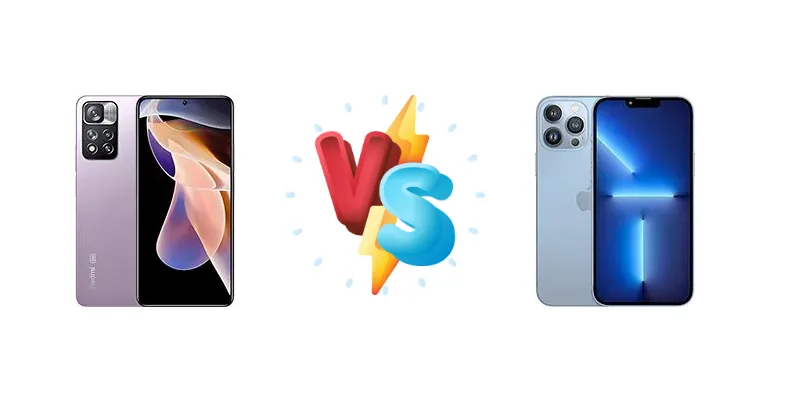
|
🏆 Quick Verdict
The iPhone 13 Pro Max dominates in performance, camera quality, and overall ecosystem integration. However, the Redmi Note 11 Pro offers incredible value with its fast charging and large display, making it a compelling choice for budget-conscious users seeking a feature-rich Android experience.
| PHONES | ||
|---|---|---|
| Phone Names | Xiaomi Redmi Note 11 Pro (China) | Apple iPhone 13 Pro Max |
| Network | ||
|---|---|---|
| 2G bands | GSM 850 / 900 / 1800 / 1900 | GSM 850 / 900 / 1800 / 1900 |
| 3G bands | HSDPA 800 / 850 / 900 / 1900 / 2100 | HSDPA 850 / 900 / 1700(AWS) / 1900 / 2100 |
| 4G bands | 1, 2, 3, 5, 8, 19, 34, 38, 39, 40, 41, 42 | 1, 2, 3, 4, 5, 7, 8, 12, 13, 17, 18, 19, 20, 25, 26, 28, 30, 32, 34, 38, 39, 40, 41, 42, 46, 48, 66 - A2643, A2644, A2645 |
| 5G bands | 1, 3, 5, 8, 28, 38, 41, 77, 78 SA/NSA | 1, 2, 3, 5, 7, 8, 12, 20, 25, 28, 30, 38, 40, 41, 48, 66, 77, 78, 79 SA/NSA/Sub6 - A2643, A2644 |
| Speed | HSPA, LTE, 5G | HSPA, LTE, 5G, EV-DO Rev.A 3.1 Mbps |
| Technology | GSM / CDMA / HSPA / EVDO / LTE / 5G | GSM / CDMA / HSPA / EVDO / LTE / 5G |
| CDMA2000 1xEV-DO | 1, 2, 3, 5, 7, 8, 12, 20, 25, 28, 29, 30, 38, 40, 41, 48, 66, 71, 77, 78, 79 SA/NSA/Sub6 - A2641 | |
| Launch | ||
|---|---|---|
| Announced | 2021, October 28 | 2021, September 14 |
| Status | Available. Released 2021, November 01 | Available. Released 2021, September 24 |
| Body | ||
|---|---|---|
| Build | Glass front (Gorilla Glass 5), glass back, plastic frame | Glass front, glass back, stainless steel frame |
| Dimensions | 163.7 x 76.2 x 8.3 mm (6.44 x 3.00 x 0.33 in) | 160.8 x 78.1 x 7.7 mm (6.33 x 3.07 x 0.30 in) |
| SIM | Nano-SIM + Nano-SIM | · Nano-SIM + eSIM· Nano-SIM + Nano-SIM |
| Weight | 207 g (7.30 oz) | 240 g (8.47 oz) |
| - | IP68 dust/water resistant (up to 6m for 30 min) Apple Pay (Visa, MasterCard, AMEX certified) | |
| Display | ||
|---|---|---|
| Protection | Corning Gorilla Glass 5 | Ceramic Shield glass |
| Resolution | 1080 x 2400 pixels, 20:9 ratio (~395 ppi density) | 1284 x 2778 pixels, 19.5:9 ratio (~458 ppi density) |
| Size | 6.67 inches, 107.4 cm2 (~86.1% screen-to-body ratio) | 6.7 inches, 109.8 cm2 (~87.4% screen-to-body ratio) |
| Type | Super AMOLED, 120Hz, 700 nits, 1200 nits (peak) | Super Retina XDR OLED, 120Hz, HDR10, Dolby Vision, 1000 nits (HBM), 1200 nits (peak) |
| Platform | ||
|---|---|---|
| CPU | Octa-core (2x2.5 GHz Cortex-A78 & 6x2.0 GHz Cortex-A55) | Hexa-core (2x3.23 GHz Avalanche + 4x1.82 GHz Blizzard) |
| Chipset | Mediatek Dimensity 920 (6 nm) | Apple A15 Bionic (5 nm) |
| GPU | Mali-G68 MC4 | Apple GPU (5-core graphics) |
| OS | Android 11, MIUI 12.5 | iOS 15, upgradable to iOS 26.1 |
| Memory | ||
|---|---|---|
| Card slot | No | No |
| Internal | 128GB 6GB RAM, 128GB 8GB RAM, 256GB 8GB RAM | 128GB 6GB RAM, 256GB 6GB RAM, 512GB 6GB RAM, 1TB 6GB RAM |
| UFS 2.2 | NVMe | |
| Main Camera | ||
|---|---|---|
| Features | LED flash, HDR, panorama | Dual-LED dual-tone flash, HDR (photo/panorama) |
| Single | 16 MP, f/2.5, (wide), 1/3.06" 1.0µm | 12 MP, f/2.2, 23mm (wide), 1/3.6" SL 3D, (depth/biometrics sensor) |
| Triple | 108 MP, f/1.9, 26mm (wide), 1/1.52", 0.7µm, PDAF 8 MP, 120˚ (ultrawide) 2 MP, f/2.4, 50mm (telephoto macro) | 12 MP, f/1.5, 26mm (wide), 1/1.7", 1.9µm, dual pixel PDAF, sensor-shift OIS 12 MP, f/2.8, 77mm (telephoto), PDAF, 1/3.4", 1.0µm, OIS, 3x optical zoom 12 MP, f/1.8, 13mm, 120˚ (ultrawide), 1/3.4", 1.0µm, PDAF TOF 3D LiDAR scanner (depth) |
| Video | 4K@30fps, 1080p@30/60/120fps, 720p@960fps | 4K@24/25/30/60fps, 1080p@25/30/60/120/240fps, 10-bit HDR, Dolby Vision HDR (up to 60fps), ProRes, stereo sound rec. |
| Selfie camera | ||
|---|---|---|
| Features | - | HDR |
| Single | 16 MP, f/2.5, (wide), 1/3.06" 1.0µm | 12 MP, f/2.2, 23mm (wide), 1/3.6", 1.0µm SL 3D, (depth/biometrics sensor) |
| Video | 1080p@30/60fps | 4K@24/25/30/60fps, 1080p@25/30/60/120fps, gyro-EIS |
| Sound | ||
|---|---|---|
| 3.5mm jack | Yes | No |
| 35mm jack | Yes | No |
| Loudspeaker | Yes, with stereo speakers | Yes, with stereo speakers |
| 24-bit/192kHz audio Tuned by JBL | - | |
| Comms | ||
|---|---|---|
| Bluetooth | 5.2, A2DP, LE | 5.0, A2DP, LE |
| Infrared port | Yes | - |
| NFC | Yes | Yes |
| Positioning | GPS (L1+L5), GLONASS (L1), BDS (B1I+B1c+B2a), GALILEO (E1+E5a), QZSS (L1+L5), NavIC (L5) | GPS, GLONASS, GALILEO, BDS, QZSS |
| Radio | Unspecified | No |
| USB | USB Type-C 2.0, OTG | Lightning, USB 2.0 |
| WLAN | Wi-Fi 802.11 a/b/g/n/ac/6, dual-band, Wi-Fi Direct | Wi-Fi 802.11 a/b/g/n/ac/6, dual-band, hotspot |
| Features | ||
|---|---|---|
| Sensors | Fingerprint (side-mounted), accelerometer, gyro, compass | Face ID, accelerometer, gyro, proximity, compass, barometer |
| Virtual proximity sensing | Ultra Wideband (UWB) support | |
| Battery | ||
|---|---|---|
| Charging | 67W wired, PD3.0, QC3, 100% in 43 min | Wired, PD2.0, 50% in 30 min 15W wireless (MagSafe) 15W wireless (Qi2) - requires iOS 17.2 update |
| Type | Li-Po 5160 mAh | Li-Ion 4352 mAh (16.75 Wh) |
| Misc | ||
|---|---|---|
| Colors | Mysterious Black, Forest Green, Timeless Purple, Milky Way Blue | Graphite, Gold, Silver, Sierra Blue, Alpine Green |
| Models | 21091116C | A2643, A2484, A2641, A2644, A2645, iphone14,3 |
| Price | About 220 EUR | € 423.38 / $ 394.86 / £ 355.00 |
| SAR | - | 1.18 W/kg (head) 1.20 W/kg (body) |
| SAR EU | - | 0.99 W/kg (head) 0.98 W/kg (body) |
| Tests | ||
|---|---|---|
| Battery life | - | Endurance rating 121h |
| Camera | - | Photo / Video |
| Display | - | Contrast ratio: Infinite (nominal) |
| Loudspeaker | - | -24.0 LUFS (Very good) |
| Performance | - | AnTuTu: 801691 (v9) GeekBench: 4706 (v5.1) GFXBench: 60fps (ES 3.1 onscreen) |
Xiaomi Redmi Note 11 Pro (China)
- Fast Charging (67W)
- Large Display
- Excellent Value
- Feature-Rich Android Experience
- Good Camera
- Lower Performance than iPhone
- Camera Not as Good as iPhone
- Build Quality Not as Premium
- Software Updates Less Consistent
Apple iPhone 13 Pro Max
- Exceptional Performance (A15 Bionic)
- Premium Camera System
- Seamless iOS Integration
- Long-Term Software Support
- Bright and Vibrant Display
- Expensive
- Slower Charging
- Less Customization Options
- Repair Costs Can Be High
Display Comparison
The iPhone 13 Pro Max boasts a significantly brighter display (1050 nits peak) with exceptional contrast (infinite nominal), offering a superior viewing experience. The Redmi Note 11 Pro's display is good, but lacks the same level of vibrancy and brightness. Color accuracy is generally excellent on both, but the iPhone's ProMotion adaptive refresh rate (120Hz) provides smoother scrolling.
Camera Comparison
The iPhone 13 Pro Max's camera system is renowned for its exceptional image quality, video recording capabilities, and computational photography. The Redmi Note 11 Pro offers a decent camera setup, but struggles to match the iPhone's dynamic range, low-light performance, and overall detail. Cinematic mode on the iPhone is a significant advantage.
Performance
The Apple A15 Bionic chip in the iPhone 13 Pro Max utterly crushes the Mediatek Dimensity 920 in the Redmi Note 11 Pro. Expect significantly faster app loading, smoother multitasking, and better gaming performance on the iPhone. While the Dimensity 920 is capable, it simply can't compete with Apple's silicon.
Battery Life
Both phones offer excellent battery life, with the iPhone 13 Pro Max holding a slight edge thanks to its endurance rating of 121h. The Redmi Note 11 Pro's 67W charging is significantly faster than the iPhone's 20W charging, allowing for quicker top-ups.
Buying Guide
The Xiaomi Redmi Note 11 Pro is ideal for users seeking a large screen, fast charging, and a feature-rich Android experience without breaking the bank. The Apple iPhone 13 Pro Max is perfect for those prioritizing top-tier performance, a premium camera system, seamless iOS integration, and long-term software support, regardless of price.