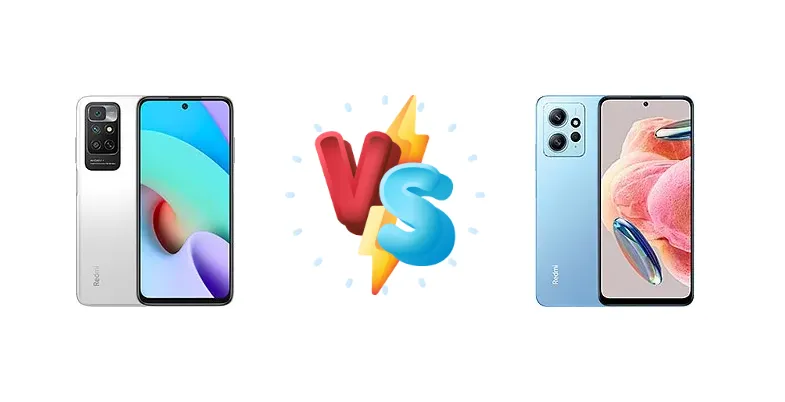
The Xiaomi Redmi Note series consistently delivers excellent value, but choosing between the latest models can be tricky. We're pitting the Redmi Note 11 4G against the Redmi Note 12 4G to determine which offers the best features and performance for your money. Let's dive in!
🏆 Quick Verdict
The Redmi Note 12 4G emerges as the clear winner thanks to its more efficient chipset, faster charging, and brighter display. While the Note 11 4G remains a solid budget option, the Note 12 4G provides a noticeable upgrade in key areas, justifying its slightly higher price.
| Network |
|---|
| 2G bands | GSM 850 / 900 / 1800 / 1900 | GSM 850 / 900 / 1800 / 1900 |
| 3G bands | HSDPA 850 / 900 / 2100 | HSDPA 850 / 900 / 2100 |
| 4G bands | 1, 3, 5, 7, 8, 34, 38, 39, 40, 41 | 1, 3, 5, 7, 8, 20, 28, 38, 40, 41 |
| Speed | HSPA, LTE | HSPA, LTE, 5G |
| Technology | GSM / CDMA / HSPA / LTE | GSM / HSPA / LTE |
| | CDMA 800 | - |
| Launch |
|---|
| Announced | 2021, November 25 | 2023, March 23 |
| Status | Available. Released 2021, December 01 | Available. Released 2023, March 30 |
| Body |
|---|
| Build | - | Glass front (Gorilla Glass 3), plastic frame, plastic back |
| Dimensions | 162 x 75.5 x 8.9 mm (6.38 x 2.97 x 0.35 in) | 165.7 x 76 x 7.9 mm (6.52 x 2.99 x 0.31 in) |
| SIM | Nano-SIM + Nano-SIM | Nano-SIM + Nano-SIM |
| Weight | 181 g (6.38 oz) | 183.5 g (6.49 oz) |
| | - | IP53, dust and splash resistant |
| Display |
|---|
| Protection | - | Corning Gorilla Glass 3 |
| Resolution | 1080 x 2400 pixels, 20:9 ratio (~405 ppi density) | 1080 x 2400 pixels, 20:9 ratio (~395 ppi density) |
| Size | 6.5 inches, 102.0 cm2 (~83.4% screen-to-body ratio) | 6.67 inches, 107.4 cm2 (~85.3% screen-to-body ratio) |
| Type | LCD, 90Hz | AMOLED, 120Hz, 450 nits (typ), 700 nits (HBM), 1200 nits (peak) |
| Platform |
|---|
| CPU | Octa-core (2x2.0 GHz Cortex-A75 & 6x1.8 GHz Cortex-A55) | Octa-core (4x2.8 GHz Cortex-A73 & 4x1.9 GHz Cortex-A53) |
| Chipset | Mediatek MT6769H Helio G88 (12 nm) | Qualcomm SM6225 Snapdragon 685 (6 nm) |
| GPU | Mali-G52 MC2 | Adreno 610 |
| OS | Android 11, MIUI 12.5 | Android 13, upgradable to Android 14, HyperOS |
| Memory |
|---|
| Card slot | microSDXC | microSDXC (dedicated slot) |
| Internal | 128GB 4GB RAM, 128GB 6GB RAM | 64GB 4GB RAM, 64GB 6GB RAM, 128GB 4GB RAM, 128GB 6GB RAM, 128GB 8GB RAM, 256GB 8GB RAM |
| | - | UFS 2.2 |
| Main Camera |
|---|
| Features | LED flash, HDR, panorama | LED flash, HDR, panorama |
| Single | 8 MP, f/2.0, (wide), 1/4.0”, 1.12µm | - |
| Triple | 50 MP, f/1.8, (wide), PDAF
8 MP, f/2.2, 120˚ (ultrawide)
2 MP (macro) | 50 MP, f/1.8, (wide), 1/2.76", 0.64µm, PDAF
8 MP, f/2.2, 120˚ (ultrawide), 1/4.0", 1.12µm
2 MP (macro) |
| Video | 1080p@30fps | 1080p@30fps |
| Selfie camera |
|---|
| Features | HDR, panorama | HDR |
| Single | 8 MP, f/2.0, (wide), 1/4.0”, 1.12µm | 13 MP, f/2.5, (wide), 1/3.0" |
| Video | 1080p@30fps | 1080p@30fps |
| Sound |
|---|
| 3.5mm jack | Yes | Yes |
| 35mm jack | Yes | Yes |
| Loudspeaker | Yes, with stereo speakers | Yes |
| Comms |
|---|
| Bluetooth | 5.1, A2DP, LE | 5.0, A2DP, LE |
| Infrared port | Yes | Yes |
| NFC | No | Yes (market/region dependent) |
| Positioning | GPS, GLONASS, GALILEO, BDS | GPS, GLONASS, GALILEO |
| Radio | Unspecified | Unspecified |
| USB | USB Type-C 2.0 | USB Type-C 2.0, OTG |
| WLAN | Wi-Fi 802.11 a/b/g/n/ac, dual-band, Wi-Fi Direct | Wi-Fi 802.11 a/b/g/n/ac, dual-band |
| Features |
|---|
| Sensors | Fingerprint (side-mounted), accelerometer, proximity, compass | Fingerprint (side-mounted), accelerometer, gyro, proximity, compass |
| Battery |
|---|
| Charging | 18W wired
9W reverse wired | 33W wired |
| Type | Li-Po 5000 mAh | Li-Po 5000 mAh |
| Misc |
|---|
| Colors | Carbon Gray, Pebble White, Sea Blue | Onyx Gray, Mint Green, Ice Blue |
| Models | 21121119SC | 23021RAAEG, 23021RAA2Y, 23027RAD4I, 23028RA60L |
| Price | About 210 EUR | £ 189.99 / € 107.98 / ₹ 9,998 |
| SAR | - | 1.09 W/kg (head) 0.89 W/kg (body) |
| SAR EU | - | 0.90 W/kg (head) 0.99 W/kg (body) |
| Tests |
|---|
| Battery life | - |
Endurance rating 117h
|
| Camera | - |
Photo / Video |
| Display | - |
Contrast ratio: Infinite (nominal) |
| Loudspeaker | - |
-27.9 LUFS (Good)
|
| Performance | - |
AnTuTu: 319219 (v9)
GeekBench: 1797 (v5.1), 1341 (v6)
GFXBench: 7.5fps (ES 3.1 onscreen) |
Xiaomi Redmi Note 11 4G
- Large Display
- Decent Battery Life
- Affordable Price
- Less Powerful Chipset
- Slower Charging
- Lower Brightness Display
Xiaomi Redmi Note 12 4G
- More Powerful Chipset (Snapdragon 685)
- Faster Charging (33W)
- Brighter Display
- Improved Efficiency
- Slightly Higher Price
- Similar Camera Hardware
Display Comparison
The Redmi Note 12 4G boasts a significant advantage with its measured 744 nits max brightness, offering better visibility in sunlight compared to the Note 11 4G. While the Note 12 4G advertises an 'infinite' contrast ratio (likely a marketing term), the increased brightness alone makes its display more appealing. Both phones likely feature similar LCD panels with FHD+ resolution.
Camera Comparison
Both phones feature similar camera setups, likely including a primary sensor, ultrawide lens, and macro lens. However, the improved image signal processor (ISP) in the Snapdragon 685 of the Note 12 4G could result in slightly better image quality, particularly in low-light conditions. Video recording capabilities are likely comparable.
Performance
The Snapdragon 685 in the Redmi Note 12 4G is a considerable upgrade over the Helio G88 in the Note 11 4G. The 6nm process offers better power efficiency and improved performance in everyday tasks and gaming. Expect smoother multitasking and faster app loading times on the Note 12 4G. The Cortex-A73 cores in the Note 12 also contribute to better performance.
Battery Life
Both devices boast impressive endurance ratings of 117 hours, suggesting excellent battery life. However, the Note 12 4G's more efficient chipset and 33W fast charging provide a faster and more convenient charging experience compared to the Note 11 4G's 18W charging.
Buying Guide
The Xiaomi Redmi Note 11 4G is a great choice for budget-conscious users who prioritize a large display and decent battery life. The Redmi Note 12 4G is ideal for those seeking improved performance, faster charging, and a brighter, more vibrant display, even if it means spending a bit more.
Frequently Asked Questions
❓ Is the Redmi Note 12 4G worth the upgrade from the Note 11 4G?
Yes, the Note 12 4G offers a noticeable upgrade in performance and charging speed, making it a worthwhile upgrade for most users.
❓ Which phone has better gaming performance?
The Redmi Note 12 4G's Snapdragon 685 chipset provides significantly better gaming performance than the Note 11 4G's Helio G88.