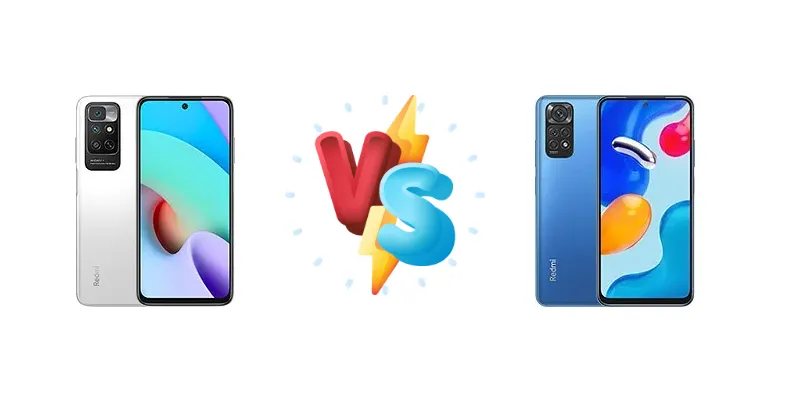
The Xiaomi Redmi Note series consistently delivers excellent value, and the Note 11 4G and Note 11S are no exception. But with subtle differences, choosing between them can be tricky. This comprehensive comparison breaks down the key features to help you make the right decision for your needs and budget.
🏆 Quick Verdict
The Redmi Note 11S emerges as the clear winner, offering a faster chipset, significantly quicker charging, and a brighter display. While the 4G is more affordable, the 11S's upgrades justify the price difference for most users seeking a smoother and more feature-rich experience.
| Network |
|---|
| 2G bands | GSM 850 / 900 / 1800 / 1900 | GSM 850 / 900 / 1800 / 1900 |
| 3G bands | HSDPA 850 / 900 / 2100 | HSDPA 850 / 900 / 1700(AWS) / 1900 / 2100 |
| 4G bands | 1, 3, 5, 7, 8, 34, 38, 39, 40, 41 | 1, 2, 3, 4, 5, 7, 8, 20, 28, 38, 40, 41 |
| Speed | HSPA, LTE | HSPA, LTE |
| Technology | GSM / CDMA / HSPA / LTE | GSM / HSPA / LTE |
| | CDMA 800 | - |
| Launch |
|---|
| Announced | 2021, November 25 | 2022, January 26 |
| Status | Available. Released 2021, December 01 | Available. Released 2022, February 09 |
| Body |
|---|
| Build | - | Glass front (Gorilla Glass 3), plastic frame, glass back |
| Dimensions | 162 x 75.5 x 8.9 mm (6.38 x 2.97 x 0.35 in) | 159.9 x 73.9 x 8.1 mm (6.30 x 2.91 x 0.32 in) |
| SIM | Nano-SIM + Nano-SIM | Nano-SIM + Nano-SIM |
| Weight | 181 g (6.38 oz) | 179 g (6.31 oz) |
| | - | IP53, dust and splash resistant |
| Display |
|---|
| Protection | - | Corning Gorilla Glass 3 |
| Resolution | 1080 x 2400 pixels, 20:9 ratio (~405 ppi density) | 1080 x 2400 pixels, 20:9 ratio (~409 ppi density) |
| Size | 6.5 inches, 102.0 cm2 (~83.4% screen-to-body ratio) | 6.43 inches, 99.8 cm2 (~84.5% screen-to-body ratio) |
| Type | LCD, 90Hz | AMOLED, 90Hz, 700 nits, 1000 nits (peak) |
| Platform |
|---|
| CPU | Octa-core (2x2.0 GHz Cortex-A75 & 6x1.8 GHz Cortex-A55) | Octa-core (2x2.05 GHz Cortex-A76 & 6x2.0 GHz Cortex-A55) |
| Chipset | Mediatek MT6769H Helio G88 (12 nm) | Mediatek MT6781 Helio G96 (12 nm) |
| GPU | Mali-G52 MC2 | Mali-G57 MC2 |
| OS | Android 11, MIUI 12.5 | Android 11, MIUI 13 |
| Memory |
|---|
| Card slot | microSDXC | microSDXC (dedicated slot) |
| Internal | 128GB 4GB RAM, 128GB 6GB RAM | 64GB 6GB RAM, 128GB 6GB RAM, 128GB 8GB RAM |
| | - | UFS 2.2 |
| Main Camera |
|---|
| Features | LED flash, HDR, panorama | LED flash, HDR, panorama |
| Quad | - | 108 MP, f/1.9, 26mm (wide), 1/1.52", 0.7µm, PDAF
8 MP, f/2.2, 118˚ (ultrawide)
2 MP (macro)
Auxiliary lens |
| Single | 8 MP, f/2.0, (wide), 1/4.0”, 1.12µm | - |
| Triple | 50 MP, f/1.8, (wide), PDAF
8 MP, f/2.2, 120˚ (ultrawide)
2 MP (macro) | - |
| Video | 1080p@30fps | 1080p@30fps |
| Selfie camera |
|---|
| Features | HDR, panorama | - |
| Single | 8 MP, f/2.0, (wide), 1/4.0”, 1.12µm | 16 MP, f/2.5, (wide), 1/3.06" 1.0µm |
| Video | 1080p@30fps | 1080p@30fps |
| Sound |
|---|
| 3.5mm jack | Yes | Yes |
| 35mm jack | Yes | Yes |
| Loudspeaker | Yes, with stereo speakers | Yes, with stereo speakers |
| | - | 24-bit/192kHz audio |
| Comms |
|---|
| Bluetooth | 5.1, A2DP, LE | 5.0, A2DP, LE |
| Infrared port | Yes | Yes |
| NFC | No | Yes (market/region dependent) |
| Positioning | GPS, GLONASS, GALILEO, BDS | GPS, GLONASS, BDS, GALILEO |
| Radio | Unspecified | FM radio |
| USB | USB Type-C 2.0 | USB Type-C 2.0, OTG |
| WLAN | Wi-Fi 802.11 a/b/g/n/ac, dual-band, Wi-Fi Direct | Wi-Fi 802.11 a/b/g/n/ac, dual-band, Wi-Fi Direct |
| Features |
|---|
| Sensors | Fingerprint (side-mounted), accelerometer, proximity, compass | Fingerprint (side-mounted), accelerometer, gyro, compass |
| | - | Virtual proximity sensing |
| Battery |
|---|
| Charging | 18W wired
9W reverse wired | 33W wired, PD3.0, QC3, 100% in 58 min |
| Type | Li-Po 5000 mAh | Li-Po 5000 mAh |
| Misc |
|---|
| Colors | Carbon Gray, Pebble White, Sea Blue | Graphite Gray, Pearl White, Twilight Blue |
| Models | 21121119SC | 2201117SG, 2201117SI, 2201117SY, 2201117SL |
| Price | About 210 EUR | € 136.99 |
| SAR | - | 1.09 W/kg (head) 1.05 W/kg (body) |
| SAR EU | - | 0.59 W/kg (head) 0.88 W/kg (body) |
| Tests |
|---|
| Battery life | - |
Endurance rating 133h
|
| Camera | - |
Photo / Video |
| Display | - |
Contrast ratio: Infinite (nominal) |
| Loudspeaker | - |
-25.4 LUFS (Very good)
|
| Performance | - |
AnTuTu: 251201 (v8), 308741 (v9)
GeekBench: 1873 (v5.1)
GFXBench: 12fps (ES 3.1 onscreen) |
Xiaomi Redmi Note 11 4G
- More affordable
- Decent battery life
- Good display quality (AMOLED)
- Slower chipset
- Slower charging
- Lower brightness display
Xiaomi Redmi Note 11S
- Faster chipset (Helio G96)
- Faster charging (33W)
- Brighter display
- Slightly better camera
- More expensive
- Still not flagship performance
Display Comparison
The Redmi Note 11S boasts a noticeable advantage with its 744 nits max brightness, making it easier to view content outdoors. Both phones feature a 6.43-inch AMOLED display with a 90Hz refresh rate, offering vibrant colors and smooth scrolling. However, the 11S's higher brightness provides a more comfortable viewing experience in bright sunlight. The 'Infinite' contrast ratio mentioned for the 11S is a nominal value, but generally AMOLED displays offer excellent contrast.
Camera Comparison
Both phones feature a quad-camera setup, but the 11S's improved image processing and slightly better sensor contribute to better photo and video quality. Expect more detail and better dynamic range from the 11S, especially in challenging lighting conditions. While both offer decent camera performance for their price range, the 11S holds a slight edge.
Performance
The Helio G96 in the Redmi Note 11S provides a significant performance boost over the Helio G88 in the 4G model. The Cortex-A76 cores in the G96 offer better single-core performance, resulting in snappier app launches and smoother multitasking. While both phones handle everyday tasks well, the 11S is noticeably more responsive during demanding tasks like gaming.
Battery Life
Both phones share the same battery capacity, but the 11S's 33W fast charging is a game-changer. It can fully charge the phone in approximately 58 minutes, compared to the 11 4G's slower 18W charging. The endurance rating of 133h for both is impressive, suggesting excellent battery life for typical usage.
Buying Guide
The Xiaomi Redmi Note 11 4G is ideal for budget-conscious users who prioritize affordability and basic smartphone functionality. The Redmi Note 11S is a better choice for those who value performance, faster charging, a brighter display, and slightly improved camera capabilities, even if it means spending a bit more.
Frequently Asked Questions
❓ Is the Redmi Note 11S worth the extra money?
Yes, if you value performance, faster charging, and a brighter display. The upgrades are significant enough to justify the price difference for most users.
❓ Which phone has better gaming performance?
The Redmi Note 11S, thanks to its more powerful Helio G96 chipset, offers noticeably better gaming performance.