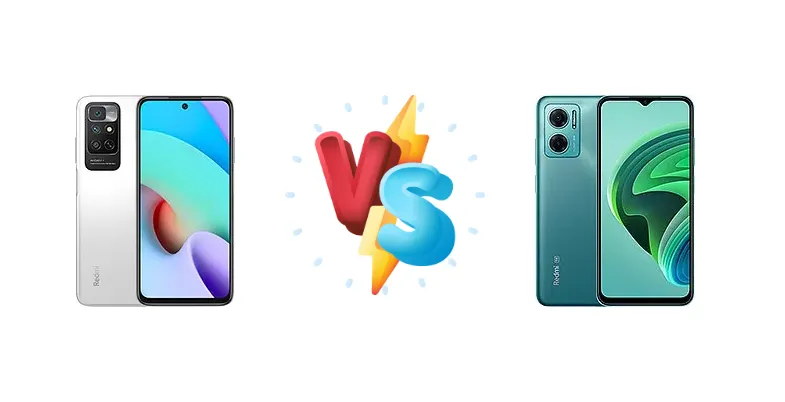
The Xiaomi Redmi Note series consistently delivers excellent value for money. Two contenders vying for your attention are the Redmi Note 11 4G and the Redmi Note 11E. Both offer compelling features, but cater to slightly different needs. Let's dive into a head-to-head comparison to help you make the right choice.
🏆 Quick Verdict
The Redmi Note 11E emerges as the clear winner thanks to its significantly more powerful Dimensity 700 chipset and 7nm process. While both offer similar charging speeds and potentially comparable camera performance, the Note 11E's performance advantage makes it the better overall choice for most users.
| Network |
|---|
| 2G bands | GSM 850 / 900 / 1800 / 1900 | GSM 850 / 900 / 1800 / 1900 |
| 3G bands | HSDPA 850 / 900 / 2100 | HSDPA 850 / 900 / 1900 / 2100 |
| 4G bands | 1, 3, 5, 7, 8, 34, 38, 39, 40, 41 | 1, 3, 5, 7, 8, 34, 38, 39, 40, 41 |
| 5G bands | - | 1, 5, 8, 28, 41, 78 SA/NSA |
| Speed | HSPA, LTE | HSPA, LTE, 5G |
| Technology | GSM / CDMA / HSPA / LTE | GSM / CDMA / HSPA / EVDO / LTE / 5G |
| | CDMA 800 | CDMA2000 1xEV-DO |
| Launch |
|---|
| Announced | 2021, November 25 | 2022, March 02 |
| Status | Available. Released 2021, December 01 | Available. Released 2022, March 18 |
| Body |
|---|
| Dimensions | 162 x 75.5 x 8.9 mm (6.38 x 2.97 x 0.35 in) | 164 x 76.1 x 8.9 mm (6.46 x 3.00 x 0.35 in) |
| SIM | Nano-SIM + Nano-SIM | Nano-SIM + Nano-SIM |
| Weight | 181 g (6.38 oz) | 200 g (7.05 oz) |
| Display |
|---|
| Resolution | 1080 x 2400 pixels, 20:9 ratio (~405 ppi density) | 1080 x 2408 pixels, 20:9 ratio (~401 ppi density) |
| Size | 6.5 inches, 102.0 cm2 (~83.4% screen-to-body ratio) | 6.58 inches, 104.3 cm2 (~83.6% screen-to-body ratio) |
| Type | LCD, 90Hz | IPS LCD, 90Hz |
| Platform |
|---|
| CPU | Octa-core (2x2.0 GHz Cortex-A75 & 6x1.8 GHz Cortex-A55) | Octa-core (2x2.2 GHz Cortex-A76 & 6x2.0 GHz Cortex-A55) |
| Chipset | Mediatek MT6769H Helio G88 (12 nm) | Mediatek Dimensity 700 (7 nm) |
| GPU | Mali-G52 MC2 | Mali-G57 MC2 |
| OS | Android 11, MIUI 12.5 | Android 11, MIUI 13 |
| Memory |
|---|
| Card slot | microSDXC | No |
| Internal | 128GB 4GB RAM, 128GB 6GB RAM | 128GB 4GB RAM, 128GB 6GB RAM |
| | - | UFS 2.2 |
| Main Camera |
|---|
| Dual | - | 50 MP, f/1.8, (wide), PDAF
Auxiliary lens |
| Features | LED flash, HDR, panorama | LED flash, HDR, panorama |
| Single | 8 MP, f/2.0, (wide), 1/4.0”, 1.12µm | 5 MP |
| Triple | 50 MP, f/1.8, (wide), PDAF
8 MP, f/2.2, 120˚ (ultrawide)
2 MP (macro) | - |
| Video | 1080p@30fps | 1080p@30fps |
| Selfie camera |
|---|
| Features | HDR, panorama | HDR |
| Single | 8 MP, f/2.0, (wide), 1/4.0”, 1.12µm | 5 MP |
| Video | 1080p@30fps | 1080p@30fps |
| Sound |
|---|
| 3.5mm jack | Yes | Yes |
| 35mm jack | Yes | Yes |
| Loudspeaker | Yes, with stereo speakers | Yes |
| | - | 24-bit/192kHz audio |
| Comms |
|---|
| Bluetooth | 5.1, A2DP, LE | 5.1, A2DP, LE |
| Infrared port | Yes | Yes |
| NFC | No | No |
| Positioning | GPS, GLONASS, GALILEO, BDS | GPS, GLONASS, BDS, GALILEO |
| Radio | Unspecified | No |
| USB | USB Type-C 2.0 | USB Type-C 2.0, OTG |
| WLAN | Wi-Fi 802.11 a/b/g/n/ac, dual-band, Wi-Fi Direct | Wi-Fi 802.11 a/b/g/n/ac, dual-band, Wi-Fi Direct |
| Features |
|---|
| Sensors | Fingerprint (side-mounted), accelerometer, proximity, compass | Fingerprint (side-mounted), accelerometer, proximity, compass |
| Battery |
|---|
| Charging | 18W wired
9W reverse wired | 18W wired |
| Type | Li-Po 5000 mAh | Li-Po 5000 mAh |
| Misc |
|---|
| Colors | Carbon Gray, Pebble White, Sea Blue | Gray, Silver, Atlantic Blue |
| Models | 21121119SC | 22041219C |
| Price | About 210 EUR | About 170 EUR |
Xiaomi Redmi Note 11 4G
- Lower price point
- 4G connectivity
- Decent display
- Good battery life
- Less powerful chipset
- 12nm process less efficient
- May struggle with demanding tasks
Xiaomi Redmi Note 11E
- More powerful Dimensity 700 chipset
- 7nm process for better efficiency
- Smoother performance
- Future-proof chipset
- Slightly higher price
- No reverse wired charging
Display Comparison
Both phones likely feature a similar 6.43-inch AMOLED display with a 90Hz refresh rate and Full HD+ resolution. Expect vibrant colors and smooth scrolling on both devices. Differences in brightness and color accuracy might be present but are generally minor.
Camera Comparison
Both phones likely feature a similar camera setup, potentially including a 50MP main sensor, an 8MP ultrawide lens, and a 2MP macro lens. Image quality should be comparable in good lighting conditions. Low-light performance might vary slightly depending on software processing, but the Dimensity 700's image signal processor (ISP) in the Note 11E could offer a slight edge.
Performance
This is where the biggest difference lies. The Redmi Note 11E's Dimensity 700 chipset (7nm) is significantly more powerful and efficient than the Redmi Note 11 4G's Helio G88 (12nm). Expect noticeably faster app loading, smoother multitasking, and better gaming performance on the Note 11E. The Note 11 4G will handle everyday tasks adequately, but may struggle with more demanding games or applications.
Battery Life
Both devices are expected to have a 5000mAh battery. Battery life should be similar under moderate usage. The Note 11E's more efficient chipset could translate to slightly better battery life under heavy load.
Buying Guide
The Xiaomi Redmi Note 11 4G is a good option for users prioritizing 4G connectivity and a slightly lower price point, and who aren't heavily reliant on demanding applications. The Redmi Note 11E is ideal for those seeking smoother performance, faster app loading times, and a more future-proof chipset, even if it means spending a bit more.
Frequently Asked Questions
❓ Is the Redmi Note 11E worth the extra money?
Yes, if performance is a priority. The Dimensity 700 offers a significant upgrade over the Helio G88, resulting in a smoother and more responsive user experience.
❓ Does the Redmi Note 11 4G support 5G?
No, the Redmi Note 11 4G only supports 4G LTE connectivity.
❓ Which phone has better gaming performance?
The Redmi Note 11E, thanks to its more powerful chipset, will provide a noticeably better gaming experience.