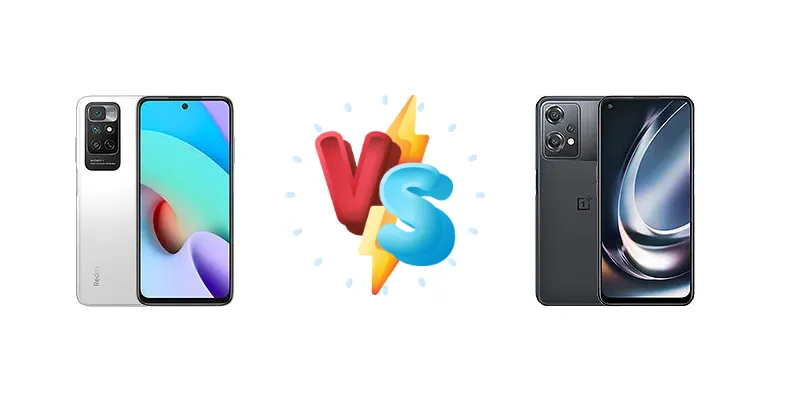
The Xiaomi Redmi Note 11 4G and the OnePlus Nord CE 2 Lite 5G represent compelling options in the crowded budget smartphone market. While both aim to deliver a solid experience without breaking the bank, they take different approaches. The Redmi Note 11 4G focuses on established reliability, while the Nord CE 2 Lite 5G prioritizes future-proofing with 5G connectivity and faster charging.
🏆 Quick Verdict
For the average user, the OnePlus Nord CE 2 Lite 5G is the better choice. Its Snapdragon 695 chipset, built on a more efficient 6nm process, offers a performance edge and unlocks 5G capabilities. The significantly faster 33W charging also provides a tangible benefit over the Redmi Note 11 4G’s 18W charging.
| Network |
|---|
| 2G bands | GSM 850 / 900 / 1800 / 1900 | GSM 850 / 900 / 1800 / 1900 |
| 3G bands | HSDPA 850 / 900 / 2100 | HSDPA 800 / 850 / 900 / 1700(AWS) / 1900 / 2100 |
| 4G bands | 1, 3, 5, 7, 8, 34, 38, 39, 40, 41 | 1, 2, 3, 4, 5, 7, 8, 12, 13, 17, 18, 19, 20, 26, 28, 38, 39, 40, 41, 66 - Europe |
| 5G bands | - | 1, 3, 5, 7, 8, 20, 28, 38, 40, 41, 66, 77, 78 SA/NSA - Europe |
| Speed | HSPA, LTE | HSPA, LTE, 5G |
| Technology | GSM / CDMA / HSPA / LTE | GSM / HSPA / LTE / 5G |
| | CDMA 800 | - |
| Launch |
|---|
| Announced | 2021, November 25 | 2022, April 28 |
| Status | Available. Released 2021, December 01 | Available. Released 2022, April 30 |
| Body |
|---|
| Build | - | Glass front, plastic frame, plastic back |
| Dimensions | 162 x 75.5 x 8.9 mm (6.38 x 2.97 x 0.35 in) | 164.3 x 75.6 x 8.5 mm (6.47 x 2.98 x 0.33 in) |
| SIM | Nano-SIM + Nano-SIM | Nano-SIM + Nano-SIM |
| Weight | 181 g (6.38 oz) | 195 g (6.88 oz) |
| Display |
|---|
| Resolution | 1080 x 2400 pixels, 20:9 ratio (~405 ppi density) | 1080 x 2412 pixels, 20:9 ratio (~401 ppi density) |
| Size | 6.5 inches, 102.0 cm2 (~83.4% screen-to-body ratio) | 6.59 inches, 104.5 cm2 (~84.1% screen-to-body ratio) |
| Type | LCD, 90Hz | IPS LCD, 120Hz |
| Platform |
|---|
| CPU | Octa-core (2x2.0 GHz Cortex-A75 & 6x1.8 GHz Cortex-A55) | Octa-core (2x2.2 GHz Kryo 660 Gold & 6x1.7 GHz Kryo 660 Silver) |
| Chipset | Mediatek MT6769H Helio G88 (12 nm) | Qualcomm SM6375 Snapdragon 695 5G (6 nm) |
| GPU | Mali-G52 MC2 | Adreno 619 |
| OS | Android 11, MIUI 12.5 | Android 12, upgradable to Android 13, OxygenOS 13 |
| Memory |
|---|
| Card slot | microSDXC | microSDXC (uses shared SIM slot) |
| Internal | 128GB 4GB RAM, 128GB 6GB RAM | 128GB 6GB RAM, 128GB 8GB RAM |
| Main Camera |
|---|
| Features | LED flash, HDR, panorama | LED flash, HDR, panorama |
| Single | 8 MP, f/2.0, (wide), 1/4.0”, 1.12µm | - |
| Triple | 50 MP, f/1.8, (wide), PDAF
8 MP, f/2.2, 120˚ (ultrawide)
2 MP (macro) | 64 MP, f/1.7, 26mm (wide), 0.7µm, PDAF
2 MP (macro)
Auxiliary lens |
| Video | 1080p@30fps | 1080p@30fps |
| Selfie camera |
|---|
| Features | HDR, panorama | HDR |
| Single | 8 MP, f/2.0, (wide), 1/4.0”, 1.12µm | 16 MP, f/2.0, (wide), 1/3.0", 1.0µm |
| Video | 1080p@30fps | 1080p@30fps |
| Sound |
|---|
| 3.5mm jack | Yes | Yes |
| 35mm jack | Yes | Yes |
| Loudspeaker | Yes, with stereo speakers | Yes |
| Comms |
|---|
| Bluetooth | 5.1, A2DP, LE | 5.2, A2DP, LE, aptX HD |
| Infrared port | Yes | - |
| NFC | No | Yes (market/region dependent) |
| Positioning | GPS, GLONASS, GALILEO, BDS | GPS, GLONASS, GALILEO, BDS, QZSS |
| Radio | Unspecified | Unspecified |
| USB | USB Type-C 2.0 | USB Type-C 2.0, OTG |
| WLAN | Wi-Fi 802.11 a/b/g/n/ac, dual-band, Wi-Fi Direct | Wi-Fi 802.11 a/b/g/n/ac, dual-band, Wi-Fi Direct |
| Features |
|---|
| Sensors | Fingerprint (side-mounted), accelerometer, proximity, compass | Fingerprint (side-mounted), accelerometer, gyro, proximity, compass |
| Battery |
|---|
| Charging | 18W wired
9W reverse wired | 33W wired |
| Type | Li-Po 5000 mAh | Li-Po 5000 mAh |
| Misc |
|---|
| Colors | Carbon Gray, Pebble White, Sea Blue | Black Dusk, Blue Tide |
| Models | 21121119SC | CPH2381, CPH2409 |
| Price | About 210 EUR | About 220 EUR |
| SAR | - | 1.19 W/kg (head) 0.71 W/kg (body) |
Xiaomi Redmi Note 11 4G
- Established brand reputation for software updates (potentially)
- 9W reverse wired charging for emergency top-ups
- Potentially lower price point
- Less powerful Helio G88 chipset
- Slower 18W charging
- Lacks 5G connectivity
OnePlus Nord CE 2 Lite 5G
- Faster Snapdragon 695 5G chipset
- Significantly faster 33W charging
- 5G connectivity for future network compatibility
- OnePlus’s software update track record can be inconsistent
- Potentially slightly higher price
Display Comparison
Neither device boasts a standout display. Both likely feature LCD panels, a common trait in this price bracket. However, detailed specs like resolution and refresh rate are missing. The key difference lies in the underlying chipsets, which impact the display’s responsiveness. The Snapdragon 695’s more capable GPU can potentially drive a smoother user interface, even if the panel itself is similar. Bezels are likely comparable, and color accuracy will depend on software calibration.
Camera Comparison
Without detailed sensor information, a direct camera comparison is difficult. However, the market segment suggests both phones will feature a primary sensor paired with depth and macro lenses. The Redmi Note 11 4G’s image processing likely leans towards Xiaomi’s signature vibrant color profile, while OnePlus typically aims for a more natural look. The Snapdragon 695’s ISP (Image Signal Processor) is generally more advanced than the Helio G88’s, potentially leading to better dynamic range and noise reduction in the Nord CE 2 Lite 5G. The usefulness of the 2MP macro cameras on both devices is questionable.
Performance
The OnePlus Nord CE 2 Lite 5G’s Qualcomm Snapdragon 695 5G (6nm) represents a significant architectural advantage over the Redmi Note 11 4G’s MediaTek Helio G88 (12nm). The 6nm process inherently offers better power efficiency, translating to less heat generation and potentially sustained performance during demanding tasks. The Snapdragon 695’s Kryo 660 Gold cores, clocked at 2.2 GHz, also outperform the Helio G88’s Cortex-A75 cores at 2.0 GHz. This difference is noticeable in app loading times and multitasking. While both phones likely feature similar RAM configurations, the Snapdragon’s superior processing power will be the bottleneck.
Battery Life
The battery capacity is not specified, but both phones likely hover around the 5000mAh mark, typical for this class. The critical difference is charging speed. The OnePlus Nord CE 2 Lite 5G’s 33W wired charging is a substantial upgrade over the Redmi Note 11 4G’s 18W charging. This translates to significantly faster top-up times – potentially reducing a full charge from over two hours to under an hour. While the Redmi Note 11 4G offers 9W reverse wired charging, a niche feature, the Nord CE 2 Lite 5G’s faster charging is a more universally beneficial advantage.
Buying Guide
Buy the Xiaomi Redmi Note 11 4G if you prioritize a proven track record of software stability and are content with 4G connectivity. It’s a solid all-rounder for basic smartphone tasks. Buy the OnePlus Nord CE 2 Lite 5G if you want faster charging, 5G connectivity for future network upgrades, and a slightly more powerful processor for smoother multitasking and gaming.
Frequently Asked Questions
❓ Will the Snapdragon 695 in the Nord CE 2 Lite 5G handle demanding games like PUBG Mobile smoothly?
The Snapdragon 695 is capable of running PUBG Mobile, but you’ll likely need to stick to medium graphics settings for a consistently smooth experience. The Helio G88 in the Redmi Note 11 4G will struggle more with higher settings and may exhibit more frame drops.
❓ How much faster is the 33W charging on the Nord CE 2 Lite 5G compared to the Redmi Note 11 4G’s 18W charging?
Expect a full charge on the Nord CE 2 Lite 5G to take around 60-75 minutes, while the Redmi Note 11 4G will likely take over 2 hours. This difference is particularly noticeable for quick top-ups when you’re short on time.
❓ Is 5G connectivity on the Nord CE 2 Lite 5G worth the extra cost if 5G isn't widely available in my area yet?
Even if 5G isn't currently available, the Nord CE 2 Lite 5G future-proofs your investment. 5G networks are expanding rapidly, and the phone will be ready when it arrives in your area. The Snapdragon 695 also offers improved 4G performance compared to the Helio G88.