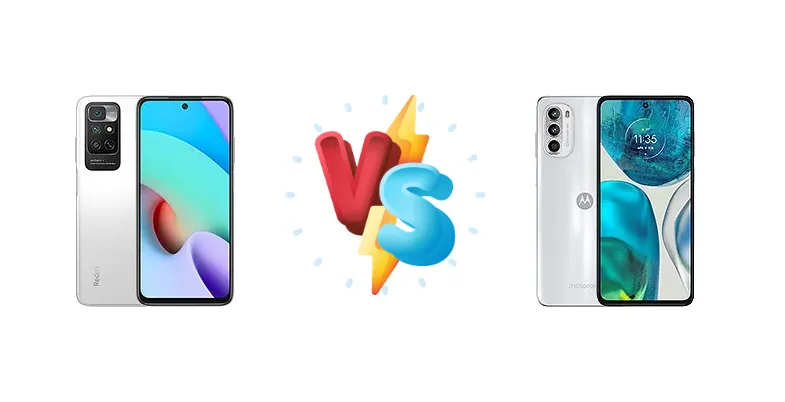
The Xiaomi Redmi Note 11 4G and Motorola Moto G52 represent compelling options in the crowded budget smartphone market. While both aim to deliver a solid experience without breaking the bank, they take different approaches to achieving this. The Redmi Note 11 4G relies on MediaTek’s Helio G88, while the Moto G52 opts for Qualcomm’s more efficient Snapdragon 680. This comparison dives deep into the specifics to determine which device offers the best overall package.
🏆 Quick Verdict
For the average user prioritizing efficiency and faster charging, the Motorola Moto G52 emerges as the better choice. Its Snapdragon 680, built on a 6nm process, offers improved power efficiency and a smoother experience, complemented by 30W charging. While the Redmi Note 11 4G offers a slightly more powerful CPU core configuration, the G52’s overall refinement wins out.
| Network |
|---|
| 2G bands | GSM 850 / 900 / 1800 / 1900 | GSM 850 / 900 / 1800 / 1900 |
| 3G bands | HSDPA 850 / 900 / 2100 | HSDPA 850 / 900 / 1700(AWS) / 1900 / 2100 |
| 4G bands | 1, 3, 5, 7, 8, 34, 38, 39, 40, 41 | LTE |
| Speed | HSPA, LTE | HSPA, LTE |
| Technology | GSM / CDMA / HSPA / LTE | GSM / HSPA / LTE |
| | CDMA 800 | - |
| Launch |
|---|
| Announced | 2021, November 25 | 2022, April 12 |
| Status | Available. Released 2021, December 01 | Available. Released 2022, April 20 |
| Body |
|---|
| Dimensions | 162 x 75.5 x 8.9 mm (6.38 x 2.97 x 0.35 in) | 160.1 x 74.5 x 8 mm (6.30 x 2.93 x 0.31 in) |
| SIM | Nano-SIM + Nano-SIM | Nano-SIM + Nano-SIM |
| Weight | 181 g (6.38 oz) | 169 g (5.96 oz) |
| | - | Water-repellent design |
| Display |
|---|
| Resolution | 1080 x 2400 pixels, 20:9 ratio (~405 ppi density) | 1080 x 2400 pixels, 20:9 ratio (~402 ppi density) |
| Size | 6.5 inches, 102.0 cm2 (~83.4% screen-to-body ratio) | 6.6 inches, 103.6 cm2 (~86.9% screen-to-body ratio) |
| Type | LCD, 90Hz | AMOLED, 90Hz |
| Platform |
|---|
| CPU | Octa-core (2x2.0 GHz Cortex-A75 & 6x1.8 GHz Cortex-A55) | Octa-core (4x2.4 GHz Kryo 265 Gold & 4x1.9 GHz Kryo 265 Silver) |
| Chipset | Mediatek MT6769H Helio G88 (12 nm) | Qualcomm SM6225 Snapdragon 680 4G (6 nm) |
| GPU | Mali-G52 MC2 | Adreno 610 |
| OS | Android 11, MIUI 12.5 | Android 12, planned upgrade to Android 13 |
| Memory |
|---|
| Card slot | microSDXC | microSDXC (uses shared SIM slot) |
| Internal | 128GB 4GB RAM, 128GB 6GB RAM | 64GB 4GB RAM, 128GB 4GB RAM, 128GB 6GB RAM, 256GB 6GB RAM |
| Main Camera |
|---|
| Features | LED flash, HDR, panorama | LED flash, HDR, panorama |
| Single | 8 MP, f/2.0, (wide), 1/4.0”, 1.12µm | - |
| Triple | 50 MP, f/1.8, (wide), PDAF
8 MP, f/2.2, 120˚ (ultrawide)
2 MP (macro) | 50 MP, f/1.8 (wide), 1/2.76", 0.64µm, PDAF
8 MP, f/2.2, 118˚ (ultrawide), 1/4.0", 1.12µm
2 MP (macro) |
| Video | 1080p@30fps | 1080p@30fps |
| Selfie camera |
|---|
| Features | HDR, panorama | - |
| Single | 8 MP, f/2.0, (wide), 1/4.0”, 1.12µm | 16 MP, f/2.5, (wide), 1.0µm |
| Video | 1080p@30fps | 1080p@30fps |
| Sound |
|---|
| 3.5mm jack | Yes | Yes |
| 35mm jack | Yes | Yes |
| Loudspeaker | Yes, with stereo speakers | Yes, with stereo speakers |
| Comms |
|---|
| Bluetooth | 5.1, A2DP, LE | 5.0, A2DP, LE |
| Infrared port | Yes | - |
| NFC | No | Yes (market/region dependent) |
| Positioning | GPS, GLONASS, GALILEO, BDS | GPS, GLONASS, GALILEO |
| Radio | Unspecified | Unspecified |
| USB | USB Type-C 2.0 | USB Type-C 2.0 |
| WLAN | Wi-Fi 802.11 a/b/g/n/ac, dual-band, Wi-Fi Direct | Wi-Fi 802.11 a/b/g/n/ac, dual-band, Wi-Fi Direct |
| Features |
|---|
| Sensors | Fingerprint (side-mounted), accelerometer, proximity, compass | Fingerprint (side-mounted), accelerometer, gyro, proximity, compass |
| Battery |
|---|
| Charging | 18W wired
9W reverse wired | 30W wired |
| Type | Li-Po 5000 mAh | Li-Po 5000 mAh |
| Misc |
|---|
| Colors | Carbon Gray, Pebble White, Sea Blue | Charcoal Gray, Porcelain White |
| Models | 21121119SC | XT2221-1, XT2221-2 |
| Price | About 210 EUR | About 470 EUR |
Xiaomi Redmi Note 11 4G
- Potentially higher peak CPU performance for specific tasks.
- 9W reverse wired charging for accessory top-ups.
- Xiaomi’s MIUI offers extensive customization options.
- Less efficient 12nm chipset leads to potential throttling.
- Slower 18W charging.
- MIUI can be resource-intensive and include bloatware.
Motorola Moto G52
- More efficient 6nm Snapdragon 680 chipset.
- Faster 30W wired charging.
- Motorola’s near-stock Android experience is clean and responsive.
- CPU core clock speeds are lower than the Redmi Note 11 4G.
- Camera processing may be less vibrant than Xiaomi’s.
- Limited customization options compared to MIUI.
Display Comparison
Neither device boasts a standout display. Specifications are not provided, so we must rely on market positioning. Both likely feature 6.5-6.6 inch LCD panels at 1080p resolution. However, the Moto G52’s potential for a slightly better color calibration, typical of Motorola’s software tuning, could give it a minor edge. The absence of high refresh rates on either device suggests a focus on battery conservation rather than visual fluidity.
Camera Comparison
Without detailed sensor information, a direct comparison is difficult. However, both phones likely feature a primary camera around the 50MP mark. The Snapdragon 680’s image signal processor (ISP) is generally considered more advanced than the Helio G88’s, potentially leading to better dynamic range and noise reduction in photos and videos. Motorola’s software processing often prioritizes natural-looking images, while Xiaomi tends towards more saturated colors. The absence of optical image stabilization (OIS) on either device suggests a reliance on software stabilization.
Performance
The core difference lies in the chipsets. The Redmi Note 11 4G’s MediaTek Helio G88 (12nm) features a dual-core Cortex-A75 setup clocked at 2.0 GHz, paired with six Cortex-A55 cores at 1.8 GHz. This configuration *appears* stronger on paper, but the 12nm manufacturing process is less efficient. The Moto G52’s Snapdragon 680 (6nm) utilizes a quad-core Kryo 265 Gold setup at 2.4 GHz and four Kryo 265 Silver cores at 1.9 GHz. The 6nm process is significantly more power-efficient, meaning the Snapdragon 680 will deliver comparable, and potentially better, sustained performance with less thermal throttling. This benefits everyday tasks and light gaming.
Battery Life
The Moto G52’s 30W wired charging is a clear advantage over the Redmi Note 11 4G’s 18W charging. This translates to significantly faster top-up times, reducing downtime. While battery capacity isn’t specified, the Snapdragon 680’s superior efficiency means the Moto G52 will likely offer comparable or better battery life despite potentially having a smaller battery cell. The 9W reverse wired charging on the Redmi Note 11 4G is a niche feature, useful for topping up accessories but unlikely to be a primary selling point.
Buying Guide
Buy the Xiaomi Redmi Note 11 4G if you need a phone that *might* offer a slight edge in raw CPU performance for demanding tasks, and you're comfortable with slower charging speeds. Buy the Motorola Moto G52 if you prefer a more balanced experience with better battery life, faster 30W charging, and a more modern, efficient chipset that will likely translate to better long-term performance and thermal management.
Frequently Asked Questions
❓ Will the Snapdragon 680 in the Moto G52 struggle with graphically demanding games like PUBG Mobile?
While the Snapdragon 680 isn't a gaming powerhouse, it's capable of running PUBG Mobile at medium settings with stable frame rates. The 6nm process helps maintain thermal control, preventing significant throttling during extended gaming sessions. Expect a smoother experience than the Redmi Note 11 4G, which may experience more noticeable frame drops under sustained load.
❓ How much faster is the 30W charging on the Moto G52 compared to the 18W charging on the Redmi Note 11 4G?
The 30W charging on the Moto G52 can realistically reduce charging times by 30-50% compared to the Redmi Note 11 4G’s 18W charging. A full 0-100% charge on the Moto G52 is likely to take around 60-75 minutes, while the Redmi Note 11 4G could take upwards of 2 hours.
❓ Does the Motorola Moto G52 receive regular software updates and security patches?
Motorola has improved its software update commitment in recent years. The Moto G52 is likely to receive at least one major Android version update and regular security patches for a period of two years. While not as frequent as updates on some other brands, Motorola provides a reasonable level of software support.