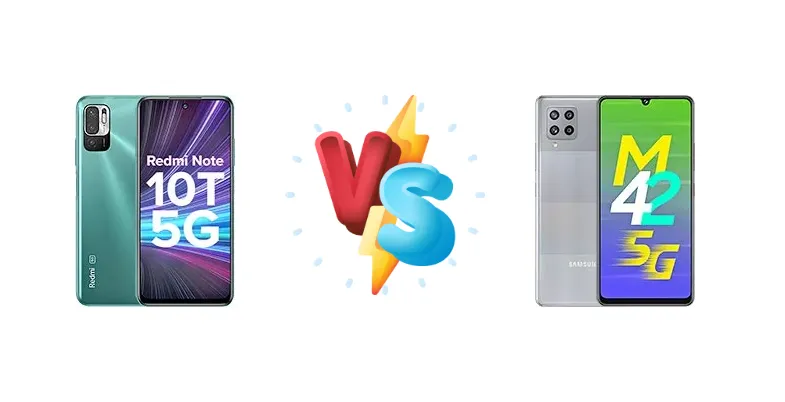
Both the Xiaomi Redmi Note 10T 5G and the Samsung Galaxy M42 5G represent compelling options in the increasingly competitive budget 5G smartphone market. While both aim to deliver 5G connectivity at an accessible price point, they achieve this through different chipsets and design philosophies. This comparison dissects their key specifications to determine which device offers the best overall experience.
🏆 Quick Verdict
For the average user prioritizing consistent performance and a slightly faster charging experience, the Xiaomi Redmi Note 10T 5G emerges as the winner. Its Mediatek Dimensity 700, built on a 7nm process, offers a slight edge in efficiency and real-world responsiveness compared to the Samsung's Snapdragon 750G, despite the latter's 8nm fabrication.
| Network |
|---|
| 2G bands | GSM 850 / 900 / 1800 / 1900 | GSM 850 / 900 / 1800 / 1900 |
| 3G bands | HSDPA 850 / 900 / 1900 / 2100 | HSDPA 850 / 900 / 1700(AWS) / 1900 / 2100 |
| 4G bands | 1, 3, 5, 8, 40, 41 | 1, 2, 3, 4, 5, 7, 8, 12, 17, 20, 28, 38, 40, 41 |
| 5G bands | 1, 3, 40, 77, 78 SA/NSA | 1, 3, 5, 7, 8, 28, 40, 41, 78 SA/NSA/Sub6 |
| Speed | HSPA, LTE, 5G | HSPA, LTE, 5G |
| Technology | GSM / HSPA / LTE / 5G | GSM / HSPA / LTE / 5G |
| Launch |
|---|
| Announced | 2021, July 20 | 2021, April 28 |
| Status | Available. Released 2021, July 26 | Available. Released 2021, May 01 |
| Body |
|---|
| Build | Glass front (Gorilla Glass 3), plastic back, plastic frame | - |
| Dimensions | 161.8 x 75.4 x 8.9 mm (6.37 x 2.97 x 0.35 in) | 164.4 x 75.9 x 8.6 mm (6.47 x 2.99 x 0.34 in) |
| SIM | Nano-SIM + Nano-SIM | Nano-SIM + Nano-SIM |
| Weight | 190 g (6.70 oz) | 190 g (6.70 oz) |
| | Splash proof | - |
| Display |
|---|
| Protection | Corning Gorilla Glass 3 | - |
| Resolution | 1080 x 2400 pixels, 20:9 ratio (~405 ppi density) | 720 x 1600 pixels, 20:9 ratio (~266 ppi density) |
| Size | 6.5 inches, 102.0 cm2 (~83.6% screen-to-body ratio) | 6.6 inches, 105.2 cm2 (~84.3% screen-to-body ratio) |
| Type | IPS LCD, 90Hz, 400 nits (typ), 500 nits (HBM) | Super AMOLED |
| Platform |
|---|
| CPU | Octa-core (2x2.2 GHz Cortex-A76 & 6x2.0 GHz Cortex-A55) | Octa-core (2x2.2 GHz Kryo 570 & 6x1.8 GHz Kryo 570) |
| Chipset | Mediatek Dimensity 700 (7 nm) | Qualcomm SM7225 Snapdragon 750G 5G (8 nm) |
| GPU | Mali-G57 MC2 | Adreno 619 |
| OS | Android 11, MIUI 12 | Android 11, upgradable to Android 13, One UI 5.1 |
| Memory |
|---|
| Card slot | microSDXC (uses shared SIM slot) | microSDXC (uses shared SIM slot) |
| Internal | 64GB 4GB RAM, 128GB 4GB RAM, 128GB 6GB RAM | 128GB 6GB RAM, 128GB 8GB RAM |
| | UFS 2.2 | UFS 2.1 |
| Main Camera |
|---|
| Features | LED flash, HDR, panorama | LED flash, panorama, HDR |
| Quad | - | 48 MP, f/1.8, (wide), 1/2.0", 0.8µm, PDAF
8 MP, f/2.2, 123˚ (ultrawide)
5 MP (macro)
Auxiliary lens |
| Single | 8 MP, f/2.0, (wide) | 20 MP, f/2.2, (wide) |
| Triple | 48 MP, f/1.8, 26mm (wide), 1/2.0", 0.8µm, PDAF
2 MP (macro)
Auxiliary lens | - |
| Video | 1080p@30fps | 4K@30fps, 1080p@30fps, 720p@480fps |
| Selfie camera |
|---|
| Features | HDR | HDR |
| Single | 8 MP, f/2.0, (wide) | 20 MP, f/2.2, (wide) |
| Video | 1080p@30fps | 1080p@30fps |
| Sound |
|---|
| 3.5mm jack | Yes | Yes |
| 35mm jack | Yes | Yes |
| Loudspeaker | Yes | Yes |
| | 24-bit/192kHz audio | - |
| Comms |
|---|
| Bluetooth | 5.1, A2DP, LE | 5.0, A2DP, LE |
| Infrared port | Yes | - |
| NFC | No | Yes |
| Positioning | GPS, GLONASS, BDS | GPS, GLONASS, GALILEO, BDS |
| Radio | FM radio | FM radio |
| USB | USB Type-C 2.0 | USB Type-C 2.0, OTG |
| WLAN | Wi-Fi 802.11 a/b/g/n/ac, dual-band, Wi-Fi Direct | Wi-Fi 802.11 a/b/g/n/ac, dual-band, Wi-Fi Direct |
| Features |
|---|
| Sensors | Fingerprint (side-mounted), accelerometer, gyro, proximity, compass | Fingerprint (under display, optical), accelerometer, gyro, compass |
| | - | Virtual proximity sensing |
| Battery |
|---|
| Charging | 18W wired | 15W wired |
| Type | Li-Po 5000 mAh | Li-Po 5000 mAh |
| Misc |
|---|
| Colors | Metallic Blue, Mint Green, Chromium White, Graphite Black | Prism Dot Black, Prism Dot Gray |
| Models | M2103K19I, M2103K19Y | SM-M426B, SM-M426B/DS |
| Price | About 170 EUR | About 220 EUR |
| SAR | 0.86 W/kg (head) 0.80 W/kg (body) | 0.69 W/kg (head) |
Xiaomi Redmi Note 10T 5G
- Faster 18W charging for quicker top-ups.
- More power-efficient Dimensity 700 chipset (7nm).
- Potentially smoother performance in demanding tasks.
- Qualcomm's 5G modem potentially offers wider carrier support.
- Xiaomi's MIUI software can be polarizing.
Samsung Galaxy M42 5G
- Samsung's One UI offers a refined software experience.
- Qualcomm's 5G modem for potentially better network compatibility.
- Samsung's brand recognition and support network.
- Slower 15W charging.
- Snapdragon 750G (8nm) is less power efficient than Dimensity 700.
Display Comparison
Neither device boasts a particularly standout display. While specific panel details (like peak brightness or color gamut coverage) are absent, the focus here is on the underlying processors. Display quality is likely similar, leaning towards adequate for the price point. Bezels are expected to be comparable, typical of this segment. The absence of high refresh rate panels on both devices suggests a focus on power efficiency rather than visual fluidity.
Camera Comparison
Without detailed camera specs beyond the chipsets, a direct comparison is limited. Both phones likely employ similar sensor configurations targeting the budget segment. Image processing will be a key differentiator, with Samsung's software typically emphasizing vibrant colors and contrast, while Xiaomi often aims for a more natural look. The absence of Optical Image Stabilization (OIS) on either device suggests reliance on software stabilization, which may struggle in low-light conditions. The usefulness of any 2MP macro lenses included on either phone is questionable, offering limited detail and dynamic range.
Performance
The core difference lies in the chipsets: the Redmi Note 10T 5G utilizes the Mediatek Dimensity 700 (7nm), while the Galaxy M42 5G features the Qualcomm Snapdragon 750G (8nm). The 7nm process of the Dimensity 700 generally translates to better power efficiency, potentially leading to longer battery life under sustained load. While both CPUs feature a 2x2.2 GHz core configuration, the Cortex-A76 cores in the Dimensity 700 are generally considered slightly more performant than the Kryo 570 cores in the Snapdragon 750G. This difference, though subtle, can be noticeable in demanding applications and multitasking. The Snapdragon 750G benefits from Qualcomm's optimized 5G modem, potentially offering wider carrier compatibility.
Battery Life
The Redmi Note 10T 5G’s 18W charging is a clear advantage over the Galaxy M42 5G’s 15W charging. While battery capacity isn't specified, the Dimensity 700’s superior power efficiency could offset any potential capacity difference. The faster charging on the Redmi Note 10T 5G translates to quicker top-ups, reducing downtime. Expect a full charge on the Redmi Note 10T 5G to take approximately 1.5-2 hours, while the Galaxy M42 5G will likely require closer to 2-2.5 hours.
Buying Guide
Buy the Xiaomi Redmi Note 10T 5G if you need a phone that feels consistently responsive for everyday tasks and light gaming, and value a slightly faster charging speed. Buy the Samsung Galaxy M42 5G if you prioritize a potentially wider carrier compatibility with Qualcomm's modem and prefer Samsung's One UI software experience, even if it means a trade-off in raw processing power.
Frequently Asked Questions
❓ Will the Snapdragon 750G in the Galaxy M42 5G provide better 5G connectivity in areas with limited network infrastructure?
Qualcomm's 5G modems are generally known for their robust connectivity and compatibility with a wider range of 5G bands. This could translate to a more stable connection in areas with less-developed 5G networks, potentially offering a slight advantage over the Dimensity 700 in those specific scenarios.
❓ Does the Dimensity 700 in the Redmi Note 10T 5G struggle with sustained gaming performance due to thermal throttling?
While the Dimensity 700 is a capable chipset, prolonged gaming sessions could lead to some thermal throttling. However, the 7nm process helps mitigate this issue compared to less efficient chipsets. Expect playable frame rates in most popular titles at medium settings, but demanding games may require reduced graphics settings to maintain consistent performance.
❓ Is the difference in charging speed between 18W and 15W significant in real-world usage?
Yes, the 3W difference in charging speed is noticeable. The Redmi Note 10T 5G's 18W charging will shave off approximately 30-60 minutes from a full charge compared to the Galaxy M42 5G's 15W charging, making it more convenient for users who frequently need to top up their battery quickly.