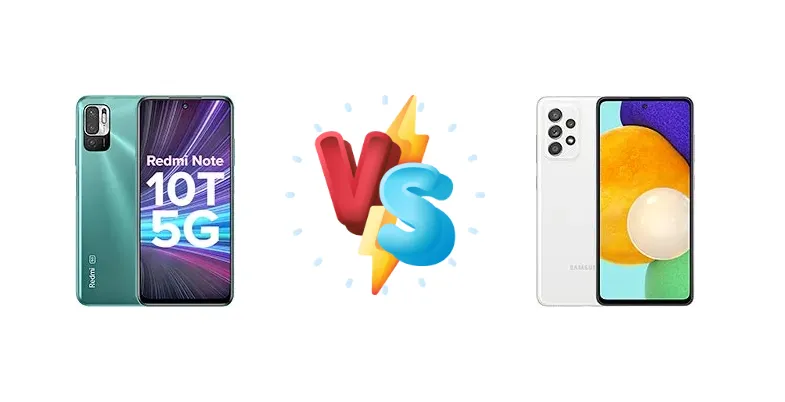
The Xiaomi Redmi Note 10T 5G and Samsung Galaxy A52 5G represent compelling options in the increasingly competitive mid-range 5G smartphone market. While both aim to deliver 5G connectivity at an accessible price point, they diverge in their core hardware choices, impacting performance, display quality, and overall user experience. This comparison dissects these differences to help you determine which device best suits your needs.
🏆 Quick Verdict
For the average user prioritizing display quality and consistent performance, the Samsung Galaxy A52 5G emerges as the stronger choice. Its brighter 787 nit display and Qualcomm Snapdragon 750G chipset offer a smoother, more refined experience, despite the Redmi Note 10T 5G’s potential for slightly lower cost.
| Network |
|---|
| 2G bands | GSM 850 / 900 / 1800 / 1900 | GSM 850 / 900 / 1800 / 1900 |
| 3G bands | HSDPA 850 / 900 / 1900 / 2100 | HSDPA 850 / 900 / 1700(AWS) / 1900 / 2100 |
| 4G bands | 1, 3, 5, 8, 40, 41 | 1, 2, 3, 4, 5, 7, 8, 12, 17, 20, 26, 28, 32, 38, 40, 41, 66 |
| 5G bands | 1, 3, 40, 77, 78 SA/NSA | 1, 3, 5, 7, 8, 20, 28, 38, 40, 41, 66, 78 SA/NSA/Sub6 |
| Speed | HSPA, LTE, 5G | HSPA, LTE, 5G |
| Technology | GSM / HSPA / LTE / 5G | GSM / HSPA / LTE / 5G |
| Launch |
|---|
| Announced | 2021, July 20 | 2021, March 17 |
| Status | Available. Released 2021, July 26 | Available. Released 2021, March 19 |
| Body |
|---|
| Build | Glass front (Gorilla Glass 3), plastic back, plastic frame | Glass front (Gorilla Glass 5), plastic back |
| Dimensions | 161.8 x 75.4 x 8.9 mm (6.37 x 2.97 x 0.35 in) | 159.9 x 75.1 x 8.4 mm (6.30 x 2.96 x 0.33 in) |
| SIM | Nano-SIM + Nano-SIM | · Nano-SIM· Nano-SIM + Nano-SIM |
| Weight | 190 g (6.70 oz) | 189 g (6.67 oz) |
| | Splash proof | IP67 dust/water resistant (up to 1m for 30 min) |
| Display |
|---|
| Protection | Corning Gorilla Glass 3 | Corning Gorilla Glass 5 |
| Resolution | 1080 x 2400 pixels, 20:9 ratio (~405 ppi density) | 1080 x 2400 pixels, 20:9 ratio (~407 ppi density) |
| Size | 6.5 inches, 102.0 cm2 (~83.6% screen-to-body ratio) | 6.5 inches, 101.0 cm2 (~84.1% screen-to-body ratio) |
| Type | IPS LCD, 90Hz, 400 nits (typ), 500 nits (HBM) | Super AMOLED, 120Hz, HDR10+, 800 nits (HBM) |
| | - | Always-on display |
| Platform |
|---|
| CPU | Octa-core (2x2.2 GHz Cortex-A76 & 6x2.0 GHz Cortex-A55) | Octa-core (2x2.2 GHz Kryo 570 & 6x1.8 GHz Kryo 570) |
| Chipset | Mediatek Dimensity 700 (7 nm) | Qualcomm SM7225 Snapdragon 750G 5G (8 nm) |
| GPU | Mali-G57 MC2 | Adreno 619 |
| OS | Android 11, MIUI 12 | Android 11, upgradable to Android 14, One UI 6.1 |
| Memory |
|---|
| Card slot | microSDXC (uses shared SIM slot) | microSDXC (uses shared SIM slot) |
| Internal | 64GB 4GB RAM, 128GB 4GB RAM, 128GB 6GB RAM | 128GB 4GB RAM, 128GB 6GB RAM, 128GB 8GB RAM, 256GB 4GB RAM, 256GB 8GB RAM |
| | UFS 2.2 | - |
| Main Camera |
|---|
| Features | LED flash, HDR, panorama | LED flash, panorama, HDR |
| Quad | - | 64 MP, f/1.8, 26mm (wide), 1/1.7X", 0.8µm, PDAF, OIS
12 MP, f/2.2, 123˚ (ultrawide), 1.12µm
5 MP (macro)
Auxiliary lens |
| Single | 8 MP, f/2.0, (wide) | - |
| Triple | 48 MP, f/1.8, 26mm (wide), 1/2.0", 0.8µm, PDAF
2 MP (macro)
Auxiliary lens | - |
| Video | 1080p@30fps | 4K@30fps, 1080p@30/60fps; gyro-EIS |
| Selfie camera |
|---|
| Features | HDR | HDR |
| Single | 8 MP, f/2.0, (wide) | 32 MP, f/2.2, 26mm (wide), 1/2.8", 0.8µm |
| Video | 1080p@30fps | 4K@30fps, 1080p@30fps |
| Sound |
|---|
| 3.5mm jack | Yes | Yes |
| 35mm jack | Yes | Yes |
| Loudspeaker | Yes | Yes, with stereo speakers |
| | 24-bit/192kHz audio | - |
| Comms |
|---|
| Bluetooth | 5.1, A2DP, LE | 5.0, A2DP, LE |
| Infrared port | Yes | - |
| NFC | No | Yes (market/region dependent) |
| Positioning | GPS, GLONASS, BDS | GPS, GLONASS, GALILEO, BDS |
| Radio | FM radio | FM radio (market/region dependent) |
| USB | USB Type-C 2.0 | USB Type-C 2.0, OTG |
| WLAN | Wi-Fi 802.11 a/b/g/n/ac, dual-band, Wi-Fi Direct | Wi-Fi 802.11 a/b/g/n/ac, dual-band, Wi-Fi Direct |
| Features |
|---|
| Sensors | Fingerprint (side-mounted), accelerometer, gyro, proximity, compass | Fingerprint (under display, optical), accelerometer, gyro, compass |
| | - | Virtual proximity sensing |
| Battery |
|---|
| Charging | 18W wired | 25W wired, 50% in 30 min |
| Type | Li-Po 5000 mAh | Li-Po 4500 mAh |
| Misc |
|---|
| Colors | Metallic Blue, Mint Green, Chromium White, Graphite Black | Awesome Black, Awesome White, Awesome Violet, Awesome Blue |
| Models | M2103K19I, M2103K19Y | SM-A526B, SM-A526B/DS, SM-A5260, SM-A526W, SM-A526U, SM-A526U1 |
| Price | About 170 EUR | $ 137.39 / £ 280.00 / € 115.49 |
| SAR | 0.86 W/kg (head) 0.80 W/kg (body) | 0.74 W/kg (head) 0.53 W/kg (body) |
| SAR EU | - | 1.05 W/kg (head) 1.42 W/kg (body) |
| Tests |
|---|
| Battery life | - |
Endurance rating 111h
|
| Camera | - |
Photo / Video |
| Display | - |
Contrast ratio: Infinite (nominal) |
| Loudspeaker | - |
-27.5 LUFS (Good)
|
| Performance | - |
AnTuTu: 334981 (v8), 386474 (v9)
GeekBench: 1820 (v5.1)
GFXBench: 16fps (ES 3.1 onscreen) |
Xiaomi Redmi Note 10T 5G
- Potentially lower price point
- 5G connectivity
- Decent CPU performance for everyday tasks
- Less efficient chipset
- Lower display brightness
- Slower charging speed
Samsung Galaxy A52 5G
- Brighter, higher-quality display
- More efficient Snapdragon 750G chipset
- Faster 25W charging
- Potentially higher price
- Similar battery endurance to Redmi Note 10T 5G
- Camera performance relies heavily on software
Display Comparison
The Samsung Galaxy A52 5G boasts a significantly brighter display, reaching a measured 787 nits, compared to the Redmi Note 10T 5G’s unspecified brightness. This difference is crucial for outdoor visibility. While both feature infinite (nominal) contrast ratios, the higher peak brightness of the A52 5G translates to a more dynamic and vivid image. The A52 5G’s panel technology, though not explicitly stated as LTPO, benefits from Samsung’s display expertise, likely offering superior color accuracy and viewing angles. The Redmi Note 10T 5G’s display specs are less detailed, suggesting a more basic panel.
Camera Comparison
Both devices offer photo and video capabilities, but detailed sensor information is lacking. The absence of specific sensor details makes a direct comparison difficult. However, Samsung’s image processing algorithms are generally more refined, potentially leading to better dynamic range and color accuracy in the A52 5G. The Redmi Note 10T 5G may rely more heavily on software enhancements to compensate for potentially less capable hardware. The presence or absence of Optical Image Stabilization (OIS) on either device is unknown, but OIS would significantly benefit low-light photography and video stabilization.
Performance
The core of the performance difference lies in the chipsets. The Samsung Galaxy A52 5G utilizes the Qualcomm SM7225 Snapdragon 750G 5G (8 nm), built on a more efficient 8nm process compared to the Mediatek Dimensity 700 (7 nm) in the Redmi Note 10T 5G. While both CPUs feature an octa-core configuration with 2x2.2 GHz prime cores, the Snapdragon 750G’s Kryo 570 cores are generally more efficient. The Redmi Note 10T 5G’s Cortex-A76 cores offer strong burst performance, but the Snapdragon 750G’s architecture is better suited for sustained workloads. The A52 5G’s likely use of faster LPDDR4X RAM further contributes to smoother multitasking.
Battery Life
Both the Redmi Note 10T 5G and Samsung Galaxy A52 5G achieve an endurance rating of 111 hours, indicating similar overall battery life. However, the charging speeds differ significantly. The Galaxy A52 5G supports 25W wired charging, achieving 50% charge in 30 minutes, while the Redmi Note 10T 5G is limited to 18W charging. This faster charging capability gives the A52 5G a practical advantage for users who need to quickly top up their battery.
Buying Guide
Buy the Xiaomi Redmi Note 10T 5G if you need a highly affordable 5G phone and are willing to compromise on display brightness and sustained performance under heavy load. Buy the Samsung Galaxy A52 5G if you prioritize a vibrant, easily viewable display, a more efficient chipset for everyday tasks, and faster charging capabilities, even if it means a slightly higher upfront cost.
Frequently Asked Questions
❓ Does the Mediatek Dimensity 700 in the Redmi Note 10T 5G struggle with graphically intensive games like PUBG?
While the Dimensity 700 can handle PUBG, you may need to lower graphics settings to maintain a stable frame rate. The Snapdragon 750G in the A52 5G offers a more consistent gaming experience at higher settings due to its more efficient architecture and potentially better thermal management.
❓ Is the 18W charging on the Redmi Note 10T 5G significantly slower in real-world use compared to the A52 5G's 25W charging?
Yes, the difference is noticeable. The A52 5G's 25W charging can get you from 0-50% in just 30 minutes, while the Redmi Note 10T 5G will take considerably longer to reach the same level, making it less convenient for users who need a quick charge.
❓ How does the image processing differ between the Redmi Note 10T 5G and the Galaxy A52 5G?
Samsung's Galaxy A52 5G typically employs more aggressive image processing, aiming for vibrant colors and enhanced detail. The Redmi Note 10T 5G may offer a more natural look, but potentially at the expense of dynamic range and sharpness in challenging lighting conditions.