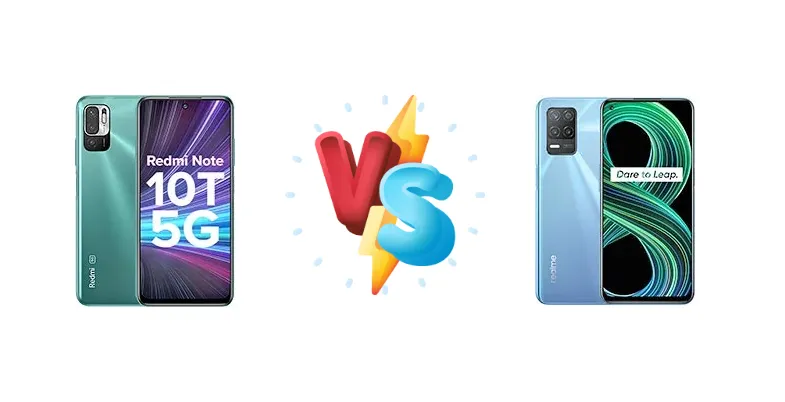
The Xiaomi Redmi Note 10T 5G and Realme 8 5G represent the accessible end of the 5G smartphone market. Both devices leverage the Mediatek Dimensity 700 chipset, aiming to deliver next-generation connectivity without a flagship price tag. This comparison dissects their similarities and differences to determine which phone offers the most compelling package for budget-conscious consumers.
🏆 Quick Verdict
For the average user prioritizing consistent performance and a potentially smoother software experience, the Realme 8 5G edges out the Redmi Note 10T 5G. While both share the same chipset and charging speed, the Realme 8 5G’s reported endurance rating suggests better battery optimization, making it a more reliable daily driver.
| Network |
|---|
| 2G bands | GSM 850 / 900 / 1800 / 1900 | GSM 850 / 900 / 1800 / 1900 |
| 3G bands | HSDPA 850 / 900 / 1900 / 2100 | HSDPA 800 / 850 / 900 / 1900 / 2100 |
| 4G bands | 1, 3, 5, 8, 40, 41 | 1, 2, 3, 4, 5, 7, 8, 12, 17, 18, 19, 20, 26, 28, 38, 39, 40, 41, 66 - International |
| 5G bands | 1, 3, 40, 77, 78 SA/NSA | 1, 3, 5, 7, 8, 20, 28, 38, 40, 41, 77, 78 SA/NSA - International |
| Speed | HSPA, LTE, 5G | HSPA, LTE, 5G |
| Technology | GSM / HSPA / LTE / 5G | GSM / HSPA / LTE / 5G |
| | - | 1, 28, 41, 77, 78 SA/NSA - India |
| Launch |
|---|
| Announced | 2021, July 20 | 2021, April 21 |
| Status | Available. Released 2021, July 26 | Available. Released 2021, April 28 |
| Body |
|---|
| Build | Glass front (Gorilla Glass 3), plastic back, plastic frame | Glass front, plastic frame, plastic back |
| Dimensions | 161.8 x 75.4 x 8.9 mm (6.37 x 2.97 x 0.35 in) | 162.5 x 74.8 x 8.5 mm (6.40 x 2.94 x 0.33 in) |
| SIM | Nano-SIM + Nano-SIM | Nano-SIM + Nano-SIM |
| Weight | 190 g (6.70 oz) | 185 g (6.53 oz) |
| | Splash proof | - |
| Display |
|---|
| Protection | Corning Gorilla Glass 3 | - |
| Resolution | 1080 x 2400 pixels, 20:9 ratio (~405 ppi density) | 1080 x 2400 pixels, 20:9 ratio (~405 ppi density) |
| Size | 6.5 inches, 102.0 cm2 (~83.6% screen-to-body ratio) | 6.5 inches, 102.0 cm2 (~83.9% screen-to-body ratio) |
| Type | IPS LCD, 90Hz, 400 nits (typ), 500 nits (HBM) | IPS LCD, 90Hz, 480 nits (typ), 600 nits |
| Platform |
|---|
| CPU | Octa-core (2x2.2 GHz Cortex-A76 & 6x2.0 GHz Cortex-A55) | Octa-core (2x2.2 GHz Cortex-A76 & 6x2.0 GHz Cortex-A55) |
| Chipset | Mediatek Dimensity 700 (7 nm) | Mediatek Dimensity 700 (7 nm) |
| GPU | Mali-G57 MC2 | Mali-G57 MC2 |
| OS | Android 11, MIUI 12 | Android 11, upgradable to Android 13, Realme UI 4.0 |
| Memory |
|---|
| Card slot | microSDXC (uses shared SIM slot) | microSDXC (dedicated slot) |
| Internal | 64GB 4GB RAM, 128GB 4GB RAM, 128GB 6GB RAM | 64GB 4GB RAM, 128GB 4GB RAM, 128GB 6GB RAM, 128GB 8GB RAM |
| | UFS 2.2 | UFS 2.1 |
| Main Camera |
|---|
| Features | LED flash, HDR, panorama | LED flash, HDR, panorama |
| Single | 8 MP, f/2.0, (wide) | 16 MP, f/2.1, 26mm (wide) |
| Triple | 48 MP, f/1.8, 26mm (wide), 1/2.0", 0.8µm, PDAF
2 MP (macro)
Auxiliary lens | 48 MP, f/1.8, 26mm (wide), PDAF
2 MP (macro)
Auxiliary lens |
| Video | 1080p@30fps | 1080p@30fps |
| Selfie camera |
|---|
| Features | HDR | HDR |
| Single | 8 MP, f/2.0, (wide) | 16 MP, f/2.1, 26mm (wide) |
| Video | 1080p@30fps | 1080p@30fps |
| Sound |
|---|
| 3.5mm jack | Yes | Yes |
| 35mm jack | Yes | Yes |
| Loudspeaker | Yes | Yes |
| | 24-bit/192kHz audio | 24-bit/192kHz audio |
| Comms |
|---|
| Bluetooth | 5.1, A2DP, LE | 5.1, A2DP, LE |
| Infrared port | Yes | - |
| NFC | No | Yes |
| Positioning | GPS, GLONASS, BDS | GPS, GLONASS, BDS, GALILEO, QZSS |
| Radio | FM radio | Unspecified |
| USB | USB Type-C 2.0 | USB Type-C 2.0, OTG |
| WLAN | Wi-Fi 802.11 a/b/g/n/ac, dual-band, Wi-Fi Direct | Wi-Fi 802.11 a/b/g/n/ac, dual-band, Wi-Fi Direct |
| Features |
|---|
| Sensors | Fingerprint (side-mounted), accelerometer, gyro, proximity, compass | Fingerprint (side-mounted), accelerometer, gyro, proximity, compass |
| Battery |
|---|
| Charging | 18W wired | 18W wired |
| Type | Li-Po 5000 mAh | 5000 mAh |
| Misc |
|---|
| Colors | Metallic Blue, Mint Green, Chromium White, Graphite Black | Supersonic Blue, Supersonic Black |
| Models | M2103K19I, M2103K19Y | RMX3241 |
| Price | About 170 EUR | About 170 EUR |
| SAR | 0.86 W/kg (head) 0.80 W/kg (body) | - |
| Tests |
|---|
| Battery life | - |
Endurance rating 118h
|
| Camera | - |
Photo / Video |
| Display | - |
Contrast ratio: 1413:1 (nominal) |
| Loudspeaker | - |
-27.8 LUFS (Good)
|
| Performance | - |
AnTuTu: 302059 (v8), 361505 (v9)
GeekBench: 1784 (v5.1)
GFXBench: 13fps (ES 3.1 onscreen) |
Xiaomi Redmi Note 10T 5G
- Identical Dimensity 700 chipset for 5G connectivity
- 18W fast charging for quick top-ups
- Potentially lower price point (depending on market)
- Missing battery endurance rating raises concerns about longevity
- Lack of detailed camera specifications hinders assessment
Realme 8 5G
- 118-hour endurance rating suggests excellent battery life
- Identical Dimensity 700 chipset for 5G connectivity
- 18W fast charging for quick top-ups
- Lack of detailed camera specifications hinders assessment
- Software experience may be less customizable than MIUI
Display Comparison
Both the Redmi Note 10T 5G and Realme 8 5G share a nominal contrast ratio of 1413:1, indicating similar visual depth and black levels. However, without specific brightness (nits) data, it’s difficult to assess outdoor visibility. The absence of information regarding panel technology (IPS vs AMOLED) and refresh rates further complicates a direct comparison. Users prioritizing vibrant colors and high contrast may want to seek out more detailed display testing before making a decision.
Camera Comparison
Both phones feature 'Photo / Video' capabilities, but lack specific details regarding sensor size, aperture, or optical image stabilization (OIS). This makes a meaningful camera comparison impossible based on the provided data. The presence of a 2MP macro camera on either device is unlikely to significantly impact image quality, serving primarily as a marketing feature. Image processing algorithms will be the key differentiator, but without sample images, it’s impossible to determine which phone produces more pleasing results.
Performance
The core of both devices is the Mediatek Dimensity 700 (7nm) paired with an octa-core CPU configuration – 2x2.2 GHz Cortex-A76 and 6x2.0 GHz Cortex-A55. This means raw processing power will be virtually identical for most everyday tasks and even moderate gaming. The performance bottleneck will likely be RAM speed and storage type, data not provided. Thermal management, also unstated, will determine sustained performance under load. The identical chipset suggests similar gaming capabilities, but real-world performance will depend on software optimization.
Battery Life
The Realme 8 5G boasts an endurance rating of 118 hours, a significant metric indicating battery life under typical usage. The Redmi Note 10T 5G lacks this data. Both devices utilize 18W wired charging, suggesting similar charging speeds (approximately 1.5-2 hours for a full charge). The Realme 8 5G’s higher endurance rating suggests more efficient power management, potentially translating to longer screen-on time and reduced anxiety about running out of battery during the day.
Buying Guide
Buy the Xiaomi Redmi Note 10T 5G if you need a straightforward, no-frills 5G experience and are comfortable with Xiaomi’s MIUI software. Buy the Realme 8 5G if you prefer a potentially longer-lasting battery and a cleaner, more streamlined Android experience, even if it means sacrificing some software customization options.
Frequently Asked Questions
❓ Does the Mediatek Dimensity 700 in either phone struggle with demanding games like PUBG or Call of Duty?
The Dimensity 700 is capable of running PUBG and Call of Duty, but expect to use medium graphics settings for a smooth experience. Sustained performance will depend on thermal management, which isn't specified for either device. Frame rate drops may occur during extended gaming sessions.
❓ Is the 18W charging speed sufficient, or will it take a long time to fully charge the battery?
18W charging is relatively standard for this price range. Expect a full charge to take approximately 1.5 to 2 hours. While not the fastest charging available, it's adequate for overnight charging or topping up during downtime. The Realme 8 5G's better endurance rating means you may not need to charge it as frequently.
❓ How does the software experience differ between Xiaomi's MIUI and Realme UI?
MIUI is known for its extensive customization options and feature set, but can also be perceived as bloated. Realme UI aims for a cleaner, more streamlined Android experience, closer to stock Android. Preference is subjective; MIUI offers more control, while Realme UI prioritizes simplicity.