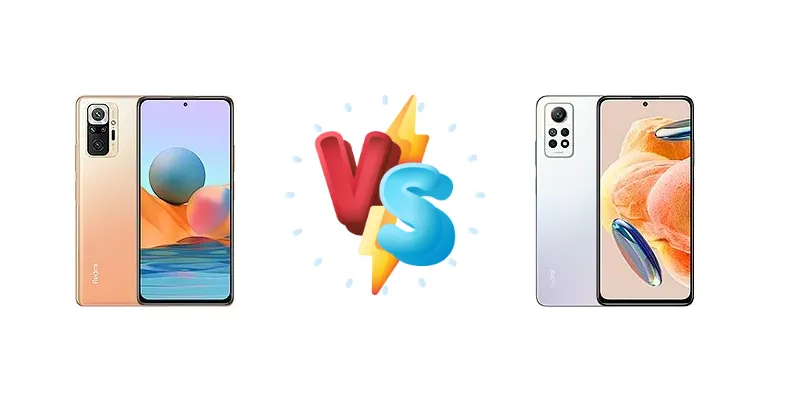
Xiaomi's Redmi Note series consistently delivers excellent value, but choosing between models can be tricky. We're pitting the Redmi Note 10 Pro Max against the Redmi Note 12 Pro 4G to determine which offers the best overall experience for your money. Let's dive into a comprehensive comparison.
🏆 Quick Verdict
The Redmi Note 12 Pro 4G edges out the 10 Pro Max primarily due to its significantly faster 67W charging. While both share the same Snapdragon 732G chipset, the 12 Pro 4G's improved charging speed and potentially updated software make it the slightly better choice for most users.
| Network |
|---|
| 2G bands | GSM 850 / 900 / 1800 / 1900 | GSM 850 / 900 / 1800 / 1900 |
| 3G bands | HSDPA 850 / 900 / 1900 / 2100 | HSDPA 850 / 900 / 1700(AWS) / 1900 / 2100 |
| 4G bands | 1, 3, 5, 7, 8, 40, 41 | 1, 2, 3, 4, 5, 7, 8, 20, 28, 38, 40, 41, 66 |
| Speed | HSPA, LTE | HSPA, LTE |
| Technology | GSM / HSPA / LTE | GSM / HSPA / LTE |
| Launch |
|---|
| Announced | 2021, March 04 | 2023, March 03 |
| Status | Available. Released 2021, March 18 | Available. Released 2023, April 11 |
| Body |
|---|
| Build | Glass front (Gorilla Glass 5), glass back | - |
| Dimensions | 164.5 x 76.2 x 8.1 mm (6.48 x 3.00 x 0.32 in) | 164.2 x 76.1 x 8.1 mm (6.46 x 3.00 x 0.32 in) |
| SIM | Nano-SIM + Nano-SIM | Nano-SIM + Nano-SIM |
| Weight | 192 g (6.77 oz) | 201.8 g (7.13 oz) |
| | IP53, dust and splash resistant | - |
| Display |
|---|
| Protection | Corning Gorilla Glass 5 | - |
| Resolution | 1080 x 2400 pixels, 20:9 ratio (~395 ppi density) | 1080 x 2400 pixels, 20:9 ratio (~395 ppi density) |
| Size | 6.67 inches, 107.4 cm2 (~85.7% screen-to-body ratio) | 6.67 inches, 107.4 cm2 (~86.0% screen-to-body ratio) |
| Type | Super AMOLED, 120Hz, HDR10, 450 nits (typ), 1200 nits (peak) | AMOLED, 120Hz, Dolby Vision, 700 nits (HBM), 1100 nits (peak) |
| Platform |
|---|
| CPU | Octa-core (2x2.3 GHz Kryo 470 Gold & 6x1.8 GHz Kryo 470 Silver) | Octa-core (2x2.2 GHz Kryo 470 Gold & 6x1.8 GHz Kryo 470 Silver) |
| Chipset | Qualcomm SM7150 Snapdragon 732G (8 nm) | Qualcomm SM7150 Snapdragon 732G (8 nm) |
| GPU | Adreno 618 | Adreno 618 |
| OS | Android 11, MIUI 12 | Android 11, MIUI 13 |
| Memory |
|---|
| Card slot | microSDXC (dedicated slot) | microSDXC (uses shared SIM slot) |
| Internal | 64GB 6GB RAM, 128GB 6GB RAM, 128GB 8GB RAM | 128GB 6GB RAM, 128GB 8GB RAM, 256GB 8GB RAM |
| | UFS 2.2 | UFS 2.2 |
| Main Camera |
|---|
| Features | LED flash, HDR, panorama | LED flash, HDR, panorama |
| Quad | 108 MP, f/1.9, 26mm (wide), 1/1.52", 0.7µm, PDAF
8 MP, f/2.2, 118˚ (ultrawide), 1/4.0", 1.12µm
5 MP (macro)
Auxiliary lens | 108 MP, f/1.9, (wide), 1/1.52", 0.7µm, PDAF
8 MP, 120˚, (ultrawide)
2 MP (macro)
Auxiliary lens |
| Video | 4K@30fps, 1080p@30/60/120fps, 720p@960fps | 4K@30fps, 1080p@30/60fps |
| Selfie camera |
|---|
| Features | Panorama | - |
| Single | 16 MP, f/2.5, (wide), 1/3.06", 1.0µm | 16 MP, f/2.4, (wide) |
| Video | 1080p@30fps | 1080p@30fps |
| Sound |
|---|
| 3.5mm jack | Yes | Yes |
| 35mm jack | Yes | Yes |
| Loudspeaker | Yes, with stereo speakers | Yes, with stereo speakers |
| | 24-bit/192kHz audio | - |
| Comms |
|---|
| Bluetooth | 5.1, A2DP, LE | 5.0, A2DP, LE |
| Infrared port | Yes | Yes |
| NFC | No | Yes (market/region dependent) |
| Positioning | GPS, GLONASS, BDS | GPS, GLONASS, GALILEO, BDS |
| Radio | Unspecified | Unspecified |
| USB | USB Type-C 2.0, OTG | USB Type-C 2.0, OTG |
| WLAN | Wi-Fi 802.11 a/b/g/n/ac, dual-band, Wi-Fi Direct | Wi-Fi 802.11 a/b/g/n/ac, dual-band |
| Features |
|---|
| Sensors | Fingerprint (side-mounted), accelerometer, gyro, proximity, compass | Fingerprint (side-mounted), accelerometer, gyro, compass |
| Battery |
|---|
| Charging | 33W wired, 60% in 30 min, 100% in 75 min | 67W wired |
| Type | Li-Po 5020 mAh | Li-Po 5000 mAh |
| Misc |
|---|
| Colors | Dark Night, Glacial Blue, Vintage Bronze | Star Blue, Graphite Gray, Polar White, Ice blue |
| Models | M2101K6I | 2209116AG, 2209116AG |
| Price | About 220 EUR | About 150 EUR |
| SAR | 0.83 W/kg (head) 0.65 W/kg (body) | - |
Xiaomi Redmi Note 10 Pro Max
- Excellent 108MP Camera
- Vibrant Super AMOLED Display
- Smooth 120Hz Refresh Rate
- Good Value for Money
- Slower 33W Charging
- Older Software Version (potentially)
- Design may feel dated
Xiaomi Redmi Note 12 Pro 4G
- Significantly Faster 67W Charging
- Potentially Newer Software Updates
- Slightly Improved Display (potentially)
- Modern Design
- Lower Resolution Main Camera (50MP)
- Performance virtually identical to 10 Pro Max
- Price may be slightly higher
Display Comparison
Both phones feature a 6.67-inch Super AMOLED display with a 120Hz refresh rate, offering vibrant colors and smooth scrolling. The Note 12 Pro 4G *may* have slightly improved brightness and color accuracy due to potential panel updates, but the difference is likely minimal. Resolution is generally FHD+ on both.
Camera Comparison
The Redmi Note 10 Pro Max typically features a 108MP main camera, an 8MP ultrawide, and a 2MP macro lens. The Redmi Note 12 Pro 4G usually has a 50MP main camera, an 8MP ultrawide, and a 2MP macro lens. While megapixels aren't everything, the 10 Pro Max's higher resolution main sensor *could* offer slightly more detail in well-lit conditions. Image processing algorithms will also play a significant role.
Performance
Both devices are powered by the Qualcomm Snapdragon 732G chipset. While the CPU clock speeds differ slightly (2.3 GHz vs 2.2 GHz for the gold cores), real-world performance will be very similar for everyday tasks and moderate gaming. The Note 12 Pro 4G might benefit from newer software optimizations.
Battery Life
The Redmi Note 10 Pro Max has a 5020mAh battery, while the Redmi Note 12 Pro 4G has a 5000mAh battery. The key difference here is charging speed: the 10 Pro Max supports 33W charging, while the 12 Pro 4G boasts 67W charging, drastically reducing charging times.
Buying Guide
The Redmi Note 10 Pro Max is a solid choice for budget-conscious buyers who prioritize a vibrant display and a capable camera system. The Redmi Note 12 Pro 4G is ideal for those who value fast charging and a more modern software experience, even if it means a slight trade-off in other areas.
Frequently Asked Questions
❓ Is the Snapdragon 732G good for gaming?
Yes, the Snapdragon 732G is capable of handling most mobile games at medium to high settings. However, don't expect flagship-level performance.
❓ Which phone has better software support?
The Redmi Note 12 Pro 4G is likely to receive more frequent software updates and security patches due to being a newer model.