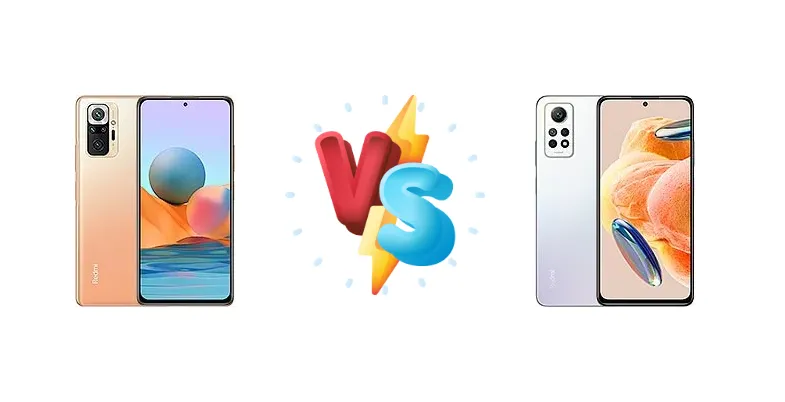
The Xiaomi Redmi Note series consistently delivers excellent value, and the Note 10 Pro and Note 12 Pro 4G are prime examples. But with subtle differences, which one should you choose? This comprehensive comparison will help you decide based on your needs and budget.
🏆 Quick Verdict
The Redmi Note 12 Pro 4G takes the win thanks to its significantly faster 67W charging and potentially improved camera software. However, the Note 10 Pro remains a strong contender, especially if you find it at a discounted price, offering similar performance and a great display.
| Network |
|---|
| 2G bands | GSM 850 / 900 / 1800 / 1900 | GSM 850 / 900 / 1800 / 1900 |
| 3G bands | HSDPA 850 / 900 / 1900 / 2100 | HSDPA 850 / 900 / 1700(AWS) / 1900 / 2100 |
| 4G bands | 1, 3, 5, 7, 8, 40, 41 | 1, 2, 3, 4, 5, 7, 8, 20, 28, 38, 40, 41, 66 |
| Speed | HSPA, LTE | HSPA, LTE |
| Technology | GSM / HSPA / LTE | GSM / HSPA / LTE |
| Launch |
|---|
| Announced | 2021, March 04 | 2023, March 03 |
| Status | Available. Released 2021, March 17 | Available. Released 2023, April 11 |
| Body |
|---|
| Dimensions | 164.5 x 76.2 x 8.1 mm (6.48 x 3.00 x 0.32 in) | 164.2 x 76.1 x 8.1 mm (6.46 x 3.00 x 0.32 in) |
| SIM | Nano-SIM + Nano-SIM | Nano-SIM + Nano-SIM |
| Weight | 192 g (6.77 oz) | 201.8 g (7.13 oz) |
| Display |
|---|
| Protection | Corning Gorilla Glass 5 | - |
| Resolution | 1080 x 2400 pixels, 20:9 ratio (~395 ppi density) | 1080 x 2400 pixels, 20:9 ratio (~395 ppi density) |
| Size | 6.67 inches, 107.4 cm2 (~85.7% screen-to-body ratio) | 6.67 inches, 107.4 cm2 (~86.0% screen-to-body ratio) |
| Type | Super AMOLED, 120Hz, HDR10, 450 nits (typ), 1200 nits (peak) | AMOLED, 120Hz, Dolby Vision, 700 nits (HBM), 1100 nits (peak) |
| Platform |
|---|
| CPU | Octa-core (2x2.3 GHz Kryo 470 Gold & 6x1.8 GHz Kryo 470 Silver) | Octa-core (2x2.2 GHz Kryo 470 Gold & 6x1.8 GHz Kryo 470 Silver) |
| Chipset | Qualcomm SM7150 Snapdragon 732G (8 nm) | Qualcomm SM7150 Snapdragon 732G (8 nm) |
| GPU | Adreno 618 | Adreno 618 |
| OS | Android 11, MIUI 12 | Android 11, MIUI 13 |
| Memory |
|---|
| Card slot | microSDXC (dedicated slot) | microSDXC (uses shared SIM slot) |
| Internal | 64GB 6GB RAM, 128GB 6GB RAM, 128GB 8GB RAM | 128GB 6GB RAM, 128GB 8GB RAM, 256GB 8GB RAM |
| | UFS 2.2 | UFS 2.2 |
| Main Camera |
|---|
| Features | LED flash, HDR, panorama | LED flash, HDR, panorama |
| Quad | 64 MP, f/1.9, 26mm (wide), 1/1.97", 0.7µm, PDAF
8 MP, f/2.2, 118˚ (ultrawide), 1/4.0", 1.12µm
5 MP (macro)
Auxiliary lens | 108 MP, f/1.9, (wide), 1/1.52", 0.7µm, PDAF
8 MP, 120˚, (ultrawide)
2 MP (macro)
Auxiliary lens |
| Single | 16 MP, f/2.5, (wide), 1/3.06", 1.0µm | - |
| Video | 4K@30fps, 1080p@30/60/120fps, 720p@960fps | 4K@30fps, 1080p@30/60fps |
| Selfie camera |
|---|
| Features | Panorama | - |
| Single | 16 MP, f/2.5, (wide), 1/3.06", 1.0µm | 16 MP, f/2.4, (wide) |
| Video | 1080p@30fps | 1080p@30fps |
| Sound |
|---|
| 3.5mm jack | Yes | Yes |
| 35mm jack | Yes | Yes |
| Loudspeaker | Yes, with stereo speakers | Yes, with stereo speakers |
| | 24-bit/192kHz audio | - |
| Comms |
|---|
| Bluetooth | 5.1, A2DP, LE | 5.0, A2DP, LE |
| Infrared port | Yes | Yes |
| NFC | No | Yes (market/region dependent) |
| Positioning | GPS, GLONASS, BDS | GPS, GLONASS, GALILEO, BDS |
| Radio | Unspecified | Unspecified |
| USB | USB Type-C 2.0 | USB Type-C 2.0, OTG |
| WLAN | Wi-Fi 802.11 a/b/g/n/ac, dual-band, Wi-Fi Direct | Wi-Fi 802.11 a/b/g/n/ac, dual-band |
| Features |
|---|
| Sensors | Fingerprint (side-mounted), accelerometer, gyro, proximity, compass | Fingerprint (side-mounted), accelerometer, gyro, compass |
| Battery |
|---|
| Charging | 33W wired, 57% in 30 min, 100% in 74 min | 67W wired |
| Type | Li-Po 5020 mAh | Li-Po 5000 mAh |
| Misc |
|---|
| Colors | Vintage Bronze, Glacial Blue, Dark Night | Star Blue, Graphite Gray, Polar White, Ice blue |
| Models | M2101K6P | 2209116AG, 2209116AG |
| Price | About 180 EUR | About 150 EUR |
| SAR | 0.83 W/kg (head) 0.65 W/kg (body) | - |
Xiaomi Redmi Note 10 Pro (India)
- Excellent AMOLED display
- Reliable performance
- Good value for money (especially at discounted prices)
- Capable camera system
- Slower charging speed
- Older software version
Xiaomi Redmi Note 12 Pro 4G
- Faster 67W charging
- Potentially improved camera software
- Slightly newer design
- Good performance
- May be slightly more expensive
- Similar chipset to Note 10 Pro
Display Comparison
Both phones feature a 6.67-inch Super AMOLED display with a 120Hz refresh rate, offering vibrant colors and smooth scrolling. The Note 12 Pro 4G *may* have slightly improved brightness and color accuracy, but the difference is likely minimal for most users. Resolution is likely FHD+ on both.
Camera Comparison
The Note 10 Pro typically features a 108MP main camera, an 8MP ultrawide, and a 2MP macro lens. The Note 12 Pro 4G is expected to have a similar setup, but Xiaomi often improves image processing with software updates. Expect slightly better low-light performance and dynamic range on the Note 12 Pro 4G. Both have a 16MP front camera.
Performance
Both devices utilize the Snapdragon 732G chipset, meaning core performance will be very similar. Expect smooth multitasking and capable gaming at medium settings. The Note 12 Pro 4G *might* benefit from slightly optimized software, but the difference won't be drastic.
Battery Life
The Note 10 Pro has a 5020mAh battery, while the Note 12 Pro 4G has a 5000mAh battery. The key difference is charging speed: 33W on the Note 10 Pro versus 67W on the Note 12 Pro 4G. This means the Note 12 Pro 4G can charge significantly faster.
Buying Guide
The Redmi Note 10 Pro is ideal for users prioritizing a vibrant display and reliable performance at a potentially lower price point. The Redmi Note 12 Pro 4G is better suited for those who value fast charging and potentially a slightly enhanced camera experience, willing to pay a bit more.
Frequently Asked Questions
❓ Is the Snapdragon 732G good for gaming?
Yes, the Snapdragon 732G is capable of handling most games at medium settings. Don't expect high frame rates on demanding titles, but it's perfectly adequate for casual and mid-core gaming.
❓ Which phone has better software support?
The Redmi Note 12 Pro 4G is likely to receive longer software support and updates due to being a newer model. However, Xiaomi's update track record is generally good for both devices.