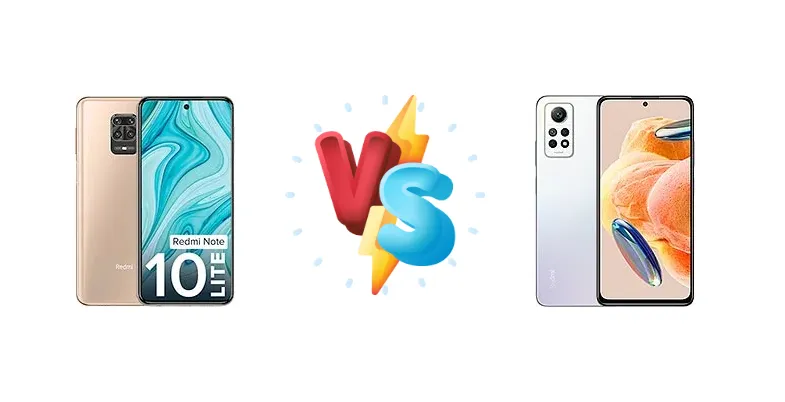
The Xiaomi Redmi Note series consistently delivers excellent value for money. But with new models arriving, choosing the right one can be tricky. We're pitting the Redmi Note 10 Lite against the newer Redmi Note 12 Pro 4G to see which offers the best overall package.
🏆 Quick Verdict
The Redmi Note 12 Pro 4G is the clear winner thanks to its significantly faster charging, improved chipset, and likely camera upgrades. While the Note 10 Lite remains a capable budget option, the 12 Pro 4G offers a noticeable step up in performance and features for a reasonable price increase.
| Network |
|---|
| 2G bands | GSM 850 / 900 / 1800 / 1900 | GSM 850 / 900 / 1800 / 1900 |
| 3G bands | HSDPA 850 / 900 / 1700(AWS) / 1900 / 2100 | HSDPA 850 / 900 / 1700(AWS) / 1900 / 2100 |
| 4G bands | 1, 2, 3, 4, 5, 7, 8, 20, 28, 38, 40, 41 | 1, 2, 3, 4, 5, 7, 8, 20, 28, 38, 40, 41, 66 |
| Speed | HSPA, LTE | HSPA, LTE |
| Technology | GSM / HSPA / LTE | GSM / HSPA / LTE |
| Launch |
|---|
| Announced | 2021, October 01 | 2023, March 03 |
| Status | Available. Released 2021, October 02 | Available. Released 2023, April 11 |
| Body |
|---|
| Build | Glass front (Gorilla Glass 5), glass back (Gorilla Glass 5), plastic frame | - |
| Dimensions | 165.8 x 76.7 x 8.8 mm (6.53 x 3.02 x 0.35 in) | 164.2 x 76.1 x 8.1 mm (6.46 x 3.00 x 0.32 in) |
| SIM | Nano-SIM + Nano-SIM | Nano-SIM + Nano-SIM |
| Weight | 209 g (7.37 oz) | 201.8 g (7.13 oz) |
| | Water-repellent coating | - |
| Display |
|---|
| Protection | Corning Gorilla Glass 5 | - |
| Resolution | 1080 x 2400 pixels, 20:9 ratio (~395 ppi density) | 1080 x 2400 pixels, 20:9 ratio (~395 ppi density) |
| Size | 6.67 inches, 107.4 cm2 (~84.5% screen-to-body ratio) | 6.67 inches, 107.4 cm2 (~86.0% screen-to-body ratio) |
| Type | IPS LCD | AMOLED, 120Hz, Dolby Vision, 700 nits (HBM), 1100 nits (peak) |
| Platform |
|---|
| CPU | Octa-core (2x2.3 GHz Kryo 465 Gold & 6x1.8 GHz Kryo 465 Silver) | Octa-core (2x2.2 GHz Kryo 470 Gold & 6x1.8 GHz Kryo 470 Silver) |
| Chipset | Qualcomm SM7125 Snapdragon 720G (8 nm) | Qualcomm SM7150 Snapdragon 732G (8 nm) |
| GPU | Adreno 618 | Adreno 618 |
| OS | Android 10, MIUI 11 | Android 11, MIUI 13 |
| Memory |
|---|
| Card slot | microSDXC (dedicated slot) | microSDXC (uses shared SIM slot) |
| Internal | 64GB 4GB RAM, 64GB 6GB RAM, 128GB 4GB RAM, 128GB 6GB RAM | 128GB 6GB RAM, 128GB 8GB RAM, 256GB 8GB RAM |
| | - | UFS 2.2 |
| Main Camera |
|---|
| Features | LED flash, HDR, panorama | LED flash, HDR, panorama |
| Quad | 48 MP, f/1.9, 26mm (wide), 0.8µm, PDAF
8 MP, f/2.2, 119˚ (ultrawide), 1/4.0", 1.12µm
5 MP (macro), AF
Auxiliary lens | 108 MP, f/1.9, (wide), 1/1.52", 0.7µm, PDAF
8 MP, 120˚, (ultrawide)
2 MP (macro)
Auxiliary lens |
| Single | 16 MP, f/2.5, (wide), 1/3.06", 1.0µm | - |
| Video | 4K@30fps, 1080p@30/60/120fps, 720p@960fps, gyro-EIS | 4K@30fps, 1080p@30/60fps |
| Selfie camera |
|---|
| Features | HDR, panorama | - |
| Single | 16 MP, f/2.5, (wide), 1/3.06", 1.0µm | 16 MP, f/2.4, (wide) |
| Video | 1080p@30fps | 1080p@30fps |
| Sound |
|---|
| 3.5mm jack | Yes | Yes |
| 35mm jack | Yes | Yes |
| Loudspeaker | Yes | Yes, with stereo speakers |
| Comms |
|---|
| Bluetooth | 5.0, A2DP, LE | 5.0, A2DP, LE |
| Infrared port | Yes | Yes |
| NFC | Yes | Yes (market/region dependent) |
| Positioning | GPS, GLONASS, GALILEO, BDS, NavIC | GPS, GLONASS, GALILEO, BDS |
| Radio | FM radio, recording | Unspecified |
| USB | USB Type-C 2.0 | USB Type-C 2.0, OTG |
| WLAN | Wi-Fi 802.11 a/b/g/n/ac, dual-band, Wi-Fi Direct | Wi-Fi 802.11 a/b/g/n/ac, dual-band |
| Features |
|---|
| Sensors | Fingerprint (side-mounted), accelerometer, gyro, proximity, compass | Fingerprint (side-mounted), accelerometer, gyro, compass |
| Battery |
|---|
| Charging | 18W wired | 67W wired |
| Type | Li-Po 5020 mAh | Li-Po 5000 mAh |
| Misc |
|---|
| Colors | Aurora Blue, Glacier White, Interstellar Black, Champagne Gold | Star Blue, Graphite Gray, Polar White, Ice blue |
| Models | M2002F4LG | 2209116AG, 2209116AG |
| Price | About 200 EUR | About 150 EUR |
| SAR | 1.17 W/kg (head) 0.86 W/kg (body) | - |
| SAR EU | 1.01 W/kg (head) 1.39 W/kg (body) | - |
Xiaomi Redmi Note 10 Lite
- Large display
- Good value for money
- Decent performance for everyday tasks
- AMOLED display (likely)
- Slow charging
- Older chipset
- Camera performance could be better
- 60Hz refresh rate
Xiaomi Redmi Note 12 Pro 4G
- Fast charging (67W)
- Improved chipset (Snapdragon 732G)
- Potentially better camera
- Likely 120Hz refresh rate
- Slightly higher price
- IPS LCD display (potentially)
- May lack some features of higher-end models
Display Comparison
Both phones feature a large 6.67-inch display, likely with a Full HD+ resolution. However, the Note 12 Pro 4G may have a slightly improved panel with better color accuracy and brightness. The Note 10 Lite likely uses an AMOLED panel, while the 12 Pro 4G may use an IPS LCD, though this can vary by region. Refresh rate is likely 120Hz on the 12 Pro 4G and 60Hz on the 10 Lite.
Camera Comparison
While both phones have a quad-camera setup, the Note 12 Pro 4G likely boasts improvements in image processing and sensor technology. Expect better low-light performance, more detailed photos, and potentially improved video recording capabilities on the 12 Pro 4G. The Note 10 Lite's main sensor is likely 64MP, while the 12 Pro 4G could have a 50MP or 108MP sensor.
Performance
The Snapdragon 732G in the Redmi Note 12 Pro 4G offers a noticeable performance boost over the Snapdragon 720G in the Note 10 Lite. Expect smoother multitasking, faster app loading times, and better gaming performance on the 12 Pro 4G. Both phones have ample RAM options, but the newer chipset makes a significant difference.
Battery Life
The Redmi Note 12 Pro 4G's 67W fast charging is a game-changer compared to the Note 10 Lite's 18W charging. You can expect a full charge in around 40 minutes on the 12 Pro 4G, while the Note 10 Lite will take significantly longer. Both phones likely have a similar battery capacity (around 5000mAh), but the faster charging makes a huge difference in convenience.
Buying Guide
The Xiaomi Redmi Note 10 Lite is a good choice for budget-conscious users who prioritize a large display and don't need the absolute latest performance. The Xiaomi Redmi Note 12 Pro 4G is ideal for those seeking faster charging, a more powerful processor, and potentially better camera capabilities, even if it means spending a bit more.
Frequently Asked Questions
❓ Is the Redmi Note 12 Pro 4G worth the upgrade from the Note 10 Lite?
Yes, if you value faster charging, improved performance, and potentially better camera quality. The upgrade is noticeable, especially in day-to-day usage.
❓ What type of display does each phone have?
The Redmi Note 10 Lite likely has an AMOLED display, while the Redmi Note 12 Pro 4G may have an IPS LCD display, though this can vary by region. Check the specific model details for confirmation.