
Xiaomi Redmi K90 vs. Xiaomi 12 Lite: A Head-to-Head Comparison of Power and Efficiency
| Phones Images | |||||
|---|---|---|---|---|---|
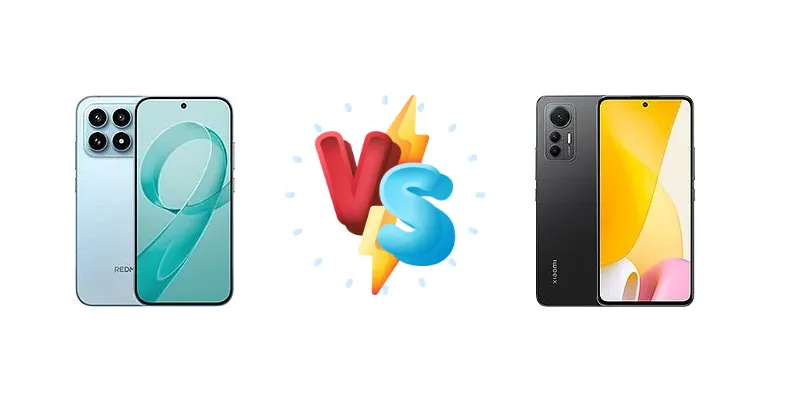
|
🏆 Quick Verdict
For users prioritizing raw performance and future-proofing, the Xiaomi Redmi K90 is the clear winner. Its Snapdragon 8 Elite chipset delivers significantly faster processing speeds. However, the Xiaomi 12 Lite remains a compelling option for those valuing a refined design and solid all-around experience without the flagship price tag.
| PHONES | ||
|---|---|---|
| Phone Names | Xiaomi Redmi K90 | Xiaomi 12 Lite |
| Network | ||
|---|---|---|
| 2G bands | GSM 850 / 900 / 1800 / 1900 | GSM 850 / 900 / 1800 / 1900 |
| 3G bands | HSDPA 800 / 850 / 900 / 1700(AWS) / 1900 / 2100 | HSDPA 850 / 900 / 1700(AWS) / 1900 / 2100 |
| 4G bands | 1, 3, 4, 5, 7, 8, 19, 28, 34, 38, 39, 40, 41, 42, 48, 66 | 1, 2, 3, 4, 5, 7, 8, 12, 13, 17, 18, 19, 20, 26, 28, 32, 38, 40, 41, 42, 48, 66 |
| 5G bands | 1, 3, 5, 7, 8, 28, 66, 38, 40, 41, 48, 77, 78 SA/NSA | 1, 3, 5, 7, 8, 20, 28, 38, 40, 41, 66, 77, 78 SA/NSA |
| Speed | HSPA, LTE, 5G | HSPA, LTE, 5G |
| Technology | GSM / HSPA / LTE / 5G | GSM / HSPA / LTE / 5G |
| Launch | ||
|---|---|---|
| Announced | 2025, October 23 | 2022, July 09 |
| Status | Available. Released 2025, October 23 | Available. Released 2022, July 11 |
| Body | ||
|---|---|---|
| Build | Glass front, aluminum frame | Glass front (Gorilla Glass 5), glass back, plastic frame |
| Dimensions | 157.5 x 75.3 x 8 mm (6.20 x 2.96 x 0.31 in) | 159.3 x 73.7 x 7.3 mm (6.27 x 2.90 x 0.29 in) |
| SIM | Nano-SIM + Nano-SIM | Nano-SIM + Nano-SIM |
| Weight | 206 g (7.27 oz) | 173 g (6.10 oz) |
| Display | ||
|---|---|---|
| Protection | - | Corning Gorilla Glass 5 |
| Resolution | 1156 x 2510 pixels, 19.5:9 ratio (~419 ppi density) | 1080 x 2400 pixels, 20:9 ratio (~402 ppi density) |
| Size | 6.59 inches, 106.5 cm2 (~89.8% screen-to-body ratio) | 6.55 inches, 103.6 cm2 (~88.2% screen-to-body ratio) |
| Type | AMOLED, 68B colors, 2560Hz PWM, 120Hz, Dolby Vision, HDR Vivid, HDR10+, 3500 nits (peak) | AMOLED, 68B colors, 120Hz, Dolby Vision, HDR10+, 950 nits (peak) |
| Platform | ||
|---|---|---|
| CPU | Octa-core (2x4.32 GHz Oryon V2 Phoenix L + 6x3.53 GHz Oryon V2 Phoenix M) | Octa-core (1x2.4 GHz Cortex-A78 & 3x2.2 GHz Cortex-A78 & 4x1.9 GHz Cortex-A55) |
| Chipset | Qualcomm SM8750-AB Snapdragon 8 Elite (3 nm) | Qualcomm SM7325 Snapdragon 778G 5G (6 nm) |
| GPU | Adreno 830 | Adreno 642L |
| OS | Android 16, HyperOS 3 | Android 12, upgradable to Android 14, HyperOS |
| Memory | ||
|---|---|---|
| Card slot | No | No |
| Internal | 256GB 12GB RAM, 512GB 12GB RAM, 512GB 16GB RAM, 1TB 16GB RAM | 128GB 6GB RAM, 128GB 8GB RAM, 256GB 8GB RAM |
| - | UFS 2.2 | |
| Main Camera | ||
|---|---|---|
| Features | Color spectrum sensor, LED flash, HDR, panorama | Dual-LED dual-tone flash, HDR, panorama |
| Single | - | 32 MP, f/2.5, (wide), 1/2.8", 0.8µm, AF |
| Triple | 50 MP, f/1.9, 24mm (wide), 1/1.55", 1.0µm, PDAF, OIS 50 MP, f/2.2, 60mm (telephoto), PDAF, 2.5x optical zoom 8 MP, f/2.2, 15mm, 120˚ (ultrawide) | 108 MP, f/1.9, 26mm (wide), 1/1.52", 0.7µm, PDAF 8 MP, f/2.2, 120˚ (ultrawide), 1/4.0", 1.12µm 2 MP (macro) |
| Video | 8K@30fps, 4K@30/60fps, 1080p@30/60/120/240/960fps, gyro-EIS, HDR10+ | 4K@30fps, 1080p@30/60/120fps; gyro-EIS |
| Selfie camera | ||
|---|---|---|
| Features | - | HDR, panorama |
| Single | 20 MP, (wide), 1/2.0", 0.8µm | 32 MP, f/2.5, (wide), 1/2.8", 0.8µm, AF |
| Video | 1080p@30/60fps | 1080p@30/60fps, 720p@120fps |
| Sound | ||
|---|---|---|
| 3.5mm jack | - | No |
| 35mm jack | No | No |
| Loudspeaker | Yes, with stereo speakers | Yes, with dual speakers |
| - | 24-bit/192kHz audio | |
| Comms | ||
|---|---|---|
| Bluetooth | 5.4, A2DP, LE, LHDC 5.0, ASHA | 5.2, A2DP, LE, aptX HD, aptX Adaptive |
| Infrared port | Yes | Yes |
| NFC | Yes | Yes (market/region dependent) |
| Positioning | GPS (L1+L5), BDS (B1I+B1c+B2a), GALILEO (E1+E5a), QZSS (L1+L5), NavIC, GLONASS | GPS (L1), GLONASS (G1), BDS (B1I+B1c), GALILEO (E1), QZSS (L1) |
| Radio | No | No |
| USB | USB Type-C, OTG | USB Type-C 2.0, OTG |
| WLAN | Wi-Fi 802.11 a/b/g/n/ac/6/7, dual-band, Wi-Fi Direct | Wi-Fi 802.11 a/b/g/n/ac/6, dual-band, Wi-Fi Direct |
| Features | ||
|---|---|---|
| Sensors | Fingerprint (under display, ultrasonic), accelerometer, gyro, proximity, compass | Fingerprint (under display, optical), accelerometer, gyro, compass |
| - | Virtual proximity sensing | |
| Battery | ||
|---|---|---|
| Charging | 100W wired, PD3.0, QC3+, 100W PPS 22.5W reverse wired | 67W wired, PD3.0, QC4, 50% in 13 min |
| Type | Si/C Li-Po 7100 mAh | Li-Po 4300 mAh |
| Misc | ||
|---|---|---|
| Colors | Black, White, Blue, Purple | Black, Lite Green, Lite Pink |
| Models | 2510DRK44C | 2203129G |
| Price | About 350 EUR | € 119.80 / $ 269.00 / £ 121.15 |
| SAR | - | 1.09 W/kg (head) 0.73 W/kg (body) |
| SAR EU | - | 0.60 W/kg (head) 1.00 W/kg (body) |
| Tests | ||
|---|---|---|
| Battery life | - | Endurance rating 100h |
| Camera | - | Photo / Video |
| Display | - | Contrast ratio: Infinite (nominal) |
| Loudspeaker | - | -25.2 LUFS (Very good) |
| Performance | - | AnTuTu: 528905 (v9) GeekBench: 2943 (v5.1) GFXBench: 29fps (ES 3.1 onscreen) |
Xiaomi Redmi K90
- Significantly faster processor with Snapdragon 8 Elite
- Ultra-fast 100W charging
- Potentially superior camera performance
- Likely higher price point
- Potential for increased heat generation under heavy load
Xiaomi 12 Lite
- Sleek and lightweight design
- Good battery endurance (100h)
- Competitive price
- Less powerful processor (Snapdragon 778G)
- Slower charging speed (67W)
Display Comparison
The Xiaomi 12 Lite boasts a measured peak brightness of 824 nits, providing good visibility outdoors. However, the Redmi K90, while lacking specific brightness data, likely surpasses this due to its flagship positioning. Both phones feature an 'Infinite' (nominal) contrast ratio, typical of OLED panels. The K90’s potential for a higher refresh rate (likely 120Hz or higher, based on its segment) would offer smoother scrolling and animations compared to the 12 Lite, assuming the latter is limited to 60Hz. The K90’s display tech is likely to be more advanced, potentially including LTPO for variable refresh rate and improved power efficiency.
Camera Comparison
Both phones offer photo and video capabilities, but detailed sensor information is limited. The K90, positioned as a higher-end device, likely features a larger main sensor and more advanced image processing algorithms. While the 12 Lite may excel in well-lit conditions, the K90 should offer superior low-light performance and dynamic range. The absence of specific details necessitates caution; however, the K90’s flagship status suggests a more capable camera system overall. We can assume the K90 will have more advanced video recording capabilities, potentially including 8K recording.
Performance
The core difference lies in the chipsets. The Redmi K90’s Qualcomm SM8750-AB Snapdragon 8 Elite (3nm) is a substantial upgrade over the Xiaomi 12 Lite’s Snapdragon 778G 5G (6nm). The K90’s octa-core CPU, with its 2x4.32 GHz Oryon V2 Phoenix L cores and 6x3.53 GHz Oryon V2 Phoenix M cores, will deliver significantly faster processing speeds than the 12 Lite’s 1x2.4 GHz Cortex-A78 & 3x2.2 GHz Cortex-A78 & 4x1.9 GHz Cortex-A55 configuration. The 3nm process node of the Snapdragon 8 Elite also translates to improved thermal efficiency, potentially mitigating throttling during sustained workloads. While the 12 Lite is capable for everyday tasks, the K90 is built for demanding gaming and multitasking.
Battery Life
Interestingly, both phones share an endurance rating of 100 hours, despite differing battery capacities (not specified). This suggests efficient power management on both sides. However, the Redmi K90’s 100W wired charging (with PD3.0, QC3+, and 100W PPS support) is significantly faster than the 12 Lite’s 67W wired charging (with PD3.0 and QC4). The K90 can likely achieve a full charge in under 30 minutes, while the 12 Lite takes approximately 13 minutes to reach 50%, implying a longer total charge time. The K90 also offers 22.5W reverse wired charging, a feature absent in the 12 Lite.
Buying Guide
Buy the Xiaomi Redmi K90 if you need uncompromising performance for demanding tasks like gaming, video editing, or running resource-intensive applications. It's ideal for power users who want a phone that won't slow down for years. Buy the Xiaomi 12 Lite if you prefer a lighter, more stylish device with a good camera and reliable performance for everyday use, and are less concerned with having the absolute fastest processor.