
Xiaomi Redmi K90 vs. Samsung Galaxy A53 5G: A Deep Dive into Performance and Value
| Phones Images | |||||
|---|---|---|---|---|---|
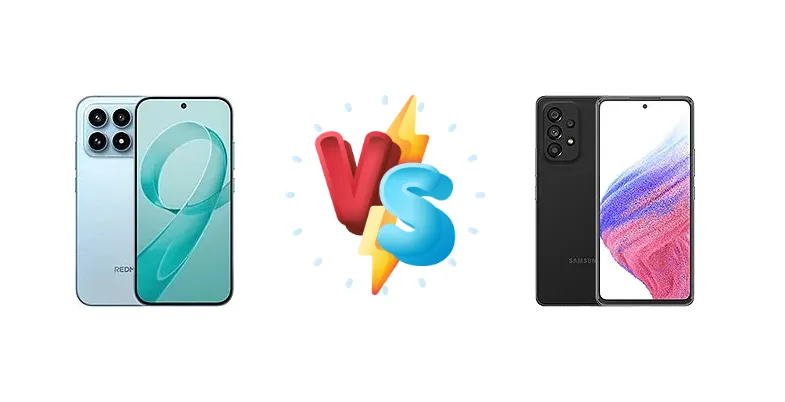
|
🏆 Quick Verdict
For users prioritizing raw performance and fast charging, the Xiaomi Redmi K90 is the clear winner. Its Snapdragon 8 Elite chipset offers a substantial leap over the Galaxy A53’s Exynos 1280. However, Samsung’s refined software and established brand reputation make the A53 a compelling choice for those valuing a polished, all-around experience.
| PHONES | ||
|---|---|---|
| Phone Names | Xiaomi Redmi K90 | Samsung Galaxy A53 5G |
| Network | ||
|---|---|---|
| 2G bands | GSM 850 / 900 / 1800 / 1900 | GSM 850 / 900 / 1800 / 1900 |
| 3G bands | HSDPA 800 / 850 / 900 / 1700(AWS) / 1900 / 2100 | HSDPA 850 / 900 / 1700(AWS) / 1900 / 2100 |
| 4G bands | 1, 3, 4, 5, 7, 8, 19, 28, 34, 38, 39, 40, 41, 42, 48, 66 | 1, 2, 3, 4, 5, 7, 12, 14, 20, 29, 30, 38, 39, 40, 41, 46, 48, 66 - SM-A536U |
| 5G bands | 1, 3, 5, 7, 8, 28, 66, 38, 40, 41, 48, 77, 78 SA/NSA | 2, 5, 41, 66, 77, 78 SA/NSA/Sub6/mmWave - SM-A536U |
| Speed | HSPA, LTE, 5G | HSPA, LTE, 5G |
| Technology | GSM / HSPA / LTE / 5G | GSM / HSPA / LTE / 5G |
| - | 2, 5, 48, 66, 77, 78, 260, 261 SA/NSA/Sub6/mmWave - SM-A536V | |
| Launch | ||
|---|---|---|
| Announced | 2025, October 23 | 2022, March 17 |
| Status | Available. Released 2025, October 23 | Available. Released 2022, March 24 |
| Body | ||
|---|---|---|
| Build | Glass front, aluminum frame | Glass front (Gorilla Glass 5), plastic frame, plastic back |
| Dimensions | 157.5 x 75.3 x 8 mm (6.20 x 2.96 x 0.31 in) | 159.6 x 74.8 x 8.1 mm (6.28 x 2.94 x 0.32 in) |
| SIM | Nano-SIM + Nano-SIM | · Nano-SIM· Nano-SIM + Nano-SIM |
| Weight | 206 g (7.27 oz) | 189 g (6.67 oz) |
| - | IP67 dust/water resistant (up to 1m for 30 min) | |
| Display | ||
|---|---|---|
| Protection | - | Corning Gorilla Glass 5 |
| Resolution | 1156 x 2510 pixels, 19.5:9 ratio (~419 ppi density) | 1080 x 2400 pixels, 20:9 ratio (~405 ppi density) |
| Size | 6.59 inches, 106.5 cm2 (~89.8% screen-to-body ratio) | 6.5 inches, 102.0 cm2 (~85.4% screen-to-body ratio) |
| Type | AMOLED, 68B colors, 2560Hz PWM, 120Hz, Dolby Vision, HDR Vivid, HDR10+, 3500 nits (peak) | Super AMOLED, 120Hz, 800 nits (HBM) |
| Platform | ||
|---|---|---|
| CPU | Octa-core (2x4.32 GHz Oryon V2 Phoenix L + 6x3.53 GHz Oryon V2 Phoenix M) | Octa-core (2x2.4 GHz Cortex-A78 & 6x2.0 GHz Cortex-A55) |
| Chipset | Qualcomm SM8750-AB Snapdragon 8 Elite (3 nm) | Exynos 1280 (5 nm) |
| GPU | Adreno 830 | Mali-G68 |
| OS | Android 16, HyperOS 3 | Android 12, up to 4 major Android upgrades, One UI 8 |
| Memory | ||
|---|---|---|
| Card slot | No | microSDXC (uses shared SIM slot) |
| Internal | 256GB 12GB RAM, 512GB 12GB RAM, 512GB 16GB RAM, 1TB 16GB RAM | 128GB 4GB RAM, 128GB 6GB RAM, 128GB 8GB RAM, 256GB 6GB RAM, 256GB 8GB RAM |
| Main Camera | ||
|---|---|---|
| Features | Color spectrum sensor, LED flash, HDR, panorama | LED flash, panorama, HDR |
| Quad | - | 64 MP, f/1.8, 26mm (wide), 1/1.7X", 0.8µm, PDAF, OIS 12 MP, f/2.2, 123˚ (ultrawide), 1.12µm 5 MP (macro) Auxiliary lens |
| Single | - | 32 MP, f/2.2, 26mm (wide), 1/2.8", 0.8µm |
| Triple | 50 MP, f/1.9, 24mm (wide), 1/1.55", 1.0µm, PDAF, OIS 50 MP, f/2.2, 60mm (telephoto), PDAF, 2.5x optical zoom 8 MP, f/2.2, 15mm, 120˚ (ultrawide) | - |
| Video | 8K@30fps, 4K@30/60fps, 1080p@30/60/120/240/960fps, gyro-EIS, HDR10+ | 4K@30fps, 1080p@30/60fps; gyro-EIS |
| Selfie camera | ||
|---|---|---|
| Features | - | HDR |
| Single | 20 MP, (wide), 1/2.0", 0.8µm | 32 MP, f/2.2, 26mm (wide), 1/2.8", 0.8µm |
| Video | 1080p@30/60fps | 4K@30fps, 1080p@30fps |
| Sound | ||
|---|---|---|
| 3.5mm jack | - | No |
| 35mm jack | No | No |
| Loudspeaker | Yes, with stereo speakers | Yes, with stereo speakers |
| Comms | ||
|---|---|---|
| Bluetooth | 5.4, A2DP, LE, LHDC 5.0, ASHA | 5.1, A2DP, LE |
| Infrared port | Yes | - |
| NFC | Yes | Yes (market/region dependent) |
| Positioning | GPS (L1+L5), BDS (B1I+B1c+B2a), GALILEO (E1+E5a), QZSS (L1+L5), NavIC, GLONASS | GPS, GLONASS, GALILEO, BDS |
| Radio | No | No |
| USB | USB Type-C, OTG | USB Type-C 2.0, OTG |
| WLAN | Wi-Fi 802.11 a/b/g/n/ac/6/7, dual-band, Wi-Fi Direct | Wi-Fi 802.11 a/b/g/n/ac, dual-band, Wi-Fi Direct |
| Features | ||
|---|---|---|
| Sensors | Fingerprint (under display, ultrasonic), accelerometer, gyro, proximity, compass | Fingerprint (under display, optical), accelerometer, gyro, compass, barometer (market/region dependent) |
| - | Virtual proximity sensing | |
| Battery | ||
|---|---|---|
| Charging | 100W wired, PD3.0, QC3+, 100W PPS 22.5W reverse wired | 25W wired |
| Type | Si/C Li-Po 7100 mAh | Li-Po 5000 mAh |
| Misc | ||
|---|---|---|
| Colors | Black, White, Blue, Purple | Black, White, Blue, Peach |
| Models | 2510DRK44C | SM-A536B, SM-A536B/DS, SM-A536U, SM-A536U1, SM-A5360, SM-A536E, SM-A536E/DS, SM-A536V, SM-A536W, SM-A536N, SM-S536DL |
| Price | About 350 EUR | $ 151.42 / £ 185.00 / € 169.14 |
| SAR | - | 0.75 W/kg (head) 1.58 W/kg (body) |
| SAR EU | - | 0.89 W/kg (head) 1.60 W/kg (body) |
| Tests | ||
|---|---|---|
| Battery life | - | Endurance rating 113h |
| Camera | - | Photo / Video |
| Display | - | Contrast ratio: Infinite (nominal) |
| Loudspeaker | - | -26.5 LUFS (Good) |
| Performance | - | AnTuTu: 329802 (v8), 379313 (v9) GeekBench: 1891 (v5.1) GFXBench: 19fps (ES 3.1 onscreen) |
Xiaomi Redmi K90
- Significantly faster processor (Snapdragon 8 Elite)
- Ultra-fast 100W charging
- Likely superior thermal management
- Potential for higher display quality
- Software experience may be less refined than Samsung
- Camera specs currently unknown
Samsung Galaxy A53 5G
- Reliable and polished software experience
- Good battery life (113h endurance)
- Established brand reputation
- Consistent camera performance
- Slower processor (Exynos 1280)
- Slow 25W charging
- Potential for thermal throttling under heavy load
Display Comparison
The Samsung Galaxy A53 5G boasts a measured peak brightness of 830 nits, providing good visibility outdoors. However, the Redmi K90, while lacking specific brightness data, likely surpasses this thanks to its flagship-level positioning. Both devices feature an 'Infinite' (Samsung) contrast ratio, typical of OLED/AMOLED panels. The K90’s display technology is unknown, but given its price point, it’s likely to be a high-refresh-rate AMOLED. The A53’s display is adequate, but the K90 is expected to offer a more vibrant and responsive visual experience.
Camera Comparison
Both phones offer photo and video capabilities, but details are limited. The A53’s camera system is known for its consistent image processing, but lacks standout features. The K90’s camera specs are currently unknown, but Xiaomi often prioritizes high-resolution sensors. Without specific sensor size or aperture information, it’s difficult to definitively declare a winner. However, the K90’s more powerful ISP (Image Signal Processor) within the Snapdragon 8 Elite chipset suggests superior image processing capabilities, particularly in low-light conditions. We can safely assume the A53's 2MP macro camera will be less useful than a dedicated, higher-resolution sensor on the K90.
Performance
The performance gap is significant. The Xiaomi Redmi K90’s Qualcomm SM8750-AB Snapdragon 8 Elite (3nm) is a powerhouse, featuring an octa-core CPU with Oryon V2 Phoenix cores clocked up to 4.32 GHz. This contrasts sharply with the Samsung Galaxy A53 5G’s Exynos 1280 (5nm) and its Cortex-A78/A55 configuration peaking at 2.4 GHz. The 3nm process node of the Snapdragon 8 Elite translates to superior power efficiency and reduced thermal throttling compared to the 5nm Exynos. This means the K90 will sustain peak performance for longer during intensive tasks like gaming and video editing. The K90’s likely LPDDR5x RAM further enhances its performance advantage.
Battery Life
The Samsung Galaxy A53 5G has an endurance rating of 113 hours, indicating solid battery life. However, the Redmi K90’s 100W wired charging is a game-changer. While the K90’s battery capacity is unknown, the ultra-fast charging will significantly reduce downtime. The A53’s 25W charging is comparatively slow. The K90 also supports PD3.0, QC3+, and 100W PPS, offering broader compatibility and faster charging speeds with compatible chargers. The K90’s 22.5W reverse wired charging is also a useful feature for topping up accessories.
Buying Guide
Buy the Xiaomi Redmi K90 if you need uncompromising performance for gaming, demanding applications, or future-proofing. Its 100W charging is a game-changer for minimizing downtime. Buy the Samsung Galaxy A53 5G if you prefer a more established brand with a focus on software stability, a reliable camera system, and a generally smoother user experience, even if it means sacrificing some processing power.