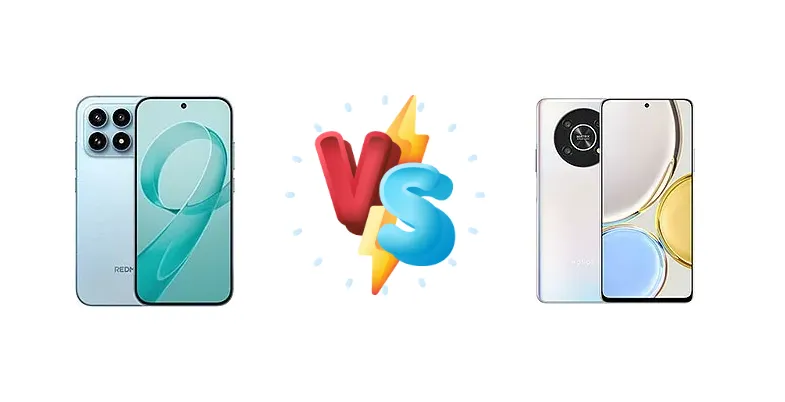
The Xiaomi Redmi K90 and Honor X9 5G represent distinct approaches to the smartphone market. The K90 aims for near-flagship performance at a competitive price, leveraging Qualcomm’s latest Snapdragon 8 Elite chipset. Conversely, the Honor X9 5G prioritizes 5G connectivity and affordability with the Snapdragon 695. This comparison dissects their core differences to determine which device best suits your needs.
🏆 Quick Verdict
For users prioritizing raw performance and fast charging, the Xiaomi Redmi K90 is the clear winner. Its Snapdragon 8 Elite chipset delivers significantly faster processing speeds. However, the Honor X9 5G provides a compelling value proposition for those seeking 5G access without breaking the bank.
| Network |
|---|
| 2G bands | GSM 850 / 900 / 1800 / 1900 | GSM 850 / 900 / 1800 / 1900 |
| 3G bands | HSDPA 800 / 850 / 900 / 1700(AWS) / 1900 / 2100 | HSDPA 850 / 900 / 1700(AWS) / 1900 / 2100 |
| 4G bands | 1, 3, 4, 5, 7, 8, 19, 28, 34, 38, 39, 40, 41, 42, 48, 66 | LTE |
| 5G bands | 1, 3, 5, 7, 8, 28, 66, 38, 40, 41, 48, 77, 78 SA/NSA | SA/NSA |
| Speed | HSPA, LTE, 5G | HSPA, LTE, 5G |
| Technology | GSM / HSPA / LTE / 5G | GSM / HSPA / LTE / 5G |
| | - | Virtual proximity sensing |
| Launch |
|---|
| Announced | 2025, October 23 | 2022, March 29 |
| Status | Available. Released 2025, October 23 | Available. Released 2022, March 29 |
| Body |
|---|
| Build | Glass front, aluminum frame | Glass front, plastic frame, plastic back |
| Dimensions | 157.5 x 75.3 x 8 mm (6.20 x 2.96 x 0.31 in) | 166.1 x 75.8 x 8.1 mm (6.54 x 2.98 x 0.32 in) |
| SIM | Nano-SIM + Nano-SIM | Nano-SIM + Nano-SIM |
| Weight | 206 g (7.27 oz) | 189 g (6.67 oz) |
| Display |
|---|
| Resolution | 1156 x 2510 pixels, 19.5:9 ratio (~419 ppi density) | 1080 x 2388 pixels (~385 ppi density) |
| Size | 6.59 inches, 106.5 cm2 (~89.8% screen-to-body ratio) | 6.81 inches, 112.3 cm2 (~89.2% screen-to-body ratio) |
| Type | AMOLED, 68B colors, 2560Hz PWM, 120Hz, Dolby Vision, HDR Vivid, HDR10+, 3500 nits (peak) | IPS LCD, 120Hz |
| Platform |
|---|
| CPU | Octa-core (2x4.32 GHz Oryon V2 Phoenix L + 6x3.53 GHz Oryon V2 Phoenix M) | Octa-core (2x2.2 GHz Kryo 660 Gold & 6x1.8 GHz Kryo 660 Silver) |
| Chipset | Qualcomm SM8750-AB Snapdragon 8 Elite (3 nm) | Qualcomm SM6375 Snapdragon 695 5G (6 nm) |
| GPU | Adreno 830 | Adreno 619 |
| OS | Android 16, HyperOS 3 | Android 11, Magic UI 4.2 |
| Memory |
|---|
| Card slot | No | No |
| Internal | 256GB 12GB RAM, 512GB 12GB RAM, 512GB 16GB RAM, 1TB 16GB RAM | 128GB 8GB RAM, 256GB 8GB RAM |
| Main Camera |
|---|
| Features | Color spectrum sensor, LED flash, HDR, panorama | LED flash, panorama, HDR |
| Single | - | 16 MP, f/2.5 |
| Triple | 50 MP, f/1.9, 24mm (wide), 1/1.55", 1.0µm, PDAF, OIS
50 MP, f/2.2, 60mm (telephoto), PDAF, 2.5x optical zoom
8 MP, f/2.2, 15mm, 120˚ (ultrawide) | 48 MP, f/1.8, 26mm (wide), PDAF
2 MP (macro)
Auxiliary lens |
| Video | 8K@30fps, 4K@30/60fps, 1080p@30/60/120/240/960fps, gyro-EIS, HDR10+ | 1080p@30fps |
| Selfie camera |
|---|
| Single | 20 MP, (wide), 1/2.0", 0.8µm | 16 MP, f/2.5 |
| Video | 1080p@30/60fps | 1080p@30fps |
| Sound |
|---|
| 3.5mm jack | - | No |
| 35mm jack | No | No |
| Loudspeaker | Yes, with stereo speakers | Yes |
| Comms |
|---|
| Bluetooth | 5.4, A2DP, LE, LHDC 5.0, ASHA | 5.1, A2DP, LE |
| Infrared port | Yes | - |
| NFC | Yes | Yes |
| Positioning | GPS (L1+L5), BDS (B1I+B1c+B2a), GALILEO (E1+E5a), QZSS (L1+L5), NavIC, GLONASS | GPS, GLONASS, GALILEO, BDS |
| Radio | No | No |
| USB | USB Type-C, OTG | USB Type-C 2.0, OTG |
| WLAN | Wi-Fi 802.11 a/b/g/n/ac/6/7, dual-band, Wi-Fi Direct | Wi-Fi 802.11 a/b/g/n/ac, dual-band, Wi-Fi Direct |
| Features |
|---|
| Sensors | Fingerprint (under display, ultrasonic), accelerometer, gyro, proximity, compass | Fingerprint (side-mounted), accelerometer, gyro, compass |
| Battery |
|---|
| Charging | 100W wired, PD3.0, QC3+, 100W PPS
22.5W reverse wired | 66W wired, 81% in 30 min |
| Type | Si/C Li-Po 7100 mAh | Li-Po 4800 mAh |
| Misc |
|---|
| Colors | Black, White, Blue, Purple | Titanium Silver, Ocean Blue, Midnight Black |
| Models | 2510DRK44C | ANY-NX1 |
| Price | About 350 EUR | About 240 EUR |
Xiaomi Redmi K90
- Significantly faster processor for demanding tasks
- Ultra-fast 100W charging
- Likely superior camera system
- Potential for a higher-quality display
- Likely higher price point
- Potential for increased heat under sustained load (though mitigated by 3nm process)
Honor X9 5G
- More affordable price
- 5G connectivity
- Decent 66W charging
- Good for everyday tasks
- Significantly slower processor
- Likely inferior camera performance
- Potentially lower-quality display
Display Comparison
While display specifications are missing for both devices, the Redmi K90’s positioning suggests a higher-quality panel is likely, potentially with a higher refresh rate. The Honor X9 5G, targeting a more budget-conscious market, will likely feature a standard 60Hz or 90Hz LCD or AMOLED. The Redmi K90’s expected higher price point allows for features like LTPO technology, enabling variable refresh rates for improved power efficiency. Bezels are also likely to be slimmer on the K90, contributing to a more immersive viewing experience.
Camera Comparison
Camera details are absent, but we can infer differences based on the overall device strategy. The Redmi K90, positioned as a performance-focused device, is likely to feature a more advanced camera system with a larger main sensor and optical image stabilization (OIS). The Honor X9 5G will likely prioritize cost-effectiveness, potentially featuring a smaller sensor and relying more on software processing. Lens apertures will likely be wider on the K90, allowing for better low-light performance. While both may include multiple lenses, the K90’s image processing pipeline will likely be more sophisticated, resulting in higher-quality photos and videos.
Performance
The performance gap between these two devices is substantial. The Xiaomi Redmi K90’s Qualcomm SM8750-AB Snapdragon 8 Elite (3nm) with its Oryon V2 Phoenix cores represents a significant leap in processing power compared to the Honor X9 5G’s Snapdragon 695 (6nm). The K90’s octa-core CPU, peaking at 4.32 GHz, will deliver dramatically faster app loading times, smoother multitasking, and superior gaming performance. The 3nm process node of the Snapdragon 8 Elite also translates to improved thermal efficiency, reducing the likelihood of throttling during sustained workloads. The 695, while capable for everyday tasks, will struggle with demanding games and applications. The K90 likely utilizes faster LPDDR5x RAM, further enhancing performance.
Battery Life
The Redmi K90’s 100W wired charging is a game-changer, allowing for incredibly fast top-ups. The advertised support for PD3.0, QC3+, and 100W PPS ensures compatibility with a wide range of chargers. While the Honor X9 5G’s 66W charging is respectable, and can reach 81% in 30 minutes, it falls significantly short of the K90’s speed. The actual battery capacity is unknown for both, but the K90’s faster charging mitigates the impact of a potentially smaller battery. The K90 also offers 22.5W reverse wired charging, a feature absent on the X9 5G.
Buying Guide
Buy the Xiaomi Redmi K90 if you need a phone for demanding tasks like gaming, video editing, or running resource-intensive applications. Its superior chipset and faster charging will significantly enhance your experience. Buy the Honor X9 5G if you prioritize affordability, 5G connectivity for streaming and browsing, and a balanced everyday experience without the need for top-tier performance.
Frequently Asked Questions
❓ Will the Snapdragon 695 in the Honor X9 5G struggle with graphically intensive games like Genshin Impact?
Yes, the Snapdragon 695 is a mid-range chipset and will likely struggle to run Genshin Impact at high settings. You'll likely need to lower the graphics settings significantly to achieve playable frame rates, and even then, expect some stuttering. The Redmi K90’s Snapdragon 8 Elite is far better suited for demanding games.
❓ How much faster is the 100W charging on the Redmi K90 compared to the 66W charging on the Honor X9 5G in real-world use?
The Redmi K90’s 100W charging can potentially fully charge the battery in under 30 minutes, while the Honor X9 5G takes approximately 30 minutes to reach 81%. This means a significantly faster top-up for the K90, allowing you to quickly regain battery life during short breaks.
❓ Does the Redmi K90’s Snapdragon 8 Elite generate a lot of heat during prolonged gaming sessions?
While powerful, the Snapdragon 8 Elite’s 3nm process node is designed to improve thermal efficiency. However, sustained gaming will still generate heat. The K90 likely incorporates advanced cooling solutions to mitigate throttling, but some performance reduction may occur during extended gameplay.