
Xiaomi Redmi K80 vs Xiaomi 14T Pro: A Deep Dive into Performance and Power
| Phones Images | |||||
|---|---|---|---|---|---|
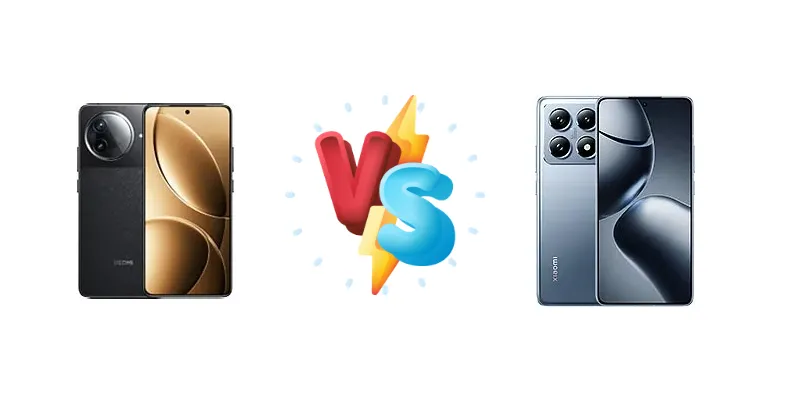
|
🏆 Quick Verdict
For the average user prioritizing raw charging speed and sustained performance, the Xiaomi 14T Pro emerges as the winner. Its 120W charging, coupled with the Dimensity 9300+'s architecture, provides a faster and potentially more thermally stable experience, despite the Redmi K80's powerful Snapdragon chipset.
| PHONES | ||
|---|---|---|
| Phone Names | Xiaomi Redmi K80 | Xiaomi 14T Pro |
| Network | ||
|---|---|---|
| 2G bands | GSM 850 / 900 / 1800 / 1900 | GSM 850 / 900 / 1800 / 1900 |
| 3G bands | HSDPA 800 / 850 / 900 / 1700(AWS) / 2100 | HSDPA 800 / 850 / 900 / 1700(AWS) / 1900 / 2100 |
| 4G bands | 1, 3, 4, 5, 7, 8, 18, 19, 26, 28, 34, 38, 39, 40, 41, 42, 48, 66 | 1, 2, 3, 4, 5, 7, 8, 12, 13, 17, 18, 19, 20, 25, 26, 28, 32, 38, 39, 40, 41, 42, 48, 66 |
| 5G bands | 1, 3, 5, 7, 8, 26, 28, 38, 40, 41, 48, 66, 77, 78 SA/NSA | 1, 2, 3, 5, 7, 8, 12, 20, 25, 26, 28, 38, 40, 41, 48, 66, 75, 77, 78 SA/NSA |
| Speed | HSPA, LTE, 5G | HSPA, LTE, 5G |
| Technology | GSM / CDMA / HSPA / CDMA2000 / LTE / 5G | GSM / HSPA / LTE / 5G |
| Launch | ||
|---|---|---|
| Announced | 2024, November 27 | 2024, September 26 |
| Status | Available. Released 2024, November 27 | Available. Released 2024, September 26 |
| Body | ||
|---|---|---|
| Build | - | Glass front (Gorilla Glass 5), aluminum frame, glass back (Panda X) |
| Dimensions | 160.3 x 75 x 8.1 mm (6.31 x 2.95 x 0.32 in) | 160.4 x 75.1 x 8.4 mm (6.31 x 2.96 x 0.33 in) |
| SIM | Nano-SIM + Nano-SIM | · Nano-SIM + eSIM· eSIM + eSIM· Nano-SIM + Nano-SIM |
| Weight | 206 g (7.27 oz) | 209 g (7.37 oz) |
| Display | ||
|---|---|---|
| Protection | Corning Gorilla Glass 7i | Corning Gorilla Glass 5 |
| Resolution | 1440 x 3200 pixels, 20:9 ratio (~526 ppi density) | 1220 x 2712 pixels, 20:9 ratio (~446 ppi density) |
| Size | 6.67 inches, 107.4 cm2 (~89.3% screen-to-body ratio) | 6.67 inches, 107.4 cm2 (~89.1% screen-to-body ratio) |
| Type | OLED, 68B colors, 120Hz, Dolby Vision, HDR10+, 1800 nits (HBM), 3200 nits (peak) | AMOLED, 68B colors, 144Hz, 3840Hz PWM, Dolby Vision, HDR10+, 1600 nits (HBM), 4000 nits (peak) |
| Platform | ||
|---|---|---|
| CPU | Octa-core (1x3.3 GHz Cortex-X4 & 3x3.2 GHz Cortex-A720 & 2x3.0 GHz Cortex-A720 & 2x2.3 GHz Cortex-A520) | Octa-core (1x3.4 GHz Cortex-X4 & 3x2.85 GHz Cortex-X4 & 4x2.0 GHz Cortex-A720) |
| Chipset | Qualcomm SM8650-AB Snapdragon 8 Gen 3 (4 nm) | Mediatek Dimensity 9300+ (4 nm) |
| GPU | Adreno 750 | Immortalis-G720 MC12 |
| OS | Android 15, HyperOS 2 | Android 14, HyperOS |
| Memory | ||
|---|---|---|
| Card slot | No | No |
| Internal | 256GB 12GB RAM, 256GB 16GB RAM, 512GB 12GB RAM, 512GB 16GB RAM, 1TB 16GB RAM | 256GB 12GB RAM, 512GB 12GB RAM, 512GB 16GB RAM, 1TB 12GB RAM |
| Main Camera | ||
|---|---|---|
| Dual | 50 MP, f/1.6, 24mm (wide), 1/1.55", 1.0µm, dual pixel PDAF, OIS 8 MP, (ultrawide) | - |
| Features | Color spectrum sensor, LED flash, HDR, panorama | Leica lens, Ultra HDR, LED flash, HDR, panorama |
| Triple | - | 50 MP, f/1.6, 23mm (wide), 1/1.31", 1.2µm, PDAF, OIS 50 MP, f/2.0, 60mm (telephoto), 1/2.88", 0.61µm, PDAF, 2.6x optical zoom 12 MP, f/2.2, 15mm (ultrawide), 1/3.06", 1.12µm |
| Video | 8K@24fps, 4K@24/30/60fps, 1080p@30/60/120/240/960fps, 720p@1920fps, gyro-EIS | 8K@24/30fps, 4K@24/30/60fps, 1080p@30/60/120/240/960fps, gyro-EIS, 10-bit Rec. 2020, HDR10+ |
| Selfie camera | ||
|---|---|---|
| Features | HDR | HDR |
| Single | 20 MP, (wide) | 32 MP, f/2.0, 25mm (wide), 1/3.44", 0.64µm |
| Video | 1080p@30/60fps, gyro-EIS | 4K@30fps, 1080p@30/60fps, HDR10+ |
| Sound | ||
|---|---|---|
| 35mm jack | No | No |
| Loudspeaker | Yes, with stereo speakers | Yes, with stereo speakers |
| Comms | ||
|---|---|---|
| Bluetooth | 5.4, A2DP, LE, aptX HD, aptX Adaptive, aptX Lossless, LHDC 5 | 5.4, A2DP, LE, LHDC |
| Infrared port | Yes | Yes |
| NFC | Yes | Yes (market/region dependent) |
| Positioning | GPS (L1+L5), GLONASS (G1), BDS (B1I+B1c+B2a), GALILEO (E1+E5a), QZSS (L1+L5), NavIC (L5) | GPS (L1+L5), BDS (B1I+B1C+B2a+B2b), GALILEO (E1+E5a+E5b), QZSS (L1+L5), NavIC (L5), GLONASS |
| Radio | No | No |
| USB | USB Type-C, OTG | USB Type-C 2.0, OTG |
| WLAN | Wi-Fi 802.11 a/b/g/n/ac/6e/7, dual-band, Wi-Fi Direct | Wi-Fi 802.11 a/b/g/n/ac/6e/7, dual-band, Wi-Fi Direct |
| Features | ||
|---|---|---|
| Sensors | Fingerprint (under display, ultrasonic), accelerometer, proximity, gyro, compass | Fingerprint (under display, optical), accelerometer, gyro, proximity, compass |
| Battery | ||
|---|---|---|
| Charging | 90W wired, PD3.0, QC3+ | 120W wired, PD3.0, QC4, 100% in 19 min 50W wireless, 100% in 45 min |
| Type | Si/C Li-Ion 6550 mAh | Li-Po 5000 mAh |
| Misc | ||
|---|---|---|
| Colors | Black, White, Mint, Blue | Titan Gray, Titan Blue, Titan Black |
| Models | 24117RK2CC | 2407FPN8EG |
| Price | About 350 EUR | $ 550.00 / £ 498.00 / € 539.99 |
| SAR EU | - | 0.99 W/kg (head) 1.00 W/kg (body) |
Xiaomi Redmi K80
- Latest Qualcomm Snapdragon 8 Gen 3 chipset
- Potentially better software optimization for Snapdragon-focused apps
- 90W fast charging is still very competitive
- Slower charging compared to the 14T Pro (90W vs 120W)
- No wireless charging support
- Battery life data unavailable
Xiaomi 14T Pro
- Blazing-fast 120W wired charging (19 minutes to full)
- 50W wireless charging support
- Excellent battery life (12:32h active use)
- MediaTek Dimensity 9300+ may have different software compatibility
- Unique CPU core configuration may not benefit all applications
- Peak brightness is the only display advantage
Display Comparison
While both devices likely feature high-quality AMOLED panels, the Xiaomi 14T Pro boasts a measured peak brightness of 1228 nits, suggesting a superior outdoor visibility experience compared to the Redmi K80 (brightness data unavailable). The absence of LTPO information for either device means we can't assess adaptive refresh rate efficiency. However, the 14T Pro's higher peak brightness is a clear advantage for content consumption in bright environments.
Camera Comparison
Without detailed camera specifications, a direct comparison is limited. However, the market positioning suggests the 14T Pro may prioritize camera capabilities slightly more. Both devices likely feature capable main sensors, but the absence of information regarding sensor size and OIS makes a definitive judgment impossible. We can assume both will offer a range of shooting modes, but image processing styles will likely differ, with Xiaomi’s software potentially influencing the final output.
Performance
The core of the difference lies in the chipsets. The Xiaomi 14T Pro’s MediaTek Dimensity 9300+ features a unique CPU configuration with a 1x3.4 GHz Cortex-X4 core alongside *three* additional Cortex-X4 cores at 2.85 GHz, a configuration designed for sustained peak performance. The Redmi K80’s Snapdragon 8 Gen 3, while powerful with its 1x3.3 GHz Cortex-X4, relies more heavily on Cortex-A720 cores. This suggests the Dimensity 9300+ may excel in multi-threaded workloads. Both are built on a 4nm process, but the Dimensity’s core arrangement could lead to better thermal distribution under prolonged load. The Redmi K80's reliance on the Snapdragon ecosystem may also offer advantages in software optimization for certain applications.
Battery Life
The Xiaomi 14T Pro’s 120W wired charging is a significant advantage, achieving a full charge in just 19 minutes. This is substantially faster than the Redmi K80’s 90W charging. The 14T Pro also adds 50W wireless charging, a feature absent on the K80. Crucially, the 14T Pro’s active use battery score of 12:32h demonstrates excellent real-world endurance, potentially offsetting any capacity differences (mAh not specified for either device). The inclusion of PD3.0 and QC4 on the 14T Pro, versus PD3.0 and QC3+ on the K80, indicates broader compatibility with charging standards.
Buying Guide
Buy the Xiaomi Redmi K80 if you prioritize the latest Qualcomm silicon and are comfortable with a slightly slower charging experience. It's ideal for users deeply invested in the Snapdragon ecosystem and those who frequently utilize CPU-intensive tasks. Buy the Xiaomi 14T Pro if you value blazing-fast 120W charging, excellent battery life (12:32h active use), and a potentially more efficient processor architecture, making it perfect for power users and gamers.