
Redmi K80 vs iQOO 12 Pro: A Deep Dive into Xiaomi and vivo's Snapdragon 8 Gen 3 Flagships
| Phones Images | |||||
|---|---|---|---|---|---|
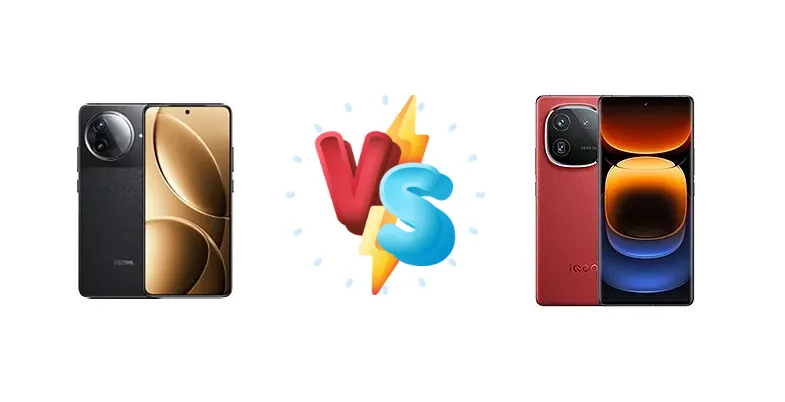
|
🏆 Quick Verdict
For the average user prioritizing rapid replenishment, the vivo iQOO 12 Pro emerges as the winner. Its 120W wired charging and inclusion of 50W wireless charging significantly outperform the Redmi K80’s 90W wired-only solution. However, the Redmi K80 remains a compelling option for those less reliant on ultra-fast charging.
| PHONES | ||
|---|---|---|
| Phone Names | Xiaomi Redmi K80 | vivo iQOO 12 Pro |
| Network | ||
|---|---|---|
| 2G bands | GSM 850 / 900 / 1800 / 1900 | GSM 850 / 900 / 1800 / 1900 |
| 3G bands | HSDPA 800 / 850 / 900 / 1700(AWS) / 2100 | HSDPA 800 / 850 / 900 / 1700(AWS) / 1900 / 2100 |
| 4G bands | 1, 3, 4, 5, 7, 8, 18, 19, 26, 28, 34, 38, 39, 40, 41, 42, 48, 66 | 1, 2, 3, 4, 5, 7, 8, 12, 17, 18, 19, 20, 25, 26, 28, 34, 38, 39, 40, 41, 42, 66 |
| 5G bands | 1, 3, 5, 7, 8, 26, 28, 38, 40, 41, 48, 66, 77, 78 SA/NSA | 1, 2, 3, 5, 7, 8, 12, 20, 25, 26, 28, 66, 38, 40, 41, 77, 78 SA/NSA |
| Speed | HSPA, LTE, 5G | HSPA, LTE, 5G |
| Technology | GSM / CDMA / HSPA / CDMA2000 / LTE / 5G | GSM / CDMA / HSPA / CDMA2000 / LTE / 5G |
| Launch | ||
|---|---|---|
| Announced | 2024, November 27 | 2023, November 07 |
| Status | Available. Released 2024, November 27 | Available. Released 2023, November 14 |
| Body | ||
|---|---|---|
| Dimensions | 160.3 x 75 x 8.1 mm (6.31 x 2.95 x 0.32 in) | 164.6 x 75.4 x 8.6 mm or 8.8 mm |
| SIM | Nano-SIM + Nano-SIM | Nano-SIM + Nano-SIM |
| Weight | 206 g (7.27 oz) | 205 g or 210 g (7.23 oz) |
| Display | ||
|---|---|---|
| Protection | Corning Gorilla Glass 7i | - |
| Resolution | 1440 x 3200 pixels, 20:9 ratio (~526 ppi density) | 1440 x 3200 pixels, 20:9 ratio (~518 ppi density) |
| Size | 6.67 inches, 107.4 cm2 (~89.3% screen-to-body ratio) | 6.78 inches, 111.0 cm2 (~89.4% screen-to-body ratio) |
| Type | OLED, 68B colors, 120Hz, Dolby Vision, HDR10+, 1800 nits (HBM), 3200 nits (peak) | LTPO AMOLED, 1B colors, 144Hz, HDR10+, 1600 nits (HBM), 3000 nits (peak) |
| Platform | ||
|---|---|---|
| CPU | Octa-core (1x3.3 GHz Cortex-X4 & 3x3.2 GHz Cortex-A720 & 2x3.0 GHz Cortex-A720 & 2x2.3 GHz Cortex-A520) | Octa-core (1x3.3 GHz Cortex-X4 & 3x3.2 GHz Cortex-A720 & 2x3.0 GHz Cortex-A720 & 2x2.3 GHz Cortex-A520) |
| Chipset | Qualcomm SM8650-AB Snapdragon 8 Gen 3 (4 nm) | Qualcomm SM8650-AB Snapdragon 8 Gen 3 (4 nm) |
| GPU | Adreno 750 | Adreno 750 |
| OS | Android 15, HyperOS 2 | Android 14, up to 2 major Android upgrades, Funtouch 14 (International), OriginOS 4 (China) |
| Memory | ||
|---|---|---|
| Card slot | No | No |
| Internal | 256GB 12GB RAM, 256GB 16GB RAM, 512GB 12GB RAM, 512GB 16GB RAM, 1TB 16GB RAM | 256GB 16GB RAM, 512GB 16GB RAM, 1TB 16GB RAM |
| Main Camera | ||
|---|---|---|
| Dual | 50 MP, f/1.6, 24mm (wide), 1/1.55", 1.0µm, dual pixel PDAF, OIS 8 MP, (ultrawide) | - |
| Features | Color spectrum sensor, LED flash, HDR, panorama | Color spectrum sensor, Dual-LED flash, HDR, panorama |
| Triple | - | 50 MP, f/1.7, 23mm (wide), 1/1.3", 1.2µm, ulti-directional PDAF, OIS 64 MP, f/2.6, 70mm (periscope telephoto), 1/2.0", PDAF, OIS, 3x optical zoom 50 MP, f/2.0, 15mm, 119˚ (ultrawide), AF |
| Video | 8K@24fps, 4K@24/30/60fps, 1080p@30/60/120/240/960fps, 720p@1920fps, gyro-EIS | 8K@30fps, 4K@24/30/60fps, 1080p@30/60/120/240fps, gyro-EIS |
| Selfie camera | ||
|---|---|---|
| Features | HDR | HDR |
| Single | 20 MP, (wide) | 16 MP, f/2.5, (wide) |
| Video | 1080p@30/60fps, gyro-EIS | 1080p@30fps, gyro-EIS |
| Sound | ||
|---|---|---|
| 35mm jack | No | No |
| Loudspeaker | Yes, with stereo speakers | Yes, with stereo speakers |
| Comms | ||
|---|---|---|
| Bluetooth | 5.4, A2DP, LE, aptX HD, aptX Adaptive, aptX Lossless, LHDC 5 | 5.4, A2DP, LE, aptX HD, aptX Adaptive, aptX Lossless |
| Infrared port | Yes | Yes |
| NFC | Yes | Yes |
| Positioning | GPS (L1+L5), GLONASS (G1), BDS (B1I+B1c+B2a), GALILEO (E1+E5a), QZSS (L1+L5), NavIC (L5) | GPS (L1+L5), GLONASS (G1), BDS (B1I+B1c+B2a), GALILEO (E1+E5a), QZSS (L1+L5) |
| Radio | No | No |
| USB | USB Type-C, OTG | USB Type-C 2.0, OTG |
| WLAN | Wi-Fi 802.11 a/b/g/n/ac/6e/7, dual-band, Wi-Fi Direct | Wi-Fi 802.11 a/b/g/n/ac/6/7, tri-band, Wi-Fi Direct |
| Features | ||
|---|---|---|
| Sensors | Fingerprint (under display, ultrasonic), accelerometer, proximity, gyro, compass | Fingerprint (under display, ultrasonic), accelerometer, gyro, proximity, compass |
| Battery | ||
|---|---|---|
| Charging | 90W wired, PD3.0, QC3+ | 120W wired 50W wireless 10W reverse wireless |
| Type | Si/C Li-Ion 6550 mAh | 5100 mAh |
| Misc | ||
|---|---|---|
| Colors | Black, White, Mint, Blue | Black, Red, White (BMW M branding) |
| Models | 24117RK2CC | V2329A |
| Price | About 350 EUR | About 650 EUR |
Xiaomi Redmi K80
- Potentially more affordable price point.
- Excellent Snapdragon 8 Gen 3 performance.
- Balanced feature set for everyday use.
- Slower 90W wired charging.
- No wireless charging support.
- Thermal management may be less aggressive.
vivo iQOO 12 Pro
- Ultra-fast 120W wired charging.
- Convenient 50W wireless charging.
- Potentially superior thermal management.
- Likely a higher price tag.
- Image processing may be overly saturated for some.
- Battery life may be slightly compromised by faster charging.
Display Comparison
While both devices are expected to feature high-refresh-rate AMOLED displays, specific details like peak brightness and panel technology (LTPO) are currently unavailable. However, given iQOO’s history with display quality, it’s reasonable to anticipate a slightly more vibrant and color-accurate panel on the 12 Pro. Bezels are likely to be minimal on both, reflecting current flagship trends. The absence of detailed display specs necessitates focusing on the core performance and charging differences.
Camera Comparison
Without specific camera sensor details, a direct comparison is challenging. However, both brands typically prioritize strong camera performance in their flagship models. The iQOO 12 Pro, given vivo’s imaging expertise, may lean towards more saturated and visually appealing image processing, while Xiaomi often aims for a more natural and accurate representation. The absence of information regarding OIS and lens apertures prevents a deeper analysis. It's safe to assume both will feature multi-camera setups, but the quality will depend heavily on sensor size and software optimization.
Performance
Both the Redmi K80 and iQOO 12 Pro utilize the Qualcomm SM8650-AB Snapdragon 8 Gen 3 (4 nm) chipset, featuring an identical CPU configuration: 1x3.3 GHz Cortex-X4, 3x3.2 GHz Cortex-A720, 2x3.0 GHz Cortex-A720, and 2x2.3 GHz Cortex-A520. This means raw processing power will be virtually indistinguishable. The key differentiator will likely be thermal management. iQOO often employs more aggressive cooling solutions, potentially allowing the 12 Pro to sustain peak performance for longer durations during demanding tasks like gaming. RAM configurations and speeds (LPDDR5x) will also play a role, but are currently unknown.
Battery Life
The iQOO 12 Pro’s charging capabilities are its standout feature. The 120W wired charging will drastically reduce charging times compared to the Redmi K80’s 90W solution. While the exact battery capacity remains unknown for both devices, the 120W charging on the iQOO 12 Pro effectively mitigates the impact of a potentially smaller battery. Furthermore, the inclusion of 50W wireless charging and 10W reverse wireless charging on the iQOO 12 Pro provides unparalleled convenience, a feature entirely absent on the Redmi K80.
Buying Guide
Buy the Xiaomi Redmi K80 if you need a powerful, well-rounded flagship experience without the premium cost associated with advanced charging features. It’s ideal for users who primarily charge overnight or don’t frequently deplete their battery. Buy the vivo iQOO 12 Pro if you prioritize minimizing downtime and value the convenience of both incredibly fast wired and wireless charging, making it perfect for power users and gamers.