
Xiaomi Redmi K80 vs. Samsung Galaxy S23 FE: Which Flagship Contender Reigns Supreme?
| Phones Images | |||||
|---|---|---|---|---|---|
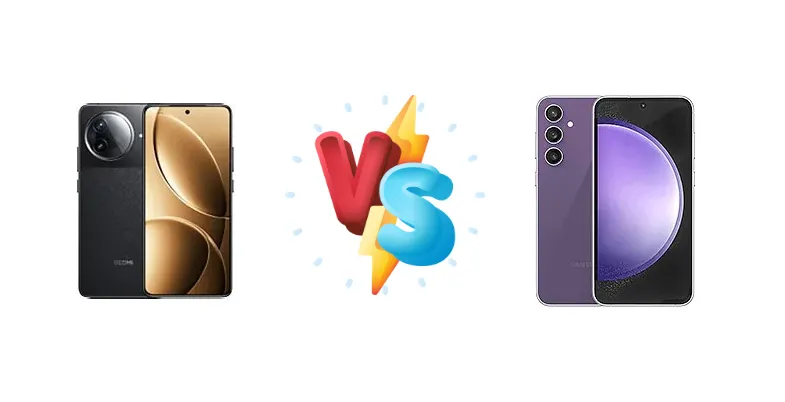
|
🏆 Quick Verdict
For users prioritizing peak performance and rapid charging, the Xiaomi Redmi K80 is the clear winner. Its Snapdragon 8 Gen 3 offers a substantial performance advantage over both the Exynos 2200 and Snapdragon 8 Gen 1 variants of the S23 FE. However, the S23 FE’s more polished software and potentially better camera processing make it a strong contender for those valuing a complete package.
| PHONES | ||
|---|---|---|
| Phone Names | Xiaomi Redmi K80 | Samsung Galaxy S23 FE |
| Network | ||
|---|---|---|
| 2G bands | GSM 850 / 900 / 1800 / 1900 | GSM 850 / 900 / 1800 / 1900 |
| 3G bands | HSDPA 800 / 850 / 900 / 1700(AWS) / 2100 | HSDPA 850 / 900 / 1700(AWS) / 1900 / 2100 |
| 4G bands | 1, 3, 4, 5, 7, 8, 18, 19, 26, 28, 34, 38, 39, 40, 41, 42, 48, 66 | 1, 2, 3, 4, 5, 7, 8, 12, 13, 17, 20, 26, 28, 38, 40, 41, 66 - International |
| 5G bands | 1, 3, 5, 7, 8, 26, 28, 38, 40, 41, 48, 66, 77, 78 SA/NSA | 1, 2, 3, 5, 7, 8, 20, 28, 38, 40, 41, 66, 77, 78 SA/NSA/Sub6 - International |
| Speed | HSPA, LTE, 5G | HSPA, LTE, 5G |
| Technology | GSM / CDMA / HSPA / CDMA2000 / LTE / 5G | GSM / HSPA / LTE / 5G |
| Launch | ||
|---|---|---|
| Announced | 2024, November 27 | 2023, October 04 |
| Status | Available. Released 2024, November 27 | Available. Released 2023, October 05 |
| Body | ||
|---|---|---|
| Build | - | Glass front (Gorilla Glass 5), glass back (Gorilla Glass 5), aluminum frame |
| Dimensions | 160.3 x 75 x 8.1 mm (6.31 x 2.95 x 0.32 in) | 158 x 76.5 x 8.2 mm (6.22 x 3.01 x 0.32 in) |
| SIM | Nano-SIM + Nano-SIM | · Nano-SIM· Nano-SIM + Nano-SIM· Nano-SIM + Nano-SIM + eSIM (max 2 at a time) |
| Weight | 206 g (7.27 oz) | 209 g (7.37 oz) |
| Display | ||
|---|---|---|
| Protection | Corning Gorilla Glass 7i | Corning Gorilla Glass 5 |
| Resolution | 1440 x 3200 pixels, 20:9 ratio (~526 ppi density) | 1080 x 2340 pixels, 19.5:9 ratio (~403 ppi density) |
| Size | 6.67 inches, 107.4 cm2 (~89.3% screen-to-body ratio) | 6.4 inches, 100.5 cm2 (~83.2% screen-to-body ratio) |
| Type | OLED, 68B colors, 120Hz, Dolby Vision, HDR10+, 1800 nits (HBM), 3200 nits (peak) | Dynamic AMOLED 2X, 120Hz, HDR10+, 1450 nits (peak) |
| Platform | ||
|---|---|---|
| CPU | Octa-core (1x3.3 GHz Cortex-X4 & 3x3.2 GHz Cortex-A720 & 2x3.0 GHz Cortex-A720 & 2x2.3 GHz Cortex-A520) | Octa-core (1x2.8 GHz Cortex-X2 & 3x2.50 GHz Cortex-A710 & 4x1.8 GHz Cortex-A510) - InternationalOcta-core (1x3.00 GHz Cortex-X2 & 3x2.50 GHz Cortex-A710 & 4x1.80 GHz Cortex-A510) - USA |
| Chipset | Qualcomm SM8650-AB Snapdragon 8 Gen 3 (4 nm) | Exynos 2200 (4 nm) - InternationalQualcomm SM8450 Snapdragon 8 Gen 1 (4 nm) - USA |
| GPU | Adreno 750 | Xclipse 920 - InternationalAdreno 730 - USA |
| OS | Android 15, HyperOS 2 | Android 13, up to 4 major Android upgrades, One UI 8 |
| Memory | ||
|---|---|---|
| Card slot | No | No |
| Internal | 256GB 12GB RAM, 256GB 16GB RAM, 512GB 12GB RAM, 512GB 16GB RAM, 1TB 16GB RAM | 128GB 8GB RAM, 256GB 8GB RAM |
| Main Camera | ||
|---|---|---|
| Dual | 50 MP, f/1.6, 24mm (wide), 1/1.55", 1.0µm, dual pixel PDAF, OIS 8 MP, (ultrawide) | - |
| Features | Color spectrum sensor, LED flash, HDR, panorama | LED flash, HDR, panorama |
| Triple | - | 50 MP, f/1.8, 23mm (wide), 1/1.57", 1.0µm, dual pixel PDAF, OIS 8 MP, f/2.4, 76mm (telephoto), 1/4.5", 1.0µm, PDAF, OIS, 3x optical zoom 12 MP, f/2.2, 13mm, 123˚ (ultrawide), 1/3.0", 1.12µm |
| Video | 8K@24fps, 4K@24/30/60fps, 1080p@30/60/120/240/960fps, 720p@1920fps, gyro-EIS | 8K@24fps, 4K@30/60fps, 1080p@30/60/120/240fps |
| Selfie camera | ||
|---|---|---|
| Features | HDR | - |
| Single | 20 MP, (wide) | 10 MP, f/2.4, 25mm (wide), 1/3.0", 1.22µm |
| Video | 1080p@30/60fps, gyro-EIS | 4K@30/60fps, 1080p@30/60fps; gyro-EIS |
| Sound | ||
|---|---|---|
| 35mm jack | No | No |
| Loudspeaker | Yes, with stereo speakers | Yes, with stereo speakers |
| Comms | ||
|---|---|---|
| Bluetooth | 5.4, A2DP, LE, aptX HD, aptX Adaptive, aptX Lossless, LHDC 5 | 5.3, A2DP, LE |
| Infrared port | Yes | - |
| NFC | Yes | Yes |
| Positioning | GPS (L1+L5), GLONASS (G1), BDS (B1I+B1c+B2a), GALILEO (E1+E5a), QZSS (L1+L5), NavIC (L5) | GPS, GLONASS, GALILEO, BDS |
| Radio | No | Unspecified |
| USB | USB Type-C, OTG | USB Type-C, OTG |
| WLAN | Wi-Fi 802.11 a/b/g/n/ac/6e/7, dual-band, Wi-Fi Direct | Wi-Fi 802.11 a/b/g/n/ac/6e, dual-band, Wi-Fi Direct |
| Features | ||
|---|---|---|
| Sensors | Fingerprint (under display, ultrasonic), accelerometer, proximity, gyro, compass | Fingerprint (under display, optical), accelerometer, gyro, compass |
| Battery | ||
|---|---|---|
| Charging | 90W wired, PD3.0, QC3+ | 25W wired, PD3.0, 50% in 30 min 15W wireless Reverse wireless |
| Type | Si/C Li-Ion 6550 mAh | Li-Ion 4500 mAh |
| Misc | ||
|---|---|---|
| Colors | Black, White, Mint, Blue | Mint, Cream, Graphite, Purple, Indigo, Tangerine |
| Models | 24117RK2CC | SM-S711B, SM-S711B/DS, SM-S711U1, SM-S711U, SM-S711W, SM-S7110, SM-S711N |
| Price | About 350 EUR | $ 219.95 / C$ 327.90 / £ 248.99 / € 272.00 / ₹ 34,999 |
| SAR | - | 0.80 W/kg (head) 0.72 W/kg (body) |
| SAR EU | - | 0.76 W/kg (head) 1.04 W/kg (body) |
Xiaomi Redmi K80
- Significantly faster processor (Snapdragon 8 Gen 3)
- Ultra-fast 90W wired charging
- Potentially more aggressive pricing
- Likely superior GPU performance for gaming
- Software experience may not be as refined as Samsung's
- Display specifications currently unknown
Samsung Galaxy S23 FE
- Polished and feature-rich One UI software
- Versatile camera system with strong image processing
- Good battery life (8:28h active use)
- Wireless charging and reverse wireless charging
- Chipset performance varies by region (Exynos 2200 vs. Snapdragon 8 Gen 1)
- Slower 25W wired charging
Display Comparison
The Samsung Galaxy S23 FE boasts a peak brightness of 985 nits, a respectable figure for outdoor visibility. However, the Redmi K80’s display specifications are currently unknown, making a direct comparison difficult. Given Xiaomi’s recent focus on high-refresh-rate AMOLED panels, it’s likely the K80 will offer a comparable or superior visual experience. The S23 FE’s panel is likely a standard 120Hz AMOLED, while the K80 could potentially incorporate LTPO technology for more efficient refresh rate scaling, improving battery life. Bezels are expected to be minimal on both devices, typical of modern flagships.
Camera Comparison
The S23 FE’s camera system is a known quantity, offering a versatile setup with a focus on image processing. While specific sensor details are missing for the K80, Xiaomi typically prioritizes high-resolution sensors. The S23 FE’s strengths lie in its computational photography, delivering consistent results in various lighting conditions. The K80 will likely rely on its powerful ISP within the Snapdragon 8 Gen 3 to enhance image quality. Without knowing the K80’s sensor sizes and lens apertures, it’s difficult to definitively assess its camera capabilities, but the processing power advantage could allow it to compete effectively. We'll ignore the likely inclusion of a 2MP macro lens on both devices as these are rarely useful.
Performance
The Redmi K80’s Qualcomm Snapdragon 8 Gen 3 (4nm) is a generational leap ahead of the Exynos 2200 (4nm) and Snapdragon 8 Gen 1 (4nm) found in the S23 FE. The 8 Gen 3’s Cortex-X4 prime core, clocked at 3.3 GHz, offers significantly improved single-core performance compared to the Cortex-X2 in the S23 FE. The K80’s CPU configuration (1x3.3 GHz X4, 3x3.2 GHz A720, 2x3.0 GHz A720, 2x2.3 GHz A520) is optimized for both peak performance and efficiency. The S23 FE’s CPU (International: 1x2.8 GHz X2, 3x2.50 GHz A710, 4x1.8 GHz A510; USA: 1x3.00 GHz X2, 3x2.50 GHz A710, 4x1.80 GHz A510) will deliver solid performance, but will struggle to match the K80 in sustained workloads. Thermal management will be crucial for the S23 FE, as the Exynos 2200 has a history of throttling under heavy load.
Battery Life
The Samsung Galaxy S23 FE achieves 8:28h of active use, a respectable result. The Redmi K80’s battery capacity is unknown, but its 90W wired charging is a significant advantage. This allows for incredibly fast charging times, potentially reaching 100% in under 40 minutes. The S23 FE’s 25W charging, while supporting PD3.0, is considerably slower, taking approximately 30 minutes to reach 50%. The K80 also supports PD3.0 and QC3+, offering broad compatibility. The K80’s faster charging mitigates the impact of a potentially smaller battery capacity.
Buying Guide
Buy the Xiaomi Redmi K80 if you need uncompromising performance for gaming and demanding tasks, and value the fastest possible charging speeds. You're willing to potentially trade off some software polish for raw power. Buy the Samsung Galaxy S23 FE if you prefer a more refined software experience, a well-integrated camera system, and the Samsung ecosystem, and are comfortable with potentially lower peak performance depending on your region.