
Xiaomi Redmi K80 vs. Samsung Galaxy A55: A Deep Dive into Performance and Value
| Phones Images | |||||
|---|---|---|---|---|---|
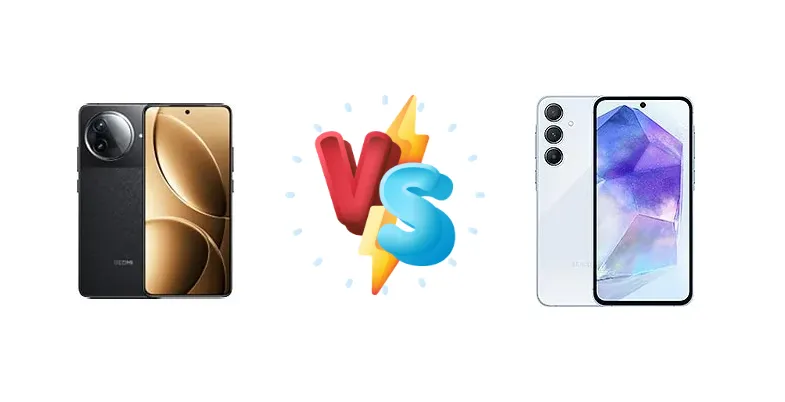
|
🏆 Quick Verdict
For users prioritizing raw power and fast charging, the Xiaomi Redmi K80 is the clear winner. Its Snapdragon 8 Gen 3 delivers significantly higher performance. However, the Samsung Galaxy A55 excels in battery life and offers a brighter, more usable display in direct sunlight, making it ideal for everyday users.
| PHONES | ||
|---|---|---|
| Phone Names | Xiaomi Redmi K80 | Samsung Galaxy A55 |
| Network | ||
|---|---|---|
| 2G bands | GSM 850 / 900 / 1800 / 1900 | GSM 850 / 900 / 1800 / 1900 |
| 3G bands | HSDPA 800 / 850 / 900 / 1700(AWS) / 2100 | HSDPA 850 / 900 / 1700(AWS) / 1900 / 2100 |
| 4G bands | 1, 3, 4, 5, 7, 8, 18, 19, 26, 28, 34, 38, 39, 40, 41, 42, 48, 66 | 1, 2, 3, 4, 5, 7, 8, 12, 17, 20, 25, 26, 28, 32, 38, 40, 41, 66 |
| 5G bands | 1, 3, 5, 7, 8, 26, 28, 38, 40, 41, 48, 66, 77, 78 SA/NSA | 1, 3, 5, 7, 8, 20, 28, 38, 40, 41, 66, 77, 78 SA/NSA/Sub6 |
| Speed | HSPA, LTE, 5G | HSPA, LTE, 5G |
| Technology | GSM / CDMA / HSPA / CDMA2000 / LTE / 5G | GSM / HSPA / LTE / 5G |
| Launch | ||
|---|---|---|
| Announced | 2024, November 27 | 2024, March 11 |
| Status | Available. Released 2024, November 27 | Available. Released 2024, March 15 |
| Body | ||
|---|---|---|
| Build | - | Glass front (Gorilla Glass Victus+), glass back (Gorilla Glass), aluminum frame |
| Dimensions | 160.3 x 75 x 8.1 mm (6.31 x 2.95 x 0.32 in) | 161.1 x 77.4 x 8.2 mm (6.34 x 3.05 x 0.32 in) |
| SIM | Nano-SIM + Nano-SIM | · Nano-SIM· Nano-SIM + eSIM· Nano-SIM + Nano-SIM· Nano-SIM + Nano-SIM + eSIM (max 2 at a time) |
| Weight | 206 g (7.27 oz) | 213 g (7.51 oz) |
| Display | ||
|---|---|---|
| Protection | Corning Gorilla Glass 7i | Corning Gorilla Glass Victus+ |
| Resolution | 1440 x 3200 pixels, 20:9 ratio (~526 ppi density) | 1080 x 2340 pixels, 19.5:9 ratio (~390 ppi density) |
| Size | 6.67 inches, 107.4 cm2 (~89.3% screen-to-body ratio) | 6.6 inches, 106.9 cm2 (~85.8% screen-to-body ratio) |
| Type | OLED, 68B colors, 120Hz, Dolby Vision, HDR10+, 1800 nits (HBM), 3200 nits (peak) | Super AMOLED, 120Hz, HDR10+, 1000 nits (HBM) |
| Platform | ||
|---|---|---|
| CPU | Octa-core (1x3.3 GHz Cortex-X4 & 3x3.2 GHz Cortex-A720 & 2x3.0 GHz Cortex-A720 & 2x2.3 GHz Cortex-A520) | Octa-core (4x2.75 GHz Cortex-A78 & 4x2.0 GHz Cortex-A55) |
| Chipset | Qualcomm SM8650-AB Snapdragon 8 Gen 3 (4 nm) | Exynos 1480 (4 nm) |
| GPU | Adreno 750 | Xclipse 530 |
| OS | Android 15, HyperOS 2 | Android 14, up to 4 major Android upgrades, One UI 6.1 |
| Memory | ||
|---|---|---|
| Card slot | No | microSDXC (uses shared SIM slot) |
| Internal | 256GB 12GB RAM, 256GB 16GB RAM, 512GB 12GB RAM, 512GB 16GB RAM, 1TB 16GB RAM | 128GB 6GB RAM, 128GB 8GB RAM, 256GB 6GB RAM, 256GB 8GB RAM, 256GB 12GB RAM |
| Main Camera | ||
|---|---|---|
| Dual | 50 MP, f/1.6, 24mm (wide), 1/1.55", 1.0µm, dual pixel PDAF, OIS 8 MP, (ultrawide) | - |
| Features | Color spectrum sensor, LED flash, HDR, panorama | LED flash, panorama, HDR |
| Triple | - | 50 MP, f/1.8, (wide), 1/1.56", 1.0µm, PDAF, OIS 12 MP, f/2.2, 123˚ (ultrawide), 1/3.06", 1.12µm 5 MP (macro) |
| Video | 8K@24fps, 4K@24/30/60fps, 1080p@30/60/120/240/960fps, 720p@1920fps, gyro-EIS | 4K@30fps, 1080p@30/60fps, gyro-EIS |
| Selfie camera | ||
|---|---|---|
| Features | HDR | - |
| Single | 20 MP, (wide) | 32 MP, f/2.2, 26mm (wide), 1/2.74", 0.8µm |
| Video | 1080p@30/60fps, gyro-EIS | 4K@30fps, 1080p@30/60fps |
| Sound | ||
|---|---|---|
| 35mm jack | No | No |
| Loudspeaker | Yes, with stereo speakers | Yes, with stereo speakers |
| Comms | ||
|---|---|---|
| Bluetooth | 5.4, A2DP, LE, aptX HD, aptX Adaptive, aptX Lossless, LHDC 5 | 5.3, A2DP, LE |
| Infrared port | Yes | - |
| NFC | Yes | Yes (market/region dependent) |
| Positioning | GPS (L1+L5), GLONASS (G1), BDS (B1I+B1c+B2a), GALILEO (E1+E5a), QZSS (L1+L5), NavIC (L5) | GPS, GALILEO, GLONASS, BDS, QZSS |
| Radio | No | No |
| USB | USB Type-C, OTG | USB Type-C 2.0, OTG |
| WLAN | Wi-Fi 802.11 a/b/g/n/ac/6e/7, dual-band, Wi-Fi Direct | Wi-Fi 802.11 a/b/g/n/ac/6, dual-band, Wi-Fi Direct |
| Features | ||
|---|---|---|
| Sensors | Fingerprint (under display, ultrasonic), accelerometer, proximity, gyro, compass | Fingerprint (under display, optical), accelerometer, gyro, compass |
| Battery | ||
|---|---|---|
| Charging | 90W wired, PD3.0, QC3+ | 25W wired |
| Type | Si/C Li-Ion 6550 mAh | Li-Ion 5000 mAh |
| Misc | ||
|---|---|---|
| Colors | Black, White, Mint, Blue | Iceblue, Lilac, Navy, Lemon |
| Models | 24117RK2CC | SM-A556V, SM-A556B, SM-A556B/DS, SM-A556E, SM-A556E/DS, SM-A5560 |
| Price | About 350 EUR | $ 324.99 / £ 251.50 / € 319.99 / ₹ 23,998 |
| SAR EU | - | 0.68 W/kg (head) 1.04 W/kg (body) |
Xiaomi Redmi K80
- Significantly faster processor with Snapdragon 8 Gen 3
- Ultra-fast 90W wired charging
- Potential for superior gaming performance
- Battery life potentially lower than A55
- Display specs currently unknown, potential for lower brightness
Samsung Galaxy A55
- Excellent battery life (13:27h active use)
- Bright and vibrant 1010 nit display
- Samsung’s refined software experience
- Slower processor compared to Snapdragon 8 Gen 3
- Slower 25W charging
Display Comparison
The Samsung Galaxy A55 boasts a measured peak brightness of 1010 nits, providing excellent visibility outdoors. While the Redmi K80’s display specs are currently unknown, Samsung’s advantage in display technology is well-established. The A55 likely benefits from Samsung’s color calibration expertise, offering more accurate colors out of the box. The K80’s display technology is unknown, but given its focus on performance, it may prioritize refresh rate over peak brightness. The A55’s panel is likely to be more power efficient, contributing to its longer battery life.
Camera Comparison
Without detailed camera specifications for the Redmi K80, a direct comparison is limited. However, the Galaxy A55’s camera system is expected to focus on computational photography and image stabilization. The K80, given its flagship chipset, likely has the processing power to handle more complex image processing algorithms. The A55’s image processing will likely prioritize color accuracy and dynamic range, while the K80 may lean towards more vibrant, social media-ready images. The absence of details on the K80’s sensor size and OIS capabilities makes it difficult to assess its low-light performance relative to the A55.
Performance
The Redmi K80’s Qualcomm Snapdragon 8 Gen 3 (4nm) is a significant leap ahead of the Galaxy A55’s Exynos 1480 (4nm). The Snapdragon 8 Gen 3 features a prime Cortex-X4 core clocked at 3.3 GHz, alongside three Cortex-A720 cores at 3.2 GHz and two more at 3.0 GHz, contrasted with the A55’s four Cortex-A78 cores at 2.75 GHz and four Cortex-A55 cores at 2.0 GHz. This architectural difference translates to substantially faster CPU performance in the K80, particularly in multi-threaded tasks. The Snapdragon’s Adreno GPU will also deliver a far superior gaming experience. While both chips are fabricated on a 4nm process, the Snapdragon 8 Gen 3’s more advanced architecture and higher clock speeds provide a clear performance advantage, though potentially at the cost of increased thermal output.
Battery Life
The Samsung Galaxy A55’s active use score of 13:27h demonstrates impressive battery endurance. The Redmi K80’s battery capacity is unknown, but its 90W wired charging significantly outperforms the A55’s 25W charging. This means the K80 can replenish its battery much faster, even if its capacity is smaller. A full charge on the K80 is likely to take under 40 minutes, while the A55 will require considerably longer. The A55’s efficiency, combined with its likely larger battery capacity, provides a clear advantage in overall battery life, while the K80 prioritizes charging speed.
Buying Guide
Buy the Xiaomi Redmi K80 if you need uncompromising performance for gaming, demanding applications, or future-proofing. Its 90W charging is a game-changer for minimizing downtime. Buy the Samsung Galaxy A55 if you prefer a more refined, balanced experience with exceptional battery life, a vibrant display, and Samsung’s established software ecosystem. It’s the better choice for users who prioritize longevity and ease of use over peak performance.