
Xiaomi Redmi K80 vs Realme GT5 Pro: A Deep Dive into Snapdragon 8 Gen 3 Flagships
| Phones Images | |||||
|---|---|---|---|---|---|
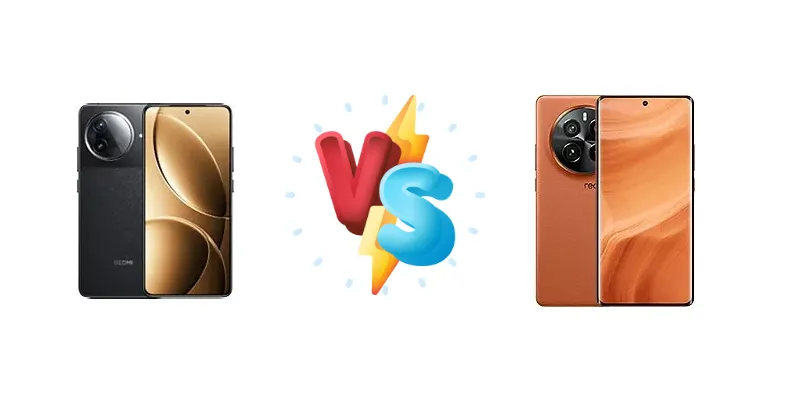
|
🏆 Quick Verdict
For the average user prioritizing all-day battery life and the fastest possible charging, the Realme GT5 Pro emerges as the winner. Its 100W wired and 50W wireless charging, coupled with a reported 14:16h active use score, provide a significant advantage. However, the Redmi K80 remains a strong contender for those seeking a slightly more affordable option.
| PHONES | ||
|---|---|---|
| Phone Names | Xiaomi Redmi K80 | Realme GT5 Pro |
| Network | ||
|---|---|---|
| 2G bands | GSM 850 / 900 / 1800 / 1900 | GSM 850 / 900 / 1800 / 1900 |
| 3G bands | HSDPA 800 / 850 / 900 / 1700(AWS) / 2100 | HSDPA 850 / 900 / 2100 |
| 4G bands | 1, 3, 4, 5, 7, 8, 18, 19, 26, 28, 34, 38, 39, 40, 41, 42, 48, 66 | 1, 3, 5, 7, 8, 28, 34, 38, 39, 40, 41 |
| 5G bands | 1, 3, 5, 7, 8, 26, 28, 38, 40, 41, 48, 66, 77, 78 SA/NSA | 1, 3, 5, 8, 28, 41, 77, 78 SA/NSA |
| Speed | HSPA, LTE, 5G | HSPA, LTE, 5G |
| Technology | GSM / CDMA / HSPA / CDMA2000 / LTE / 5G | GSM / CDMA / HSPA / CDMA2000 / LTE / 5G |
| Launch | ||
|---|---|---|
| Announced | 2024, November 27 | 2023, December 07 |
| Status | Available. Released 2024, November 27 | Available. Released 2023, December 14 |
| Body | ||
|---|---|---|
| Build | - | Glass front, glass back or silicone polymer back (eco leather), aluminum frame |
| Dimensions | 160.3 x 75 x 8.1 mm (6.31 x 2.95 x 0.32 in) | 161.7 x 75.1 x 9.2 mm (6.37 x 2.96 x 0.36 in) |
| SIM | Nano-SIM + Nano-SIM | Nano-SIM + Nano-SIM |
| Weight | 206 g (7.27 oz) | 218 g / 224 g (7.69 oz) |
| Display | ||
|---|---|---|
| Protection | Corning Gorilla Glass 7i | - |
| Resolution | 1440 x 3200 pixels, 20:9 ratio (~526 ppi density) | 1264 x 2780 pixels (~450 ppi density) |
| Size | 6.67 inches, 107.4 cm2 (~89.3% screen-to-body ratio) | 6.78 inches, 111.7 cm2 (~92.0% screen-to-body ratio) |
| Type | OLED, 68B colors, 120Hz, Dolby Vision, HDR10+, 1800 nits (HBM), 3200 nits (peak) | LTPO AMOLED, 1B colors, 144Hz, HDR10+, Dolby Vision, 4500 nits (peak) |
| Platform | ||
|---|---|---|
| CPU | Octa-core (1x3.3 GHz Cortex-X4 & 3x3.2 GHz Cortex-A720 & 2x3.0 GHz Cortex-A720 & 2x2.3 GHz Cortex-A520) | Octa-core (1x3.3 GHz Cortex-X4 & 3x3.2 GHz Cortex-A720 & 2x3.0 GHz Cortex-A720 & 2x2.3 GHz Cortex-A520) |
| Chipset | Qualcomm SM8650-AB Snapdragon 8 Gen 3 (4 nm) | Qualcomm SM8650-AB Snapdragon 8 Gen 3 (4 nm) |
| GPU | Adreno 750 | Adreno 750 |
| OS | Android 15, HyperOS 2 | Android 14, upgradable to Android 15, Realme UI 6.0 |
| Memory | ||
|---|---|---|
| Card slot | No | No |
| Internal | 256GB 12GB RAM, 256GB 16GB RAM, 512GB 12GB RAM, 512GB 16GB RAM, 1TB 16GB RAM | 256GB 12GB RAM, 256GB 16GB RAM, 512GB 16GB RAM, 1TB 16GB RAM |
| Main Camera | ||
|---|---|---|
| Dual | 50 MP, f/1.6, 24mm (wide), 1/1.55", 1.0µm, dual pixel PDAF, OIS 8 MP, (ultrawide) | - |
| Features | Color spectrum sensor, LED flash, HDR, panorama | Color spectrum sensor, Dual-LED dual-tone flash, HDR, panorama |
| Triple | - | 50 MP, f/1.7, 23mm (wide), 1/1.43", 1.12µm, dual pixel PDAF, OIS 50 MP, f/2.6, 65mm (periscope telephoto), 1/1.56", 1.0µm, multi-directional PDAF, OIS, 2.7x optical zoom 8 MP, f/2.2, 16mm, 112˚ (ultrawide), 1/4.0", 1.12µm |
| Video | 8K@24fps, 4K@24/30/60fps, 1080p@30/60/120/240/960fps, 720p@1920fps, gyro-EIS | 8K@24fps, 4K@30/60fps, 1080p@30/60fps, gyro-EIS, Dolby Vision |
| Selfie camera | ||
|---|---|---|
| Features | HDR | HDR, panorama |
| Single | 20 MP, (wide) | 32 MP, f/2.5, 22mm (wide), 1/2.74" |
| Video | 1080p@30/60fps, gyro-EIS | 4K@30fps, 1080p@30fps, gyro-EIS |
| Sound | ||
|---|---|---|
| 35mm jack | No | No |
| Loudspeaker | Yes, with stereo speakers | Yes, with stereo speakers (Dolby Atmos certified) |
| Comms | ||
|---|---|---|
| Bluetooth | 5.4, A2DP, LE, aptX HD, aptX Adaptive, aptX Lossless, LHDC 5 | 5.4, A2DP, LE, aptX HD |
| Infrared port | Yes | Yes |
| NFC | Yes | Yes, 360˚ |
| Positioning | GPS (L1+L5), GLONASS (G1), BDS (B1I+B1c+B2a), GALILEO (E1+E5a), QZSS (L1+L5), NavIC (L5) | GPS (L1+L5), GLONASS, BDS (B1I+B1c+B2a), GALILEO (E1+E5a), QZSS (L1+L5), NavIC |
| Radio | No | No |
| USB | USB Type-C, OTG | USB Type-C 3.2 |
| WLAN | Wi-Fi 802.11 a/b/g/n/ac/6e/7, dual-band, Wi-Fi Direct | Wi-Fi 802.11 a/b/g/n/ac/6/7, tri-band, Wi-Fi Direct |
| Features | ||
|---|---|---|
| Sensors | Fingerprint (under display, ultrasonic), accelerometer, proximity, gyro, compass | Fingerprint (under display, optical), accelerometer, gyro, proximity, compass |
| Battery | ||
|---|---|---|
| Charging | 90W wired, PD3.0, QC3+ | 100W wired, 50% in 12 min 50W wireless |
| Type | Si/C Li-Ion 6550 mAh | Li-Ion 5400 mAh |
| Misc | ||
|---|---|---|
| Colors | Black, White, Mint, Blue | Black, Silver, Orange |
| Models | 24117RK2CC | RMX3888 |
| Price | About 350 EUR | About 430 EUR |
Xiaomi Redmi K80
- Potentially more affordable price point
- Snapdragon 8 Gen 3 performance
- 90W fast wired charging
- No wireless charging
- Unknown battery life performance
Realme GT5 Pro
- Exceptional 1660 nits display brightness
- 100W wired and 50W wireless charging
- Long 14:16h active use battery life
- Potentially higher price
- Camera details currently limited
Display Comparison
The Realme GT5 Pro boasts a significantly brighter display, reaching a measured peak of 1660 nits. This is crucial for users who frequently use their phones outdoors in direct sunlight, offering superior readability. While the Redmi K80’s display specifications are currently unknown, the GT5 Pro’s brightness advantage is a clear win. We anticipate the Redmi K80 will likely utilize a standard AMOLED panel, while the GT5 Pro’s brightness suggests a more advanced panel technology, potentially LTPO for adaptive refresh rates and improved efficiency. Bezels and color accuracy will require further testing, but the GT5 Pro’s brightness is a standout feature.
Camera Comparison
Detailed camera analysis is hampered by limited information on the Redmi K80. The Realme GT5 Pro is advertised as having a robust camera system, but specific sensor details are missing. We can assume it will feature a primary photo and video sensor, but the quality will depend on its size, aperture, and image processing algorithms. Without knowing the Redmi K80’s camera specs, it’s difficult to make a direct comparison. The presence or absence of Optical Image Stabilization (OIS) on both devices will be a critical factor in low-light performance and video stabilization.
Performance
Both the Redmi K80 and GT5 Pro are equipped with the Qualcomm SM8650-AB Snapdragon 8 Gen 3 (4 nm) chipset, featuring an identical CPU configuration: 1x3.3 GHz Cortex-X4, 3x3.2 GHz Cortex-A720, 2x3.0 GHz Cortex-A720, and 2x2.3 GHz Cortex-A520. This means raw processing power will be nearly indistinguishable between the two. Performance differences will likely stem from thermal management and RAM configurations (which are currently unknown for the Redmi K80). The 4nm fabrication process of the Snapdragon 8 Gen 3 ensures excellent power efficiency, minimizing throttling during extended gaming sessions. However, the GT5 Pro’s larger battery could allow it to sustain peak performance for longer.
Battery Life
The Realme GT5 Pro’s battery life is a key differentiator, achieving a reported 14 hours and 16 minutes of active use. This suggests a larger battery capacity and/or more efficient power management compared to what we might expect from the Redmi K80. The GT5 Pro’s charging capabilities are also superior, offering 100W wired charging (50% charge in 12 minutes) and 50W wireless charging. The Redmi K80 supports 90W wired charging with PD3.0 and QC3+, but lacks wireless charging. For users who frequently top up their phones throughout the day, the GT5 Pro’s faster charging speeds are a significant advantage.
Buying Guide
Buy the Xiaomi Redmi K80 if you need a powerful Snapdragon 8 Gen 3 phone at a potentially lower price point and are comfortable with 90W wired charging. Buy the Realme GT5 Pro if you prioritize maximizing battery life, demand the fastest charging speeds (both wired and wireless), and value a brighter display for outdoor visibility.