
Xiaomi Redmi K80 vs OnePlus 11R: A Deep Dive into Performance and Value
| Phones Images | |||||
|---|---|---|---|---|---|
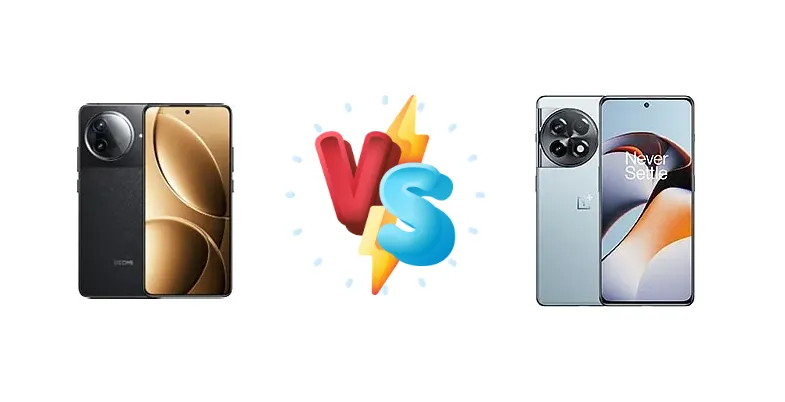
|
🏆 Quick Verdict
For users prioritizing raw performance and future-proofing, the Xiaomi Redmi K80 is the clear winner thanks to its Snapdragon 8 Gen 3. However, the OnePlus 11R offers a fantastic balance of performance, fast 100W charging, and a potentially lower price point, making it ideal for those seeking excellent value.
| PHONES | ||
|---|---|---|
| Phone Names | Xiaomi Redmi K80 | OnePlus 11R |
| Network | ||
|---|---|---|
| 2G bands | GSM 850 / 900 / 1800 / 1900 | GSM 850 / 900 / 1800 / 1900 |
| 3G bands | HSDPA 800 / 850 / 900 / 1700(AWS) / 2100 | HSDPA 850 / 900 / 1700(AWS) / 2100 |
| 4G bands | 1, 3, 4, 5, 7, 8, 18, 19, 26, 28, 34, 38, 39, 40, 41, 42, 48, 66 | 1, 3, 4, 5, 8, 28, 34, 38, 39, 40, 41 |
| 5G bands | 1, 3, 5, 7, 8, 26, 28, 38, 40, 41, 48, 66, 77, 78 SA/NSA | 1, 3, 5, 8, 28, 40, 41, 77, 78 SA/NSA |
| Speed | HSPA, LTE, 5G | HSPA, LTE (3CA), 5G |
| Technology | GSM / CDMA / HSPA / CDMA2000 / LTE / 5G | GSM / CDMA / HSPA / LTE / 5G |
| - | CDMA 800 | |
| Launch | ||
|---|---|---|
| Announced | 2024, November 27 | 2023, February 07 |
| Status | Available. Released 2024, November 27 | Available. Released 2023, February 21 |
| Body | ||
|---|---|---|
| Build | - | Glass front, glass back (Gorilla Glass 5), plastic frame |
| Dimensions | 160.3 x 75 x 8.1 mm (6.31 x 2.95 x 0.32 in) | 163.4 x 74.3 x 8.7 mm (6.43 x 2.93 x 0.34 in) |
| SIM | Nano-SIM + Nano-SIM | Nano-SIM + Nano-SIM |
| Weight | 206 g (7.27 oz) | 204 g (7.20 oz) |
| Display | ||
|---|---|---|
| Protection | Corning Gorilla Glass 7i | - |
| Resolution | 1440 x 3200 pixels, 20:9 ratio (~526 ppi density) | 1240 x 2772 pixels, 20:9 ratio (~451 ppi density) |
| Size | 6.67 inches, 107.4 cm2 (~89.3% screen-to-body ratio) | 6.74 inches, 109.2 cm2 (~90.0% screen-to-body ratio) |
| Type | OLED, 68B colors, 120Hz, Dolby Vision, HDR10+, 1800 nits (HBM), 3200 nits (peak) | Fluid AMOLED, 1B colors, 120Hz, HDR10+, 1450 nits (peak) |
| Platform | ||
|---|---|---|
| CPU | Octa-core (1x3.3 GHz Cortex-X4 & 3x3.2 GHz Cortex-A720 & 2x3.0 GHz Cortex-A720 & 2x2.3 GHz Cortex-A520) | Octa-core (1x3.0 GHz Cortex-X2 & 3x2.5 GHz Cortex-A710 & 4x1.80 GHz Cortex-A510) |
| Chipset | Qualcomm SM8650-AB Snapdragon 8 Gen 3 (4 nm) | Qualcomm SM8475 Snapdragon 8+ Gen 1 (4 nm) |
| GPU | Adreno 750 | Adreno 730 |
| OS | Android 15, HyperOS 2 | Android 13, upgradable to Android 15, OxygenOS 15 |
| Memory | ||
|---|---|---|
| Card slot | No | No |
| Internal | 256GB 12GB RAM, 256GB 16GB RAM, 512GB 12GB RAM, 512GB 16GB RAM, 1TB 16GB RAM | 128GB 8GB RAM, 256GB 16GB RAM, 512GB 18GB RAM |
| - | UFS 3.1 | |
| Main Camera | ||
|---|---|---|
| Dual | 50 MP, f/1.6, 24mm (wide), 1/1.55", 1.0µm, dual pixel PDAF, OIS 8 MP, (ultrawide) | - |
| Features | Color spectrum sensor, LED flash, HDR, panorama | Color spectrum sensor, LED flash, HDR, panorama |
| Single | - | 16 MP, f/2.4, 24mm (wide), 1/3.09", 1.0µm |
| Triple | - | 50 MP, f/1.8, 24mm (wide), 1/1.56", 1.0µm, multi-directional PDAF, OIS 8 MP, f/2.2, 120˚ (ultrawide), 1/4.0", 1.12µm 2 MP (macro) |
| Video | 8K@24fps, 4K@24/30/60fps, 1080p@30/60/120/240/960fps, 720p@1920fps, gyro-EIS | 4K@30/60fps, 1080p@30/60/240fps, gyro-EIS |
| Selfie camera | ||
|---|---|---|
| Features | HDR | HDR |
| Single | 20 MP, (wide) | 16 MP, f/2.4, 24mm (wide), 1/3.09", 1.0µm |
| Video | 1080p@30/60fps, gyro-EIS | 1080p@30fps |
| Sound | ||
|---|---|---|
| 3.5mm jack | - | No |
| 35mm jack | No | No |
| Loudspeaker | Yes, with stereo speakers | Yes, with stereo speakers |
| - | 24-bit/192kHz audio | |
| Comms | ||
|---|---|---|
| Bluetooth | 5.4, A2DP, LE, aptX HD, aptX Adaptive, aptX Lossless, LHDC 5 | 5.3, A2DP, LE, aptX HD |
| Infrared port | Yes | Yes |
| NFC | Yes | Yes |
| Positioning | GPS (L1+L5), GLONASS (G1), BDS (B1I+B1c+B2a), GALILEO (E1+E5a), QZSS (L1+L5), NavIC (L5) | GPS (L1+L5), GLONASS (G1), BDS (B1I+B1c+B2a), GALILEO (E1+E5a), QZSS (L1+L5) |
| Radio | No | No |
| USB | USB Type-C, OTG | USB Type-C 2.0 |
| WLAN | Wi-Fi 802.11 a/b/g/n/ac/6e/7, dual-band, Wi-Fi Direct | Wi-Fi 802.11 a/b/g/n/ac/6, dual-band |
| Features | ||
|---|---|---|
| Sensors | Fingerprint (under display, ultrasonic), accelerometer, proximity, gyro, compass | Fingerprint (under display, optical), accelerometer, gyro, proximity, compass |
| Battery | ||
|---|---|---|
| Charging | 90W wired, PD3.0, QC3+ | 100W wired |
| Type | Si/C Li-Ion 6550 mAh | Li-Po 5000 mAh |
| Misc | ||
|---|---|---|
| Colors | Black, White, Mint, Blue | Galactic Silver, Sonic Black, Solar Red |
| Models | 24117RK2CC | CPH2487 |
| Price | About 350 EUR | About 600 EUR |
| SAR | - | 1.16 W/kg (head) 0.61 W/kg (body) |
Xiaomi Redmi K80
- Significantly more powerful Snapdragon 8 Gen 3 chipset
- Likely superior camera system with advanced ISP
- Potential for more advanced display technology (LTPO)
- Potentially higher price point
- 90W charging is slower than the 11R’s 100W
OnePlus 11R
- Incredibly fast 100W wired charging
- Excellent value for money
- Proven performance of the Snapdragon 8+ Gen 1
- Less powerful chipset compared to the 8 Gen 3
- Potentially less advanced camera system
Display Comparison
While display specifications are missing, both phones likely feature AMOLED panels given their market segments. However, the Redmi K80, benefiting from a newer generation chipset, may incorporate more advanced display technology like LTPO for variable refresh rates, potentially leading to improved power efficiency. The OnePlus 11R, while likely offering a high refresh rate, may lack the same level of dynamic adjustment. Bezels are expected to be minimal on both, but the K80’s newer design could offer a slight edge in screen-to-body ratio.
Camera Comparison
Without detailed camera specs, it’s difficult to make definitive claims. However, the Redmi K80, as a newer device, is more likely to feature a more advanced camera system with a larger main sensor and improved image processing algorithms. The Snapdragon 8 Gen 3’s ISP (Image Signal Processor) is also significantly more capable than the 8+ Gen 1’s, enabling better low-light performance, dynamic range, and video recording capabilities. We anticipate the K80 will offer more sophisticated computational photography features. The OnePlus 11R will likely focus on delivering a solid, reliable camera experience, but may fall short of the K80 in terms of overall image quality and features.
Performance
The core difference lies in the chipsets. The Redmi K80’s Snapdragon 8 Gen 3 (4nm) boasts a significantly more powerful CPU configuration – a 1x3.3 GHz Cortex-X4 prime core, alongside 3x3.2 GHz Cortex-A720 cores, and 2x3.0 GHz Cortex-A720 cores, and 2x2.3 GHz Cortex-A520 cores – compared to the OnePlus 11R’s Snapdragon 8+ Gen 1 (4nm) with its 1x3.0 GHz Cortex-X2, 3x2.5 GHz Cortex-A710, and 4x1.80 GHz Cortex-A510. This translates to a substantial performance advantage for the K80 in CPU-intensive tasks. The 8 Gen 3’s newer architecture also provides a more powerful GPU, crucial for gaming. While both use a 4nm process, the architectural improvements in the 8 Gen 3 should result in better thermal management and sustained performance under load. The K80 likely utilizes faster LPDDR5x RAM, further enhancing performance.
Battery Life
The OnePlus 11R’s 100W wired charging is a significant advantage, promising a full charge in under 30 minutes. The Redmi K80’s 90W charging is still fast, but slower. While battery capacity is unknown for both, the 11R’s faster charging could offset a potentially smaller battery size. The Snapdragon 8 Gen 3’s improved efficiency in the K80 may also contribute to better battery life despite potentially higher power draw from the more powerful components. Both support PD3.0 and QC3+, offering versatile charging options.
Buying Guide
Buy the Xiaomi Redmi K80 if you demand the absolute best Android performance for demanding tasks like gaming and video editing, and are willing to pay a premium for the latest chipset. Buy the OnePlus 11R if you prioritize a smooth, responsive experience, incredibly fast charging, and a more budget-friendly price without sacrificing significant performance.