
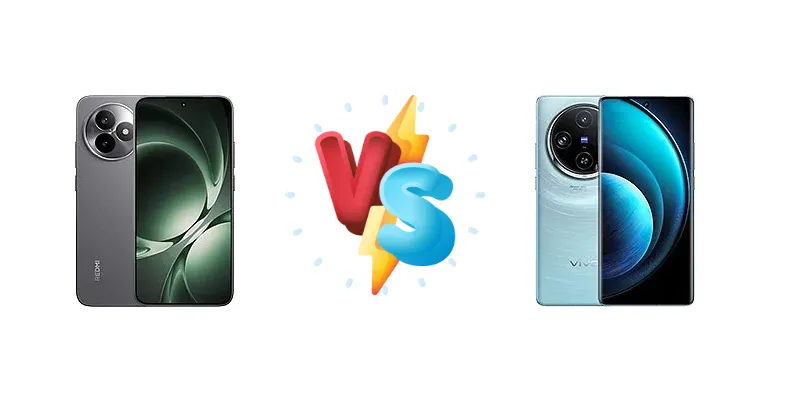
Xiaomi Redmi K80 Ultra vs. vivo X100 Pro: A Head-to-Head Flagship Showdown
| Phones Images | |||||
|---|---|---|---|---|---|
|
🏆 Quick Verdict
For the average user prioritizing all-day battery life and a consistently excellent camera, the vivo X100 Pro emerges as the winner. However, power users and mobile gamers seeking the absolute fastest CPU performance will find the Xiaomi Redmi K80 Ultra more appealing.
| PHONES | ||
|---|---|---|
| Phone Names | Xiaomi Redmi K80 Ultra | vivo X100 Pro |
| Network | ||
|---|---|---|
| 2G bands | GSM 850 / 900 / 1800 / 1900 | GSM 850 / 900 / 1800 / 1900 |
| 3G bands | HSDPA 800 / 850 / 900 / 1700(AWS) / 2100 | HSDPA 800 / 850 / 900 / 1700(AWS) / 1900 / 2100 |
| 4G bands | 1, 3, 4, 5, 7, 8, 18, 19, 26, 28, 34, 38, 39, 40, 41, 42, 48, 66 | 1, 2, 3, 4, 5, 7, 8, 12, 17, 18, 19, 20, 26, 28, 32, 38, 39, 40, 41, 42, 66 - International |
| 5G bands | 1, 3, 5, 7, 8, 26, 28, 38, 40, 41, 48, 66, 77, 78 SA/NSA | 1, 3, 5, 7, 8, 20, 28, 38, 40, 41, 66, 75, 77, 78, 79 SA/NSA - International |
| Speed | HSPA, LTE, 5G | HSPA, LTE, 5G |
| Technology | GSM / CDMA / HSPA / CDMA2000 / LTE / 5G | GSM / CDMA / HSPA / LTE / 5G |
| Launch | ||
|---|---|---|
| Announced | 2025, June 26 | 2023, November 13 |
| Status | Available. Released 2025, June 26 | Available. Released 2023, November 21 |
| Body | ||
|---|---|---|
| Build | Glass front, aluminum frame | Glass front, aluminum frame, glass back |
| Dimensions | 163.1 x 77.9 x 8.2 mm (6.42 x 3.07 x 0.32 in) | 164.1 x 75.3 x 8.9 mm or 9.1 mm |
| SIM | Nano-SIM + Nano-SIM | · Nano-SIM + eSIM· Nano-SIM + Nano-SIM |
| Weight | 219 g (7.72 oz) | 221 g or 225 g (7.80 oz) |
| Display | ||
|---|---|---|
| Protection | Scratch/drop-resistant glass | - |
| Resolution | 1280 x 2772 pixels, 19.5:9 ratio (~447 ppi density) | 1260 x 2800 pixels, 20:9 ratio (~452 ppi density) |
| Size | 6.83 inches, 114.5 cm2 (~90.2% screen-to-body ratio) | 6.78 inches, 111.5 cm2 (~90.2% screen-to-body ratio) |
| Type | OLED, 68B colors, 144Hz, Dolby Vision, HDR10+, HDR Vivid, 1800 nits (HBM), 3200 nits (peak) | LTPO AMOLED, 1B colors, 120Hz, HDR10+, 3000 nits (peak) |
| Platform | ||
|---|---|---|
| CPU | Octa-core (1x3.63 GHz Cortex-X925 & 3x3.3 GHz Cortex-X4 & 4x2.4 GHz Cortex-A720) | Octa-core (1x3.25 GHz Cortex-X4 & 3x2.85 GHz Cortex-X4 & 4x2.0 GHz Cortex-A720) |
| Chipset | Mediatek Dimensity 9400+ (3 nm) | Mediatek Dimensity 9300 (4 nm) |
| GPU | Immortalis-G925 | Immortalis-G720 MC12 |
| OS | Android 15, HyperOS 2 | Android 14, upgradable to Android 15, Funtouch 15 (International), OriginOS 4 (China) |
| Memory | ||
|---|---|---|
| Card slot | No | No |
| Internal | 256GB 12GB RAM, 256GB 16GB RAM, 512GB 12GB RAM, 512GB 16GB RAM, 1TB 16GB RAM | 256GB 12GB RAM, 256GB 16GB RAM, 512GB 16GB RAM, 1TB 16GB RAM |
| Main Camera | ||
|---|---|---|
| Dual | 50 MP, f/1.9, 23mm (wide), 1/1.55", 1.0µm, PDAF, OIS 8 MP, 119˚ (ultrawide), 1/4.0", 1.12µm | - |
| Features | Color spectrum sensor, Dual-LED dual-tone flash, HDR, panorama | Laser AF, color spectrum sensor, Zeiss optics, Zeiss T* lens coating, LED flash, panorama, HDR, 3D LUT import |
| Triple | - | 50 MP, f/1.8, 23mm (wide), 1/0.98", 1.6µm, dual pixel PDAF, OIS 50 MP, f/2.5, 100mm (periscope telephoto), 1/2.51", 0.7µm, PDAF (18cm - ∞), OIS, 4.3x optical zoom 50 MP, f/2.0, 15mm, 119˚ (ultrawide), 1/2.76", 0.64µm, AF |
| Video | 8K@30fps, 4K@30/60fps, 1080p@30/60/120/240/960fps, gyro-EIS | 8K@30fps, 4K@30/60fps, 1080p, gyro-EIS |
| Selfie camera | ||
|---|---|---|
| Features | HDR | HDR |
| Single | 20 MP, (wide), 1/2.0", 0.8µm | 32 MP, f/2.0, 20mm (ultrawide) |
| Video | 1080p@30/60fps | 4K@30/60fps, 1080p@30/60fps |
| Sound | ||
|---|---|---|
| 35mm jack | No | No |
| Loudspeaker | Yes, with stereo speakers | Yes, with stereo speakers |
| Comms | ||
|---|---|---|
| Bluetooth | 5.4, A2DP, LE, LHDC 5 | 5.4, A2DP, LE, aptX HD, LHDC |
| Infrared port | Yes | Yes |
| NFC | Yes | Yes |
| Positioning | GPS (L1+L5), BDS (B1I+B1C+B2a+B2b), GALILEO (E1+E5a+E5b), QZSS (L1+L5), NavIC, GLONASS | GPS (L1+L5), GLONASS (L1), BDS (B1I+B1c+B2a+B2b), GALILEO (E1+E5a+E5b), QZSS (L1+L5), NavIC (L5) |
| Radio | Unspecified | No |
| USB | USB Type-C | USB Type-C 3.2, OTG |
| WLAN | Wi-Fi 802.11 a/b/g/n/ac/6/7, dual-band, Wi-Fi Direct | Wi-Fi 802.11 a/b/g/n/ac/6/7, tri-band, Wi-Fi Direct |
| Features | ||
|---|---|---|
| Sensors | Fingerprint (under display, ultrasonic), accelerometer, gyro, proximity, compass | Fingerprint (under display, optical), accelerometer, gyro, proximity, compass |
| Battery | ||
|---|---|---|
| Charging | 100W wired, PD3.0 Bypass charging | 100W wired, 50% in 14 min 50W wireless Reverse wired |
| Type | Si/C Li-Ion 7410 mAh | Li-Ion 5400 mAh |
| Misc | ||
|---|---|---|
| Colors | Gray, White, Blue, Green | Startrail Blue, Asteroid Black, Sunset Orange, White |
| Models | - | V2324A, V2309 |
| Price | About 310 EUR | ₹ 59,999 |
| SAR EU | - | 0.99 W/kg (head) 1.19 W/kg (body) |
Xiaomi Redmi K80 Ultra
- Potentially faster CPU performance with Dimensity 9400+
- PD3.0 wired charging compatibility
- Likely more affordable price point
- Potentially shorter battery life
- Camera system may not be as advanced as the X100 Pro
vivo X100 Pro
- Exceptional battery life (13:53h active use)
- Brighter display (1472 nits)
- 50W wireless and reverse wired charging
- Dimensity 9300 may be slightly slower than the 9400+
- Potentially higher price
Display Comparison
The vivo X100 Pro boasts a significantly brighter display, reaching a measured peak of 1472 nits, ensuring excellent visibility even in direct sunlight. While the K80 Ultra’s display specs are currently unknown, vivo’s panel offers a superior viewing experience in bright conditions. The X100 Pro likely utilizes LTPO technology for adaptive refresh rates, contributing to battery efficiency, a feature we anticipate the K80 Ultra may lack. Bezels and color accuracy will require hands-on testing, but the X100 Pro’s brightness advantage is a clear win.
Camera Comparison
The vivo X100 Pro is positioned as a camera-centric device, and while specific sensor details are missing for both phones, vivo’s history suggests a focus on image quality and computational photography. The X100 Pro’s camera system is designed for both photo and video, likely featuring advanced OIS and large apertures for low-light performance. The K80 Ultra, while capable, is likely to prioritize overall performance over camera specialization. We can expect the X100 Pro to excel in dynamic range and detail, while the K80 Ultra may offer a more neutral image processing style.
Performance
The Xiaomi Redmi K80 Ultra’s Mediatek Dimensity 9400+ (3nm) chipset, with its Cortex-X925 prime core clocked at 3.63 GHz, is designed for peak performance, theoretically surpassing the vivo X100 Pro’s Dimensity 9300 (4nm). The 9400+’s architecture, featuring more Cortex-X4 cores (3 vs 3 in the 9300), suggests a stronger focus on multi-core performance. However, the 4nm process of the 9300 may offer better thermal efficiency, potentially mitigating throttling under sustained load. The K80 Ultra’s LPDDR5x RAM configuration is standard, but the 9300’s optimized architecture could deliver comparable real-world performance despite the clock speed difference.
Battery Life
The vivo X100 Pro’s 13:53h active use score demonstrates impressive battery endurance, a significant advantage over what we might expect from a performance-focused device like the K80 Ultra. Both phones support 100W wired charging, with the X100 Pro reaching 50% charge in 14 minutes. However, the X100 Pro adds the convenience of 50W wireless charging and reverse wired charging, offering greater flexibility. The K80 Ultra’s PD3.0 support is a welcome addition for compatibility with a wider range of chargers, but the X100 Pro’s overall battery package is more compelling.
Buying Guide
Buy the Xiaomi Redmi K80 Ultra if you need uncompromising CPU performance for demanding tasks like video editing, emulation, or competitive mobile gaming. Its Dimensity 9400+ offers a clear advantage in raw processing power. Buy the vivo X100 Pro if you prefer a more balanced experience with exceptional camera quality, long-lasting battery life (13:53h active use), and the convenience of 50W wireless charging.