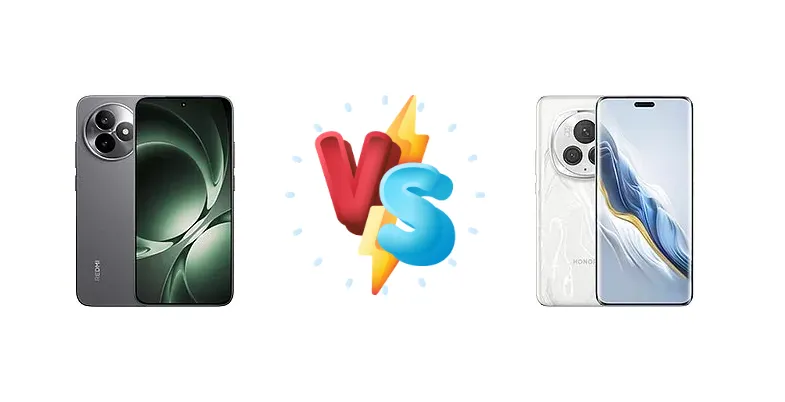
The Xiaomi Redmi K80 Ultra and Honor Magic6 Pro represent compelling choices in the increasingly competitive flagship smartphone market. The K80 Ultra aims to deliver top-tier performance with the latest MediaTek Dimensity 9400+ chipset, while the Honor Magic6 Pro counters with Qualcomm’s Snapdragon 8 Gen 3 and a focus on extended battery life and fast charging. This comparison dissects their key differences to help you choose the right device.
🏆 Quick Verdict
For the average user prioritizing raw performance and rapid charging, the Xiaomi Redmi K80 Ultra emerges as the winner. Its Dimensity 9400+ chipset promises a performance edge, and the 100W charging is significantly faster than the Honor Magic6 Pro’s 80W wired and 66W wireless options. However, the Magic6 Pro’s superior battery life is a strong contender for power users.
| Network |
|---|
| 2G bands | GSM 850 / 900 / 1800 / 1900 | GSM 850 / 900 / 1800 / 1900 |
| 3G bands | HSDPA 800 / 850 / 900 / 1700(AWS) / 2100 | HSDPA 800 / 850 / 900 / 1700(AWS) / 1900 / 2100 |
| 4G bands | 1, 3, 4, 5, 7, 8, 18, 19, 26, 28, 34, 38, 39, 40, 41, 42, 48, 66 | LTE |
| 5G bands | 1, 3, 5, 7, 8, 26, 28, 38, 40, 41, 48, 66, 77, 78 SA/NSA | SA/NSA |
| Speed | HSPA, LTE, 5G | HSPA, LTE, 5G |
| Technology | GSM / CDMA / HSPA / CDMA2000 / LTE / 5G | GSM / CDMA / HSPA / CDMA2000 / LTE / 5G |
| Launch |
|---|
| Announced | 2025, June 26 | 2024, January 11 |
| Status | Available. Released 2025, June 26 | Available. Released 2024, January 18 |
| Body |
|---|
| Build | Glass front, aluminum frame | Glass front (NanoCrystal Shield), glass back or silicone polymer back (eco leather) |
| Dimensions | 163.1 x 77.9 x 8.2 mm (6.42 x 3.07 x 0.32 in) | 162.5 x 75.8 x 8.9 mm (6.40 x 2.98 x 0.35 in) |
| SIM | Nano-SIM + Nano-SIM | · Nano-SIM + eSIM· Nano-SIM + Nano-SIM |
| Weight | 219 g (7.72 oz) | 225 g or 229 g (7.94 oz) |
| Display |
|---|
| Protection | Scratch/drop-resistant glass | NanoCrystal Shield |
| Resolution | 1280 x 2772 pixels, 19.5:9 ratio (~447 ppi density) | 1280 x 2800 pixels, 19.5:9 ratio (~453 ppi density) |
| Size | 6.83 inches, 114.5 cm2 (~90.2% screen-to-body ratio) | 6.8 inches, 112.8 cm2 (~91.6% screen-to-body ratio) |
| Type | OLED, 68B colors, 144Hz, Dolby Vision, HDR10+, HDR Vivid, 1800 nits (HBM), 3200 nits (peak) | LTPO OLED, 1B colors, 120Hz, Dolby Vision, HDR, 1600 nits (HBM), 5000 nits (peak) |
| Platform |
|---|
| CPU | Octa-core (1x3.63 GHz Cortex-X925 & 3x3.3 GHz Cortex-X4 & 4x2.4 GHz Cortex-A720) | Octa-core (1x3.3 GHz Cortex-X4 & 3x3.2 GHz Cortex-A720 & 2x3.0 GHz Cortex-A720 & 2x2.3 GHz Cortex-A520) |
| Chipset | Mediatek Dimensity 9400+ (3 nm) | Qualcomm SM8650-AB Snapdragon 8 Gen 3 (4 nm) |
| GPU | Immortalis-G925 | Adreno 750 |
| OS | Android 15, HyperOS 2 | Android 14, up to 4 major Android upgrades, MagicOS 8 |
| Memory |
|---|
| Card slot | No | No |
| Internal | 256GB 12GB RAM, 256GB 16GB RAM, 512GB 12GB RAM, 512GB 16GB RAM, 1TB 16GB RAM | 256GB 12GB RAM, 256GB 16GB RAM, 512GB 12GB RAM, 512GB 16GB RAM, 1TB 16GB RAM |
| Main Camera |
|---|
| Dual | 50 MP, f/1.9, 23mm (wide), 1/1.55", 1.0µm, PDAF, OIS
8 MP, 119˚ (ultrawide), 1/4.0", 1.12µm | - |
| Features | Color spectrum sensor, Dual-LED dual-tone flash, HDR, panorama | Laser AF, color spectrum sensor, LED flash, HDR, panorama |
| Triple | - | 50 MP, f/1.4-2.0, 23mm (wide), 1/1.3", 1.2µm, PDAF, OIS
180 MP, f/2.6, (periscope telephoto), 1/1.49", 0.56µm, PDAF, OIS, 2.5x optical zoom
50 MP, f/2.0, 13mm, 122˚ (ultrawide), 1/2.88", 0.61µm, AF |
| Video | 8K@30fps, 4K@30/60fps, 1080p@30/60/120/240/960fps, gyro-EIS | 4K@24/30/60fps, 1080p@30/60/120/240fps, gyro-EIS, OIS, HDR, 10-bit video |
| Selfie camera |
|---|
| Features | HDR | - |
| Single | 20 MP, (wide), 1/2.0", 0.8µm | 50 MP, f/2.0, 22mm (wide), 1/2.93", 0.6µm, AF
TOF 3D, (depth/biometrics sensor) |
| Video | 1080p@30/60fps | 4K@30fps, 1080p@30/60fps, gyro-EIS |
| Sound |
|---|
| 35mm jack | No | No |
| Loudspeaker | Yes, with stereo speakers | Yes, with stereo speakers |
| Comms |
|---|
| Bluetooth | 5.4, A2DP, LE, LHDC 5 | 5.3, A2DP, LE, aptX HD |
| Infrared port | Yes | Yes |
| NFC | Yes | Yes |
| Positioning | GPS (L1+L5), BDS (B1I+B1C+B2a+B2b), GALILEO (E1+E5a+E5b), QZSS (L1+L5), NavIC, GLONASS | GPS (L1+L5), GLONASS, BDS (B1I+B1c+B2a), GALILEO (E1+E5a) |
| Radio | Unspecified | No |
| USB | USB Type-C | USB Type-C 3.2, DisplayPort 1.2, OTG |
| WLAN | Wi-Fi 802.11 a/b/g/n/ac/6/7, dual-band, Wi-Fi Direct | Wi-Fi 802.11 a/b/g/n/ac/6/7, dual-band, Wi-Fi Direct |
| Features |
|---|
| Sensors | Fingerprint (under display, ultrasonic), accelerometer, gyro, proximity, compass | Fingerprint (under display, optical), Face ID, accelerometer, gyro, proximity, compass |
| Battery |
|---|
| Charging | 100W wired, PD3.0
Bypass charging | 80W wired
66W wireless
Reverse wireless
5W reverse wired |
| Type | Si/C Li-Ion 7410 mAh | Si/C Li-Ion 5600 mAh |
| Misc |
|---|
| Colors | Gray, White, Blue, Green | Black, Green, Blue, Purple, White |
| Models | - | BVL-AN16, BVL-N49 |
| Price | About 310 EUR | € 455.54 / $ 899.00 / £ 598.99 |
Xiaomi Redmi K80 Ultra
- Potentially faster CPU performance with Dimensity 9400+
- Significantly faster 100W wired charging
- Bypass charging minimizes battery degradation
- Likely lower peak display brightness
- Battery life likely shorter than the Magic6 Pro
Honor Magic6 Pro
- Exceptional battery life (14:06h active use)
- Brighter display (1578 nits)
- Wireless charging and reverse wireless charging
- Slower wired charging (80W)
- Snapdragon 8 Gen 3 may be slightly less performant in CPU tasks
Display Comparison
The Honor Magic6 Pro boasts a significantly brighter display, reaching a measured 1578 nits, making it ideal for outdoor use under direct sunlight. While the Redmi K80 Ultra’s display specifications are not provided, it’s likely to be a high-quality panel, but will likely fall short of the Magic6 Pro’s peak brightness. The Magic6 Pro’s panel technology is likely LTPO, enabling variable refresh rates for improved power efficiency, a feature not confirmed for the K80 Ultra. Bezels and color accuracy are unknown for both, but the Magic6 Pro’s higher brightness suggests a more advanced display overall.
Camera Comparison
Camera details are limited, but the focus should be on the main sensors and image processing. Without specific sensor sizes or aperture information, it’s difficult to definitively declare a winner. However, the Honor Magic6 Pro’s brand history suggests a strong emphasis on computational photography, potentially delivering more refined images in challenging conditions. The Redmi K80 Ultra, while likely equipped with a capable camera system, may prioritize speed and raw image data. The absence of details regarding OIS on either device makes it difficult to assess low-light performance.
Performance
The core of the performance difference lies in the chipsets. The Redmi K80 Ultra’s MediaTek Dimensity 9400+ (3nm) features a unique CPU configuration with a Cortex-X925 prime core clocked at 3.63 GHz, suggesting a focus on single-core performance. The Honor Magic6 Pro utilizes the Qualcomm Snapdragon 8 Gen 3 (4nm) with a Cortex-X4 prime core at 3.3 GHz. While the Snapdragon 8 Gen 3 is a proven performer, the Dimensity 9400+’s newer architecture and higher clock speed on its prime core could translate to a performance advantage in CPU-intensive tasks. The K80 Ultra’s LPDDR5x RAM is standard for flagships, and the 4nm process of the Snapdragon 8 Gen 3 offers better thermal efficiency, potentially mitigating throttling during sustained loads. The Dimensity 9400+'s 3nm process should also contribute to improved efficiency.
Battery Life
The Honor Magic6 Pro demonstrates a clear advantage in battery life, achieving an active use score of 14:06 hours. This suggests a highly optimized power management system and potentially a larger battery capacity (though not specified). The Redmi K80 Ultra compensates with significantly faster charging: 100W wired charging with PD3.0 and bypass charging will deliver a full charge much quicker than the Magic6 Pro’s 80W wired and 66W wireless options. The Magic6 Pro also offers 5W reverse wired charging, a niche feature for topping up accessories, but the K80 Ultra’s faster charging is more impactful for daily use.
Buying Guide
Buy the Xiaomi Redmi K80 Ultra if you need uncompromising processing power for demanding games and applications, and value the fastest possible wired charging speeds. Buy the Honor Magic6 Pro if you prioritize all-day battery life, appreciate the convenience of wireless charging, and desire a brighter display for outdoor visibility. The Magic6 Pro is geared towards users who value longevity and convenience over peak performance.
Frequently Asked Questions
❓ Does the Dimensity 9400+ in the Redmi K80 Ultra generate excessive heat during prolonged gaming sessions?
The Dimensity 9400+'s 3nm process should contribute to improved thermal efficiency compared to older chipsets. However, sustained gaming will inevitably generate heat. The K80 Ultra’s thermal management system will be crucial, and independent reviews will be needed to assess throttling performance under load. The Snapdragon 8 Gen 3 in the Magic6 Pro, built on a 4nm process, is also efficient, but the K80 Ultra’s higher clock speeds could lead to more heat output.
❓ How does the 66W wireless charging on the Honor Magic6 Pro compare to the 80W wired charging in terms of real-world charging time?
While 66W wireless charging is convenient, it’s significantly slower than 80W wired charging. A full charge via 80W wired charging will likely take under 40 minutes, whereas 66W wireless charging could take over an hour and a half. The Redmi K80 Ultra’s 100W wired charging further widens the gap, offering the fastest charging experience.
❓ Is the reverse wireless charging on the Honor Magic6 Pro useful for charging accessories like earbuds or smartwatches?
The 5W reverse wired and 66W wireless reverse charging on the Honor Magic6 Pro is primarily for convenience. It's suitable for slowly topping up small accessories like earbuds or smartwatches, but it won't rapidly charge them. It's a niche feature, but can be useful in a pinch when a dedicated charger isn't available.