
Xiaomi K80 Pro vs 14 Pro: A Deep Dive into Xiaomi's Flagship Showdown
| Phones Images | |||||
|---|---|---|---|---|---|
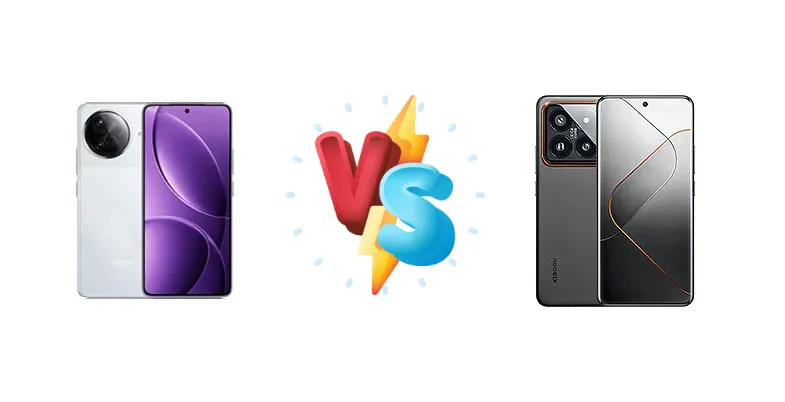
|
🏆 Quick Verdict
For most users, the Xiaomi 14 Pro emerges as the superior choice. While the K80 Pro boasts impressive specs, the 14 Pro’s Snapdragon 8 Gen 3, coupled with its faster charging (18 minutes vs 28) and potentially refined software experience, justifies the price premium. However, gamers prioritizing raw CPU power may find the K80 Pro’s Oryon cores appealing.
| PHONES | ||
|---|---|---|
| Phone Names | Xiaomi Redmi K80 Pro | Xiaomi 14 Pro |
| Network | ||
|---|---|---|
| 2G bands | GSM 850 / 900 / 1800 / 1900 | GSM 850 / 900 / 1800 / 1900 |
| 3G bands | HSDPA 800 / 850 / 900 / 1700(AWS) / 2100 | HSDPA 800 / 850 / 900 / 1700(AWS) / 1900 / 2100 |
| 4G bands | 1, 3, 4, 5, 7, 8, 18, 19, 26, 28, 34, 38, 39, 40, 41, 42, 48, 66 | 1, 3, 4, 5, 7, 8, 18, 19, 26, 28, 34, 38, 39, 40, 41, 42, 48, 66 |
| 5G bands | 1, 3, 5, 7, 8, 26, 28, 38, 40, 41, 48, 66, 77, 78, 80, 81, 83, 84, 89 SA/NSA | 1, 3, 5, 7, 8, 28, 38, 40, 41, 48, 66, 77, 78, 79 SA/NSA |
| Speed | HSPA, LTE, 5G | HSPA, LTE, 5G |
| Technology | GSM / CDMA / HSPA / CDMA2000 / LTE / 5G | GSM / CDMA / HSPA / CDMA2000 / LTE / 5G |
| Launch | ||
|---|---|---|
| Announced | 2024, November 27 | 2023, October 26 |
| Status | Available. Released 2024, November 27 | Available. Released 2023, November 01 |
| Body | ||
|---|---|---|
| Build | - | Glass front, aluminum frame or titanium frame, glass back |
| Dimensions | 160.3 x 75 x 8.4 mm (6.31 x 2.95 x 0.33 in) | 161.4 x 75.3 x 8.5 mm |
| SIM | Nano-SIM + Nano-SIM | Nano-SIM + Nano-SIM |
| Weight | 212 g or 217 g (7.48 oz) | 223 g or 230 g (7.87 oz) |
| Display | ||
|---|---|---|
| Protection | Longjing glass 2 | Shatterproof glass |
| Resolution | 1440 x 3200 pixels, 20:9 ratio (~526 ppi density) | 1440 x 3200 pixels, 20:9 ratio (~522 ppi density) |
| Size | 6.67 inches, 107.4 cm2 (~89.3% screen-to-body ratio) | 6.73 inches, 108.9 cm2 (~89.6% screen-to-body ratio) |
| Type | OLED, 68B colors, 120Hz, Dolby Vision, HDR10+, 1800 nits (HBM), 3200 nits (peak) | LTPO AMOLED, 68B colors, 120Hz, Dolby Vision, HDR10+, 3000 nits (peak) |
| Platform | ||
|---|---|---|
| CPU | Octa-core (2x4.32 GHz Oryon V2 Phoenix L + 6x3.53 GHz Oryon V2 Phoenix M) | Octa-core (1x3.3 GHz Cortex-X4 & 3x3.2 GHz Cortex-A720 & 2x3.0 GHz Cortex-A720 & 2x2.3 GHz Cortex-A520) |
| Chipset | Qualcomm SM8750-AB Snapdragon 8 Elite (3 nm) | Qualcomm SM8650-AB Snapdragon 8 Gen 3 (4 nm) |
| GPU | Adreno 830 | Adreno 750 |
| OS | Android 15, HyperOS 2 | Android 14, HyperOS |
| Memory | ||
|---|---|---|
| Card slot | No | No |
| Internal | 256GB 12GB RAM, 512GB 12GB RAM, 512GB 16GB RAM, 1TB 16GB RAM | 256GB 12GB RAM, 512GB 16GB RAM, 1TB 16GB RAM |
| Main Camera | ||
|---|---|---|
| Features | Color spectrum sensor, LED flash, HDR, panorama | Laser AF, color spectrum sensor, Leica lens, Dual-LED dual-tone flash, HDR, panorama |
| Triple | 50 MP, f/1.6, 24mm (wide), 1/1.55", 1.0µm, dual pixel PDAF, OIS 50 MP, f/2.0, 60mm (telephoto), 1/2.76", 0.64µm, PDAF (10cm - ∞), OIS, 2.5x optical zoom 32 MP, f/2.2, 15mm, 120˚ (ultrawide) | 50 MP, f/1.4-f/4.0, 23mm (wide), 1/1.31", 1.2µm, dual pixel PDAF, OIS 50 MP, f/2.0, 75mm (telephoto), PDAF (10cm - ∞), OIS, 3.2x optical zoom 50 MP, f/2.2, 14mm, 115˚ (ultrawide), AF |
| Video | 8K@24fps, 4K@24/30/60fps, 1080p@30/60/120/240/960fps, 720p@1920fps, gyro-EIS | 8K@24fps (HDR), 4K@24/30/60fps (HDR10+, 10-bit Dolby Vision HDR, 10-bit LOG), 1080p@30/60/120/240/960fps, 720p@1920fps, gyro-EIS |
| Selfie camera | ||
|---|---|---|
| Features | HDR | HDR, panorama |
| Single | 20 MP, (wide) | 32 MP, f/2.0, 22mm (wide), 0.7µm |
| Video | 1080p@30/60fps, gyro-EIS | 4K@30/60fps, 1080p@30/60fps, gyro-EIS |
| Sound | ||
|---|---|---|
| 35mm jack | No | No |
| Loudspeaker | Yes, with stereo speakers | Yes, with stereo speakers |
| Comms | ||
|---|---|---|
| Bluetooth | 6.0, A2DP, LE, aptX HD, aptX Adaptive, aptX Lossless, LHDC 5 | 5.4, A2DP, LE, aptX HD, aptX Adaptive |
| Infrared port | Yes | Yes |
| NFC | Yes | Yes |
| Positioning | GPS (L1+L5), GLONASS (G1), BDS (B1I+B1c+B2a), GALILEO (E1+E5a), QZSS (L1+L5), NavIC (L5) | GPS (L1+L5), GLONASS (G1), BDS (B1I+B1c+B2a), GALILEO (E1+E5a), QZSS (L1+L5), NavIC (L5) |
| Radio | No | No |
| USB | USB Type-C, OTG | USB Type-C 3.2 Gen 2, OTG |
| WLAN | Wi-Fi 802.11 a/b/g/n/ac/6e/7, dual-band, Wi-Fi Direct | Wi-Fi 802.11 a/b/g/n/ac/6e/7, dual-band, Wi-Fi Direct |
| Features | ||
|---|---|---|
| Sensors | Fingerprint (under display, ultrasonic), accelerometer, proximity, gyro, compass | Fingerprint (under display, optical), accelerometer, proximity, gyro, compass, barometer |
| Battery | ||
|---|---|---|
| Charging | 120W wired, PD3.0, QC3+, 100% in 28 min 50W wireless | 120W wired, PD3.0, QC4, 100% in 18 min 50W wireless, 100% in 40 min 10W reverse wireless |
| Type | Si/C Li-Ion 6000 mAh | Li-Po 4880 mAh |
| Misc | ||
|---|---|---|
| Colors | Black, White, Mint, Lamborgini Green, Lamborgini Black | Black, Silver, Titanium, Green |
| Models | 24122RKC7C | 23116PN5BC |
| Price | About 500 EUR | About 650 EUR |
Xiaomi Redmi K80 Pro
- Potentially superior CPU performance due to Oryon cores.
- 3nm Snapdragon 8 Elite may offer better power efficiency.
- Likely more affordable price point.
- Slower charging speed (28 minutes vs 18 minutes).
- Potentially less refined software experience.
- Camera system likely less advanced than the 14 Pro.
Xiaomi 14 Pro
- Faster 120W charging (18 minutes 0-100%).
- Snapdragon 8 Gen 3 offers excellent all-around performance.
- Likely superior camera system and image processing.
- Higher price point.
- 4nm process may be slightly less power efficient than 3nm.
- CPU performance may be slightly lower in sustained multi-core tasks.
Display Comparison
While both devices are expected to feature high-quality AMOLED displays, specific details like peak brightness and refresh rate are missing. However, the Xiaomi 14 Pro, being a flagship, likely benefits from a more advanced panel with potentially higher peak brightness and more accurate color calibration. The inclusion of LTPO technology in the 14 Pro is probable, enabling adaptive refresh rates for improved battery efficiency, a feature not confirmed for the K80 Pro.
Camera Comparison
Without detailed camera specs, a direct comparison is difficult. However, the Xiaomi 14 Pro, as the flagship, is expected to feature a more sophisticated camera system, potentially with a larger main sensor and more advanced image processing algorithms. The 14 Pro likely benefits from improved optical image stabilization (OIS) and potentially a variable aperture for greater versatility. While both phones will likely offer excellent image quality, the 14 Pro’s camera is expected to excel in low-light conditions and dynamic range.
Performance
The core difference lies in the chipsets. The Redmi K80 Pro’s Snapdragon 8 Elite (3nm) utilizes Oryon V2 Phoenix cores, promising exceptional CPU performance with its 4.32 GHz clock speeds. This contrasts with the Xiaomi 14 Pro’s Snapdragon 8 Gen 3 (4nm) which employs a more traditional ARM Cortex-X4 prime core at 3.3 GHz. The 3nm process of the 8 Elite *should* offer better power efficiency, but the Gen 3’s architectural improvements and optimized software integration could mitigate this advantage. The K80 Pro’s CPU architecture is geared towards sustained multi-core performance, while the 14 Pro’s focuses on single-core responsiveness. Both utilize LPDDR5x RAM, but the speed and configuration could vary.
Battery Life
Both phones offer 120W wired charging and 50W wireless charging. However, the Xiaomi 14 Pro significantly reduces the 0-100% wired charging time to 18 minutes, compared to the K80 Pro’s 28 minutes. This faster charging is a substantial advantage for users who prioritize convenience. Wireless charging takes 40 minutes on the 14 Pro versus an unspecified time on the K80 Pro. While battery capacity isn’t specified, the faster charging of the 14 Pro effectively mitigates any potential capacity disadvantage.
Buying Guide
Buy the Xiaomi Redmi K80 Pro if you prioritize raw CPU performance for demanding tasks like emulation or content creation and want a flagship-level experience at a potentially lower price point. Buy the Xiaomi 14 Pro if you value a more polished software experience, faster charging speeds, and a potentially more refined camera system, even if it means paying a premium.