
Xiaomi Redmi K80 Pro vs. vivo iQOO 12 Pro: A Head-to-Head Performance and Charging Showdown
| Phones Images | |||||
|---|---|---|---|---|---|
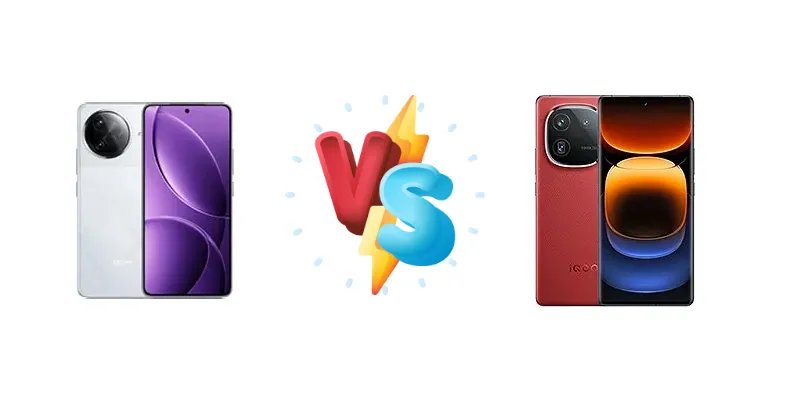
|
🏆 Quick Verdict
For users prioritizing peak CPU performance and potentially longer software support due to the newer Oryon architecture, the Xiaomi Redmi K80 Pro is the winner. However, the iQOO 12 Pro offers a more mature and broadly optimized experience with the Snapdragon 8 Gen 3, making it a strong contender for those valuing stability and established features.
| PHONES | ||
|---|---|---|
| Phone Names | Xiaomi Redmi K80 Pro | vivo iQOO 12 Pro |
| Network | ||
|---|---|---|
| 2G bands | GSM 850 / 900 / 1800 / 1900 | GSM 850 / 900 / 1800 / 1900 |
| 3G bands | HSDPA 800 / 850 / 900 / 1700(AWS) / 2100 | HSDPA 800 / 850 / 900 / 1700(AWS) / 1900 / 2100 |
| 4G bands | 1, 3, 4, 5, 7, 8, 18, 19, 26, 28, 34, 38, 39, 40, 41, 42, 48, 66 | 1, 2, 3, 4, 5, 7, 8, 12, 17, 18, 19, 20, 25, 26, 28, 34, 38, 39, 40, 41, 42, 66 |
| 5G bands | 1, 3, 5, 7, 8, 26, 28, 38, 40, 41, 48, 66, 77, 78, 80, 81, 83, 84, 89 SA/NSA | 1, 2, 3, 5, 7, 8, 12, 20, 25, 26, 28, 66, 38, 40, 41, 77, 78 SA/NSA |
| Speed | HSPA, LTE, 5G | HSPA, LTE, 5G |
| Technology | GSM / CDMA / HSPA / CDMA2000 / LTE / 5G | GSM / CDMA / HSPA / CDMA2000 / LTE / 5G |
| Launch | ||
|---|---|---|
| Announced | 2024, November 27 | 2023, November 07 |
| Status | Available. Released 2024, November 27 | Available. Released 2023, November 14 |
| Body | ||
|---|---|---|
| Dimensions | 160.3 x 75 x 8.4 mm (6.31 x 2.95 x 0.33 in) | 164.6 x 75.4 x 8.6 mm or 8.8 mm |
| SIM | Nano-SIM + Nano-SIM | Nano-SIM + Nano-SIM |
| Weight | 212 g or 217 g (7.48 oz) | 205 g or 210 g (7.23 oz) |
| Display | ||
|---|---|---|
| Protection | Longjing glass 2 | - |
| Resolution | 1440 x 3200 pixels, 20:9 ratio (~526 ppi density) | 1440 x 3200 pixels, 20:9 ratio (~518 ppi density) |
| Size | 6.67 inches, 107.4 cm2 (~89.3% screen-to-body ratio) | 6.78 inches, 111.0 cm2 (~89.4% screen-to-body ratio) |
| Type | OLED, 68B colors, 120Hz, Dolby Vision, HDR10+, 1800 nits (HBM), 3200 nits (peak) | LTPO AMOLED, 1B colors, 144Hz, HDR10+, 1600 nits (HBM), 3000 nits (peak) |
| Platform | ||
|---|---|---|
| CPU | Octa-core (2x4.32 GHz Oryon V2 Phoenix L + 6x3.53 GHz Oryon V2 Phoenix M) | Octa-core (1x3.3 GHz Cortex-X4 & 3x3.2 GHz Cortex-A720 & 2x3.0 GHz Cortex-A720 & 2x2.3 GHz Cortex-A520) |
| Chipset | Qualcomm SM8750-AB Snapdragon 8 Elite (3 nm) | Qualcomm SM8650-AB Snapdragon 8 Gen 3 (4 nm) |
| GPU | Adreno 830 | Adreno 750 |
| OS | Android 15, HyperOS 2 | Android 14, up to 2 major Android upgrades, Funtouch 14 (International), OriginOS 4 (China) |
| Memory | ||
|---|---|---|
| Card slot | No | No |
| Internal | 256GB 12GB RAM, 512GB 12GB RAM, 512GB 16GB RAM, 1TB 16GB RAM | 256GB 16GB RAM, 512GB 16GB RAM, 1TB 16GB RAM |
| Main Camera | ||
|---|---|---|
| Features | Color spectrum sensor, LED flash, HDR, panorama | Color spectrum sensor, Dual-LED flash, HDR, panorama |
| Triple | 50 MP, f/1.6, 24mm (wide), 1/1.55", 1.0µm, dual pixel PDAF, OIS 50 MP, f/2.0, 60mm (telephoto), 1/2.76", 0.64µm, PDAF (10cm - ∞), OIS, 2.5x optical zoom 32 MP, f/2.2, 15mm, 120˚ (ultrawide) | 50 MP, f/1.7, 23mm (wide), 1/1.3", 1.2µm, ulti-directional PDAF, OIS 64 MP, f/2.6, 70mm (periscope telephoto), 1/2.0", PDAF, OIS, 3x optical zoom 50 MP, f/2.0, 15mm, 119˚ (ultrawide), AF |
| Video | 8K@24fps, 4K@24/30/60fps, 1080p@30/60/120/240/960fps, 720p@1920fps, gyro-EIS | 8K@30fps, 4K@24/30/60fps, 1080p@30/60/120/240fps, gyro-EIS |
| Selfie camera | ||
|---|---|---|
| Features | HDR | HDR |
| Single | 20 MP, (wide) | 16 MP, f/2.5, (wide) |
| Video | 1080p@30/60fps, gyro-EIS | 1080p@30fps, gyro-EIS |
| Sound | ||
|---|---|---|
| 35mm jack | No | No |
| Loudspeaker | Yes, with stereo speakers | Yes, with stereo speakers |
| Comms | ||
|---|---|---|
| Bluetooth | 6.0, A2DP, LE, aptX HD, aptX Adaptive, aptX Lossless, LHDC 5 | 5.4, A2DP, LE, aptX HD, aptX Adaptive, aptX Lossless |
| Infrared port | Yes | Yes |
| NFC | Yes | Yes |
| Positioning | GPS (L1+L5), GLONASS (G1), BDS (B1I+B1c+B2a), GALILEO (E1+E5a), QZSS (L1+L5), NavIC (L5) | GPS (L1+L5), GLONASS (G1), BDS (B1I+B1c+B2a), GALILEO (E1+E5a), QZSS (L1+L5) |
| Radio | No | No |
| USB | USB Type-C, OTG | USB Type-C 2.0, OTG |
| WLAN | Wi-Fi 802.11 a/b/g/n/ac/6e/7, dual-band, Wi-Fi Direct | Wi-Fi 802.11 a/b/g/n/ac/6/7, tri-band, Wi-Fi Direct |
| Features | ||
|---|---|---|
| Sensors | Fingerprint (under display, ultrasonic), accelerometer, proximity, gyro, compass | Fingerprint (under display, ultrasonic), accelerometer, gyro, proximity, compass |
| Battery | ||
|---|---|---|
| Charging | 120W wired, PD3.0, QC3+, 100% in 28 min 50W wireless | 120W wired 50W wireless 10W reverse wireless |
| Type | Si/C Li-Ion 6000 mAh | 5100 mAh |
| Misc | ||
|---|---|---|
| Colors | Black, White, Mint, Lamborgini Green, Lamborgini Black | Black, Red, White (BMW M branding) |
| Models | 24122RKC7C | V2329A |
| Price | About 500 EUR | About 650 EUR |
Xiaomi Redmi K80 Pro
- Potentially higher peak CPU performance with Oryon cores
- Fast 120W wired and 50W wireless charging
- Newer architecture may offer longer software support
- Oryon architecture may have initial software optimization issues
- Thermal management could be a concern under sustained load
vivo iQOO 12 Pro
- Mature Snapdragon 8 Gen 3 platform with proven performance
- Excellent thermal efficiency due to 4nm process
- 10W reverse wireless charging for accessories
- CPU performance may be slightly lower than the K80 Pro in specific tasks
- May lack the cutting-edge appeal of the Oryon architecture
Display Comparison
While both devices are expected to feature high-refresh-rate AMOLED displays, the provided data doesn't detail specifics. However, given the flagship positioning, both will likely offer excellent color accuracy and brightness. The iQOO series historically prioritizes display quality, potentially offering a slightly more vibrant and color-accurate panel. The absence of LTPO information means we can't assess dynamic refresh rate efficiency, a key factor for battery life.
Camera Comparison
The provided data lacks camera specifications. However, given the brands’ history, the iQOO 12 Pro is likely to emphasize computational photography and image stabilization, potentially utilizing a larger main sensor and more advanced algorithms. Xiaomi typically focuses on high-resolution sensors, but image processing can be more saturated. Without sensor size or aperture information, a definitive camera comparison is impossible, but the iQOO’s focus on stabilization could be a key differentiator for video recording.
Performance
The core battle lies in the chipsets. The Redmi K80 Pro’s Snapdragon 8 Elite, with its Oryon V2 Phoenix cores (2x4.32 GHz L + 6x3.53 GHz M), represents a significant architectural shift for Qualcomm. Oryon’s design prioritizes single-core performance, potentially exceeding the Snapdragon 8 Gen 3’s Cortex-X4 (3.3 GHz) in specific workloads. However, the Gen 3’s more traditional core arrangement (1x3.3 GHz Cortex-X4, 3x3.2 GHz Cortex-A720, 2x3.0 GHz Cortex-A720, 2x2.3 GHz Cortex-A520) offers a balanced approach. The 4nm process of the Gen 3 should provide better thermal efficiency than the 3nm process of the 8 Elite, potentially leading to less throttling under sustained load. Both devices utilize LPDDR5x RAM, but the speed and configuration will impact real-world performance.
Battery Life
Both phones offer 120W wired charging and 50W wireless charging, promising incredibly fast top-ups. The Redmi K80 Pro claims a 100% charge in 28 minutes, while the iQOO 12 Pro’s time is unspecified but likely similar. The iQOO 12 Pro adds 10W reverse wireless charging, a convenient feature for topping up accessories. Battery capacity is not specified, but the Snapdragon 8 Gen 3’s 4nm process should offer better power efficiency, potentially offsetting a slightly smaller battery size in the iQOO 12 Pro.
Buying Guide
Buy the Xiaomi Redmi K80 Pro if you need uncompromising CPU performance for demanding tasks like video editing, emulation, or heavy multitasking, and are comfortable with potentially early adopter software quirks. Buy the vivo iQOO 12 Pro if you prefer a refined, well-tested flagship experience with a proven chipset and a focus on gaming optimization, even if it means sacrificing the absolute highest CPU scores.