
Xiaomi Redmi K70 vs. Samsung Galaxy S24 FE: A Deep Dive Comparison
| Phones Images | |||||
|---|---|---|---|---|---|
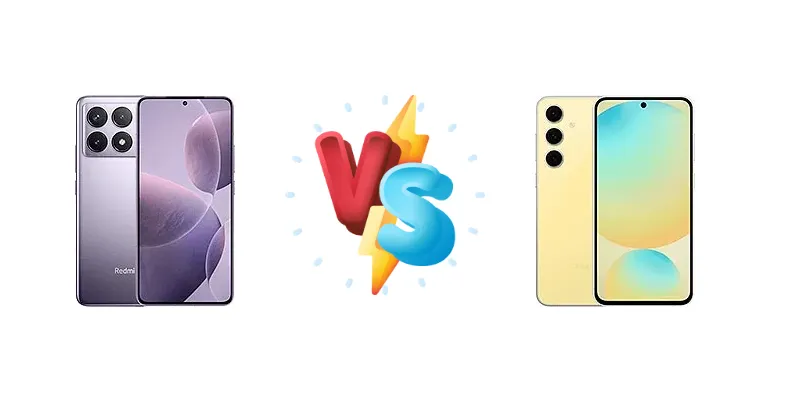
|
🏆 Quick Verdict
For users prioritizing peak performance and rapid charging, the Xiaomi Redmi K70 is the clear winner. Its Snapdragon 8 Gen 2 delivers superior processing power. However, the Samsung Galaxy S24 FE offers a more refined software experience, longer battery endurance, and a brighter display, making it ideal for everyday users.
| PHONES | ||
|---|---|---|
| Phone Names | Xiaomi Redmi K70 | Samsung Galaxy S24 FE |
| Network | ||
|---|---|---|
| 2G bands | GSM 850 / 900 / 1800 / 1900 | GSM 850 / 900 / 1800 / 1900 |
| 3G bands | HSDPA 800 / 850 / 900 / 1700(AWS) / 2100 | HSDPA 850 / 900 / 1700(AWS) / 1900 / 2100 |
| 4G bands | 1, 3, 4, 5, 8, 18, 19, 26, 28, 34, 38, 39, 40, 41, 42, 48, 66 | 1, 2, 3, 4, 5, 7, 8, 12, 17, 18, 19, 20, 25, 26, 28, 32, 38, 40, 41, 66 - International |
| 5G bands | 1, 3, 5, 8, 28, 38, 41, 48, 66, 77, 78 SA/NSA | 1, 2, 3, 5, 7, 8, 12, 20, 25, 26, 28, 38, 40, 41, 66, 75, 77, 78 SA/NSA/Sub6 - International |
| Speed | HSPA, LTE, 5G | HSPA, LTE, 5G |
| Technology | GSM / CDMA / HSPA / CDMA2000 / LTE / 5G | GSM / HSPA / LTE / 5G |
| Launch | ||
|---|---|---|
| Announced | 2023, November 29 | 2024, September 26 |
| Status | Available. Released 2023, November 29 | Available. Released 2024, October 03 |
| Body | ||
|---|---|---|
| Build | - | Glass front (Gorilla Glass Victus+), glass back (Gorilla Glass Victus+), aluminum frame |
| Dimensions | 160.9 x 75 x 8.2 mm (6.33 x 2.95 x 0.32 in) | 162 x 77.3 x 8 mm (6.38 x 3.04 x 0.31 in) |
| SIM | Nano-SIM + Nano-SIM | · Nano-SIM· Nano-SIM + Nano-SIM· Nano-SIM + eSIM· eSIM + eSIM |
| Weight | 209 g (7.37 oz) | 213 g (7.51 oz) |
| Display | ||
|---|---|---|
| Protection | - | Corning Gorilla Glass Victus+, Mohs level 5 |
| Resolution | 1440 x 3200 pixels, 20:9 ratio (~526 ppi density) | 1080 x 2340 pixels, 19.5:9 ratio (~385 ppi density) |
| Size | 6.67 inches, 107.4 cm2 (~89.0% screen-to-body ratio) | 6.7 inches, 110.2 cm2 (~88.0% screen-to-body ratio) |
| Type | OLED, 68B colors, 120Hz, Dolby Vision, HDR10+, 4000 nits (peak) | Dynamic AMOLED 2X, 120Hz, HDR10+, 1900 nits (peak) |
| Platform | ||
|---|---|---|
| CPU | Octa-core (1x3.2 GHz Cortex-X3 & 2x2.8 GHz Cortex-A715 & 2x2.8 GHz Cortex-A710 & 3x2.0 GHz Cortex-A510) | 10-core (1x3.1 GHz + 2x2.9 GHz + 3x2.6 GHz + 4x1.95 GHz) |
| Chipset | Qualcomm SM8550-AB Snapdragon 8 Gen 2 (4 nm) | Exynos 2400e (4 nm) |
| GPU | Adreno 740 | Xclipse 940 |
| OS | Android 14, HyperOS | Android 14, up to 7 major Android upgrades, One UI 8.0 |
| Memory | ||
|---|---|---|
| Card slot | No | No |
| Internal | 256GB 12GB RAM, 256GB 16GB RAM, 512GB 12GB RAM, 512GB 16GB RAM, 1TB 16GB RAM | 128GB 8GB RAM, 256GB 8GB RAM, 512GB 8GB RAM |
| Main Camera | ||
|---|---|---|
| Features | Color spectrum sensor, LED flash, HDR, panorama | LED flash, HDR, panorama |
| Triple | 50 MP, f/1.6, (wide), 1/1.55", 1.0µm, PDAF, OIS 8 MP, (ultrawide) 2 MP (macro) | 50 MP, f/1.8, 24mm (wide), 1/1.57", 1.0µm, dual pixel PDAF, OIS 8 MP, f/2.4, 75mm (telephoto), 1/4.4", 1.0µm, PDAF, OIS, 3x optical zoom 12 MP, f/2.2, 13mm, 123˚ (ultrawide), 1/3.0", 1.12µm |
| Video | 8K@24fps, 4K@24/30/60fps, 1080p@30/60/120/240/960fps, 720p@1920fps, gyro-EIS | 8K@30fps, 4K@30/60/120fps, 1080p@30/60/120/240fps |
| Selfie camera | ||
|---|---|---|
| Features | HDR | - |
| Single | 16 MP, (wide) | 10 MP, f/2.4, 26mm (wide), 1/3.0", 1.22µm |
| Video | 1080p@30/60fps, gyro-EIS | 4K@30/60fps, 1080p@30/60fps; gyro-EIS |
| Sound | ||
|---|---|---|
| 35mm jack | No | No |
| Loudspeaker | Yes, with stereo speakers | Yes, with stereo speakers |
| Comms | ||
|---|---|---|
| Bluetooth | 5.3, A2DP, LE | 5.3, A2DP, LE |
| Infrared port | Yes | - |
| NFC | Yes | Yes |
| Positioning | GPS (L1+L5), GLONASS (G1), BDS (B1I+B1c+B2a), GALILEO (E1+E5a), QZSS (L1+L5), NavIC (L5) | GPS, GLONASS, GALILEO, BDS |
| Radio | No | Unspecified |
| USB | USB Type-C, OTG | USB Type-C 3.2, OTG |
| WLAN | Wi-Fi 802.11 a/b/g/n/ac/6e/7, dual-band, Wi-Fi Direct | Wi-Fi 802.11 a/b/g/n/ac/6e, dual-band or tri-band (market/region dependent), Wi-Fi Direct |
| Features | ||
|---|---|---|
| Sensors | Fingerprint (under display, optical), accelerometer, proximity, gyro, compass | Fingerprint (under display, optical), accelerometer, gyro, compass |
| Battery | ||
|---|---|---|
| Charging | 120W wired, PD3.0, QC3+, 100% in 18 min | 25W wired, PD, QC2, 50% in 30 min 15W wireless Reverse wireless |
| Type | Li-Po 5000 mAh | 4700 mAh |
| Misc | ||
|---|---|---|
| Colors | Black, Silver, Blue/Green, Purple | Blue, Graphite, Gray, Mint, Yellow |
| Models | 23113RKC6C | SM-S721B, SM-S721B/DS, SM-S721U1, SM-S721U, SM-S721W, SM-S7210, SM-S721N |
| Price | About 320 EUR | $ 249.74 / C$ 498.99 / £ 335.00 / € 387.00 / ₹ 34,180 |
| SAR | - | 0.94 W/kg (head) 0.71 W/kg (body) |
| SAR EU | - | 0.86 W/kg (head) 1.29 W/kg (body) |
| EU LABEL | ||
|---|---|---|
| Battery | - | 42:00h endurance, 2000 cycles |
| Energy | - | Class B |
| Free fall | - | Class A (270 falls) |
| Repairability | - | Class C |
Xiaomi Redmi K70
- Significantly faster charging (120W)
- More powerful processor (Snapdragon 8 Gen 2)
- Potentially better thermal management
- Likely less refined software experience
- Battery life potentially shorter than S24 FE
Samsung Galaxy S24 FE
- Longer battery life and endurance
- Brighter and more color-accurate display
- Samsung’s established software ecosystem
- Slower charging speed (25W)
- Less powerful processor (Exynos 2400e)
Display Comparison
The Samsung Galaxy S24 FE boasts a significantly brighter display, reaching a measured 1372 nits, compared to an expected (based on segment) lower peak brightness on the Redmi K70. While the K70 likely utilizes a high refresh rate AMOLED panel, the S24 FE’s brightness advantage is crucial for outdoor visibility. Samsung’s display technology typically excels in color accuracy, and the S24 FE is expected to continue this trend. The K70’s display specs are not provided, but it is likely to be a standard high refresh rate AMOLED, lacking the LTPO technology potentially found in the S24 FE for variable refresh rate and power savings.
Camera Comparison
Without detailed camera specifications for the Redmi K70, a direct comparison is limited. However, the S24 FE is expected to feature a capable main sensor with Optical Image Stabilization (OIS), crucial for sharp images and stable video. The K70’s camera performance will likely rely heavily on software processing. The presence of a 2MP macro camera on either device is largely inconsequential; image quality from such sensors is typically poor. The S24 FE’s image processing is known for its vibrant colors and scene optimization, while the K70’s may lean towards a more natural look. The S24 FE’s video recording capabilities are likely to be more refined, benefiting from Samsung’s expertise.
Performance
The Redmi K70’s Qualcomm Snapdragon 8 Gen 2 (4nm) is a powerhouse, featuring an octa-core configuration with a prime Cortex-X3 core clocked at 3.2 GHz. This architecture is designed for sustained performance and efficiency. The S24 FE, powered by the Exynos 2400e (4nm), employs a 10-core setup, but its core clock speeds are slightly lower, peaking at 3.1 GHz. While core count isn’t everything, the Snapdragon 8 Gen 2 generally outperforms the Exynos 2400e in GPU-intensive tasks and sustained CPU loads. The K70’s superior thermal efficiency, thanks to the 4nm node, will likely result in less throttling during extended gaming sessions. The S24 FE’s performance will be adequate for most tasks, but the K70 offers a noticeable edge for demanding users.
Battery Life
The Samsung Galaxy S24 FE demonstrates a clear advantage in battery endurance, boasting a 42-hour endurance rating and 2000 charge cycles. This suggests a focus on long-term battery health. While the Redmi K70’s battery capacity isn’t specified, its 120W wired charging is significantly faster than the S24 FE’s 25W charging – achieving 100% charge in just 18 minutes versus 30% in 30 minutes. The S24 FE also offers 15W wireless and reverse wireless charging, features absent on the K70. The S24 FE’s active use score of 11:48h further reinforces its superior battery life, making it ideal for users who prioritize all-day usage.
Buying Guide
Buy the Xiaomi Redmi K70 if you need uncompromising gaming performance, incredibly fast 120W charging, and don't mind a potentially less polished software experience. Buy the Samsung Galaxy S24 FE if you prefer a more balanced device with a brighter, more color-accurate display, longer battery life, and Samsung’s established software ecosystem, even if it means sacrificing some raw processing power.