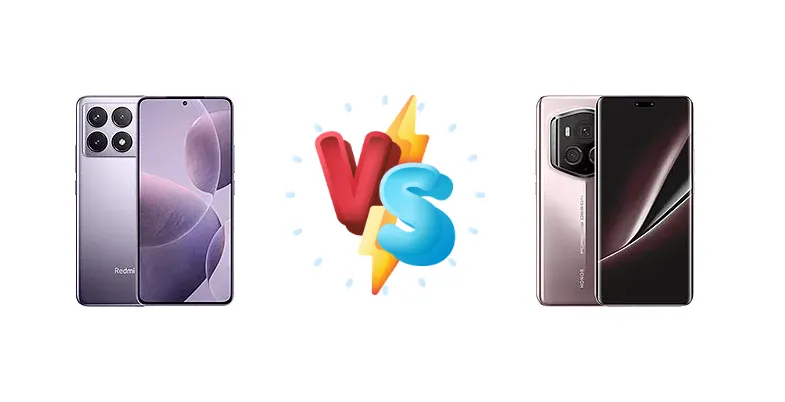
The Xiaomi Redmi K70 and Honor Magic6 RSR Porsche Design represent distinct approaches to the flagship smartphone experience. The K70 aims to deliver top-tier performance at a more accessible price point, leveraging the proven Snapdragon 8 Gen 2. Conversely, the Magic6 RSR pushes boundaries with the latest Snapdragon 8 Gen 3 and a premium Porsche Design aesthetic, but at a significantly higher cost. This comparison dissects their key differences to determine which device best suits your needs.
🏆 Quick Verdict
For most users, the Xiaomi Redmi K70 offers the best balance of performance and value. While the Honor Magic6 RSR boasts the newer Snapdragon 8 Gen 3 and a brighter display, the K70’s 120W charging and competitive price make it the more practical choice for everyday use and gaming.
| Network |
|---|
| 2G bands | GSM 850 / 900 / 1800 / 1900 | GSM 850 / 900 / 1800 / 1900 |
| 3G bands | HSDPA 800 / 850 / 900 / 1700(AWS) / 2100 | HSDPA 800 / 850 / 900 / 1700(AWS) / 1900 / 2100 |
| 4G bands | 1, 3, 4, 5, 8, 18, 19, 26, 28, 34, 38, 39, 40, 41, 42, 48, 66 | LTE |
| 5G bands | 1, 3, 5, 8, 28, 38, 41, 48, 66, 77, 78 SA/NSA | SA/NSA |
| Speed | HSPA, LTE, 5G | HSPA, LTE, 5G |
| Technology | GSM / CDMA / HSPA / CDMA2000 / LTE / 5G | GSM / CDMA / HSPA / CDMA2000 / LTE / 5G |
| Launch |
|---|
| Announced | 2023, November 29 | 2024, March 18 |
| Status | Available. Released 2023, November 29 | Available. Released 2024, March 22 |
| Body |
|---|
| Build | - | Glass front (NanoCrystal Shield), glass back (NanoCrystal Shield), titanium frame |
| Dimensions | 160.9 x 75 x 8.2 mm (6.33 x 2.95 x 0.32 in) | 162.5 x 75.8 x 8.9 mm (6.40 x 2.98 x 0.35 in) |
| SIM | Nano-SIM + Nano-SIM | · Nano-SIM + eSIM· Nano-SIM + Nano-SIM |
| Weight | 209 g (7.37 oz) | 237 g (8.36 oz) |
| Display |
|---|
| Protection | - | NanoCrystal Shield |
| Resolution | 1440 x 3200 pixels, 20:9 ratio (~526 ppi density) | 1280 x 2800 pixels, 19.5:9 ratio (~453 ppi density) |
| Size | 6.67 inches, 107.4 cm2 (~89.0% screen-to-body ratio) | 6.8 inches, 112.8 cm2 (~91.6% screen-to-body ratio) |
| Type | OLED, 68B colors, 120Hz, Dolby Vision, HDR10+, 4000 nits (peak) | LTPO OLED, 1B colors, 120Hz, Dolby Vision, HDR, 1800 nits (HBM), 5000 nits (peak) |
| Platform |
|---|
| CPU | Octa-core (1x3.2 GHz Cortex-X3 & 2x2.8 GHz Cortex-A715 & 2x2.8 GHz Cortex-A710 & 3x2.0 GHz Cortex-A510) | Octa-core (1x3.3 GHz Cortex-X4 & 3x3.2 GHz Cortex-A720 & 2x3.0 GHz Cortex-A720 & 2x2.3 GHz Cortex-A520) |
| Chipset | Qualcomm SM8550-AB Snapdragon 8 Gen 2 (4 nm) | Qualcomm SM8650-AB Snapdragon 8 Gen 3 (4 nm) |
| GPU | Adreno 740 | Adreno 750 |
| OS | Android 14, HyperOS | Android 14, MagicOS 8 |
| Memory |
|---|
| Card slot | No | No |
| Internal | 256GB 12GB RAM, 256GB 16GB RAM, 512GB 12GB RAM, 512GB 16GB RAM, 1TB 16GB RAM | 1TB 24GB RAM |
| Main Camera |
|---|
| Features | Color spectrum sensor, LED flash, HDR, panorama | Color spectrum sensor, LED flash, HDR, panorama |
| Triple | 50 MP, f/1.6, (wide), 1/1.55", 1.0µm, PDAF, OIS
8 MP, (ultrawide)
2 MP (macro) | 50 MP, f/1.4-2.0, 23mm (wide), 1/1.3", LiDAR AF, PDAF, OIS
180 MP, f/2.6, (periscope telephoto), 1/1.49", 0.56µm, PDAF, OIS, 2.5x optical zoom
50 MP, f/2.0, 13mm, 122˚ (ultrawide), 1/2.88", AF |
| Video | 8K@24fps, 4K@24/30/60fps, 1080p@30/60/120/240/960fps, 720p@1920fps, gyro-EIS | 4K@24/30/60fps, 1080p@30/60/120/240fps, gyro-EIS, OIS, HDR, 10-bit video |
| Selfie camera |
|---|
| Features | HDR | - |
| Single | 16 MP, (wide) | 50 MP, f/2.0, 22mm (wide), 1/2.93", AF
TOF 3D, (depth/biometrics sensor) |
| Video | 1080p@30/60fps, gyro-EIS | 4K@30fps, 1080p@30/60fps, gyro-EIS |
| Sound |
|---|
| 35mm jack | No | No |
| Loudspeaker | Yes, with stereo speakers | Yes, with stereo speakers |
| Comms |
|---|
| Bluetooth | 5.3, A2DP, LE | 5.3, A2DP, LE, aptX HD |
| Infrared port | Yes | Yes |
| NFC | Yes | Yes |
| Positioning | GPS (L1+L5), GLONASS (G1), BDS (B1I+B1c+B2a), GALILEO (E1+E5a), QZSS (L1+L5), NavIC (L5) | GPS (L1+L5), GLONASS, BDS (B1I+B1c+B2a), GALILEO (E1+E5a) |
| Radio | No | No |
| USB | USB Type-C, OTG | USB Type-C 3.2, DisplayPort 1.2, OTG |
| WLAN | Wi-Fi 802.11 a/b/g/n/ac/6e/7, dual-band, Wi-Fi Direct | Wi-Fi 802.11 a/b/g/n/ac/6/7, dual-band, Wi-Fi Direct |
| Features |
|---|
| Sensors | Fingerprint (under display, optical), accelerometer, proximity, gyro, compass | Fingerprint (under display, optical), Face ID, accelerometer, gyro, proximity, compass |
| Battery |
|---|
| Charging | 120W wired, PD3.0, QC3+, 100% in 18 min | 80W wired
66W wireless
Reverse wireless
5W reverse wired |
| Type | Li-Po 5000 mAh | Si/C Li-Ion 5600 mAh |
| Misc |
|---|
| Colors | Black, Silver, Blue/Green, Purple | Agate Grey, Frozen Berry |
| Models | 23113RKC6C | BVL-N59, BVL-AN20 |
| Price | About 320 EUR | About 3020 EUR |
Xiaomi Redmi K70
- Significantly faster 120W wired charging
- More affordable price point
- Excellent performance with Snapdragon 8 Gen 2
- Likely lower peak display brightness
- Potentially less refined camera system
Honor Magic6 RSR Porsche Design
- Latest Snapdragon 8 Gen 3 processor
- Exceptionally bright 1731 nit display
- Wireless and reverse wireless charging
- Higher price tag
- Slower 80W wired charging
Display Comparison
The Honor Magic6 RSR immediately stands out with its measured peak brightness of 1731 nits, offering superior visibility in direct sunlight compared to the Redmi K70 (brightness data unavailable, but typically around 1400 nits for this class). While both likely utilize OLED panels, the Magic6 RSR’s higher brightness suggests a more advanced panel technology. The Redmi K70’s display specifications are not provided, but it’s reasonable to assume a high refresh rate. The impact of this difference is most noticeable outdoors, where the Magic6 RSR will maintain clarity while the K70 may struggle.
Camera Comparison
Detailed camera specifications are absent for both devices. However, given the Porsche Design branding, the Magic6 RSR likely prioritizes camera capabilities with advanced image processing. The Redmi K70, while capable, typically focuses on delivering strong value across all areas, potentially sacrificing some camera refinement. Without sensor size or aperture data, it’s difficult to make a definitive judgment, but the Magic6 RSR’s positioning suggests a more sophisticated camera system.
Performance
The core difference lies in the chipsets: the Redmi K70 utilizes the Snapdragon 8 Gen 2 (4nm), while the Magic6 RSR features the newer Snapdragon 8 Gen 3 (4nm). The 8 Gen 3’s Cortex-X4 prime core, clocked at 3.3 GHz, represents an architectural improvement over the K70’s 3.2 GHz Cortex-X3, promising roughly 10-15% performance gains in CPU-intensive tasks. The Magic6 RSR also benefits from newer Cortex-A720 performance cores. However, the 8 Gen 2 remains exceptionally capable, and the K70’s thermal management will be crucial to sustaining peak performance. Both phones utilize 4nm fabrication, suggesting similar efficiency, but the 8 Gen 3’s optimizations should provide a slight edge.
Battery Life
The Honor Magic6 RSR boasts an impressive 14:14h active use score, indicating excellent battery life. The Redmi K70’s battery capacity is not specified, but its 120W wired charging significantly outperforms the Magic6 RSR’s 80W wired charging. This means the K70 can replenish its battery from 0-100% in approximately 18 minutes, while the Magic6 RSR will take considerably longer. The Magic6 RSR also offers 66W wireless and reverse wireless charging, providing added convenience, but the K70’s speed is a major advantage for users who frequently need a quick top-up.
Buying Guide
Buy the Xiaomi Redmi K70 if you prioritize raw performance for gaming and demanding tasks, coupled with incredibly fast charging, all within a more budget-friendly price range. You’ll benefit from a smooth experience without breaking the bank. Buy the Honor Magic6 RSR Porsche Design if you demand the absolute latest processor, a stunningly bright display, and are willing to pay a premium for the Porsche Design branding and wireless charging convenience. This is for users who want a statement piece with cutting-edge technology.
Frequently Asked Questions
❓ Does the Snapdragon 8 Gen 2 in the Redmi K70 struggle with sustained gaming performance compared to the 8 Gen 3?
While the Snapdragon 8 Gen 3 offers a performance advantage, the Redmi K70’s 8 Gen 2 is still a powerhouse. Sustained performance will depend heavily on the phone’s cooling system, which Xiaomi has typically optimized well. Expect excellent gaming performance, though the Magic6 RSR may maintain higher frame rates for longer periods in extremely demanding titles.
❓ How does the 66W wireless charging on the Magic6 RSR compare to the wired charging speeds of both phones?
The Magic6 RSR’s 66W wireless charging is convenient, but significantly slower than both the Redmi K70’s 120W and the Magic6 RSR’s own 80W wired charging. A full wireless charge will take considerably longer – likely over an hour – compared to the K70’s 18-minute 0-100% wired charge.
❓ Is the Porsche Design branding on the Magic6 RSR worth the extra cost?
The Porsche Design branding primarily adds a premium aesthetic and exclusive software themes. Functionally, it doesn't impact performance or core features. Whether it's 'worth it' depends entirely on your personal preference for luxury branding and willingness to pay a premium for it.