
Xiaomi Redmi K70 vs. Google Pixel 8a: A Deep Dive into Performance and Value
| Phones Images | |||||
|---|---|---|---|---|---|
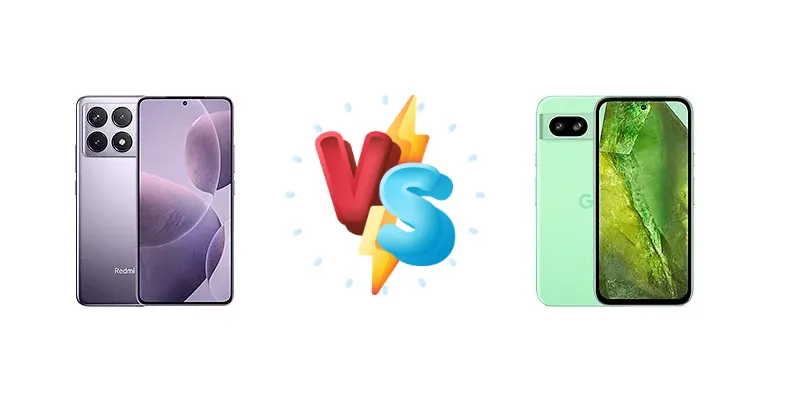
|
🏆 Quick Verdict
For users prioritizing gaming and demanding tasks, the Xiaomi Redmi K70 is the clear winner thanks to its significantly more powerful Snapdragon 8 Gen 2 chipset and 120W fast charging. However, the Google Pixel 8a excels in camera quality and software experience, making it ideal for photography enthusiasts and those deeply integrated into the Google ecosystem.
| PHONES | ||
|---|---|---|
| Phone Names | Xiaomi Redmi K70 | Google Pixel 8a |
| Network | ||
|---|---|---|
| 2G bands | GSM 850 / 900 / 1800 / 1900 | GSM 850 / 900 / 1800 / 1900 |
| 3G bands | HSDPA 800 / 850 / 900 / 1700(AWS) / 2100 | HSDPA 800 / 850 / 900 / 1700(AWS) / 1900 / 2100 |
| 4G bands | 1, 3, 4, 5, 8, 18, 19, 26, 28, 34, 38, 39, 40, 41, 42, 48, 66 | 1, 2, 3, 4, 5, 7, 8, 12, 17, 18, 19, 20, 26, 28, 32, 38, 40, 41, 42, 66 - G6GPR (International) |
| 5G bands | 1, 3, 5, 8, 28, 38, 41, 48, 66, 77, 78 SA/NSA | 1, 2, 3, 5, 7, 8, 12, 20, 26, 28, 38, 40, 41, 66, 75, 76, 77, 78 SA/NSA/Sub6 - G6GPR (International) |
| Speed | HSPA, LTE, 5G | HSPA, LTE, 5G |
| Technology | GSM / CDMA / HSPA / CDMA2000 / LTE / 5G | GSM / HSPA / LTE / 5G |
| Launch | ||
|---|---|---|
| Announced | 2023, November 29 | 2024, May 07 |
| Status | Available. Released 2023, November 29 | Available. Released 2024, May 14 |
| Body | ||
|---|---|---|
| Build | - | Glass front (Gorilla Glass 3), aluminum frame, plastic back |
| Dimensions | 160.9 x 75 x 8.2 mm (6.33 x 2.95 x 0.32 in) | 152.1 x 72.7 x 8.9 mm (5.99 x 2.86 x 0.35 in) |
| SIM | Nano-SIM + Nano-SIM | Nano-SIM + eSIM |
| Weight | 209 g (7.37 oz) | 188 g (6.63 oz) |
| Display | ||
|---|---|---|
| Protection | - | Corning Gorilla Glass 3, Mohs level 5 |
| Resolution | 1440 x 3200 pixels, 20:9 ratio (~526 ppi density) | 1080 x 2400 pixels, 20:9 ratio (~430 ppi density) |
| Size | 6.67 inches, 107.4 cm2 (~89.0% screen-to-body ratio) | 6.1 inches, 90.3 cm2 (~81.6% screen-to-body ratio) |
| Type | OLED, 68B colors, 120Hz, Dolby Vision, HDR10+, 4000 nits (peak) | OLED, HDR, 120Hz, 2000 nits (peak) |
| Platform | ||
|---|---|---|
| CPU | Octa-core (1x3.2 GHz Cortex-X3 & 2x2.8 GHz Cortex-A715 & 2x2.8 GHz Cortex-A710 & 3x2.0 GHz Cortex-A510) | Nona-core (1x3.0 GHz Cortex-X3 & 4x2.45 GHz Cortex-A715 & 4x2.15 GHz Cortex-A510) |
| Chipset | Qualcomm SM8550-AB Snapdragon 8 Gen 2 (4 nm) | Google Tensor G3 (4 nm) |
| GPU | Adreno 740 | Immortalis-G715s MC10 |
| OS | Android 14, HyperOS | Android 14, upgradable to Android 16, up to 7 major Android upgrades |
| Memory | ||
|---|---|---|
| Card slot | No | No |
| Internal | 256GB 12GB RAM, 256GB 16GB RAM, 512GB 12GB RAM, 512GB 16GB RAM, 1TB 16GB RAM | 128GB 8GB RAM, 256GB 8GB RAM |
| Main Camera | ||
|---|---|---|
| Dual | - | 64 MP (16 MP eff.), f/1.9, 26mm (wide), 1/1.73", 0.8µm, dual pixel PDAF, OIS 13 MP, f/2.2, 120˚ (ultrawide), 1.12µm |
| Features | Color spectrum sensor, LED flash, HDR, panorama | Dual-LED flash, Pixel Shift, Ultra HDR, panorama, Best Take |
| Triple | 50 MP, f/1.6, (wide), 1/1.55", 1.0µm, PDAF, OIS 8 MP, (ultrawide) 2 MP (macro) | - |
| Video | 8K@24fps, 4K@24/30/60fps, 1080p@30/60/120/240/960fps, 720p@1920fps, gyro-EIS | 4K@30/60fps, 1080p@30/60/120/240fps, OIS |
| Selfie camera | ||
|---|---|---|
| Features | HDR | HDR, panorama |
| Single | 16 MP, (wide) | 13 MP, f/2.2, 20mm (ultrawide), 1.12µm |
| Video | 1080p@30/60fps, gyro-EIS | 4K@30fps, 1080p@30/60fps |
| Sound | ||
|---|---|---|
| 35mm jack | No | No |
| Loudspeaker | Yes, with stereo speakers | Yes, with stereo speakers |
| Comms | ||
|---|---|---|
| Bluetooth | 5.3, A2DP, LE | 5.3, A2DP, LE |
| Infrared port | Yes | - |
| NFC | Yes | Yes |
| Positioning | GPS (L1+L5), GLONASS (G1), BDS (B1I+B1c+B2a), GALILEO (E1+E5a), QZSS (L1+L5), NavIC (L5) | GPS, GLONASS, GALILEO, BDS, QZSS, NavIC |
| Radio | No | No |
| USB | USB Type-C, OTG | USB Type-C 3.2 |
| WLAN | Wi-Fi 802.11 a/b/g/n/ac/6e/7, dual-band, Wi-Fi Direct | Wi-Fi 802.11 a/b/g/n/ac/6e, dual/tri-band (market/region dependent) |
| Features | ||
|---|---|---|
| Sensors | Fingerprint (under display, optical), accelerometer, proximity, gyro, compass | Fingerprint (under display, optical), accelerometer, gyro, proximity, compass, barometer |
| Battery | ||
|---|---|---|
| Charging | 120W wired, PD3.0, QC3+, 100% in 18 min | 18W wired, PD3.0 7.5W wireless Bypass charging |
| Type | Li-Po 5000 mAh | Li-Po 4492 mAh |
| Misc | ||
|---|---|---|
| Colors | Black, Silver, Blue/Green, Purple | Obsidian, Porcelain, Bay, Aloe |
| Models | 23113RKC6C | GKV4X, G6GPR, G8HHN, G576D |
| Price | About 320 EUR | $ 229.98 / C$ 417.99 / £ 279.00 / € 299.99 / ₹ 33,300 |
| EU LABEL | ||
|---|---|---|
| Battery | - | 40:06h endurance, 1000 cycles |
| Energy | - | Class B |
| Free fall | - | Class A (270 falls) |
| Repairability | - | Class B |
Xiaomi Redmi K70
- Significantly faster processor (Snapdragon 8 Gen 2)
- Ultra-fast 120W charging
- Likely superior gaming performance
- Camera performance likely trails the Pixel 8a
- Software updates may be less frequent than Pixel
Google Pixel 8a
- Exceptional camera quality and image processing
- Guaranteed software updates and Google AI features
- Excellent battery endurance
- Slower processor (Tensor G3)
- Significantly slower charging speed (18W)
Display Comparison
The Pixel 8a boasts a measured peak brightness of 1508 nits, ensuring excellent visibility even in direct sunlight. While the Redmi K70’s display specifications aren’t provided, Xiaomi typically equips its K-series with high-quality AMOLED panels. The Pixel 8a’s brightness advantage is significant, and its display technology likely benefits from Google’s image processing for accurate color reproduction. The absence of LTPO in either phone suggests both will rely on adaptive refresh rates to balance smoothness and power consumption, but the Pixel 8a’s higher peak brightness is a clear advantage for outdoor use.
Camera Comparison
While detailed camera specs for the Redmi K70 are missing, the Pixel 8a’s strength lies in Google’s computational photography. The Pixel 8a leverages the Tensor G3’s AI capabilities to deliver exceptional image quality, particularly in challenging lighting conditions. Google’s image processing excels in dynamic range, noise reduction, and color accuracy. Without knowing the Redmi K70’s sensor size or aperture, it’s difficult to directly compare, but the Pixel 8a’s software advantage is likely to be a significant differentiator for most users. The Pixel 8a’s focus on software processing will likely yield more consistently pleasing results.
Performance
The Redmi K70’s Qualcomm Snapdragon 8 Gen 2 (4nm) is a substantial leap ahead of the Google Tensor G3 (4nm) in terms of raw processing power. The Snapdragon 8 Gen 2’s octa-core configuration, featuring a Cortex-X3 prime core clocked at 3.2 GHz, provides superior single-core and multi-core performance. The Tensor G3’s nona-core setup, while incorporating a Cortex-X3, is clocked lower at 3.0 GHz and has a different core arrangement, prioritizing AI tasks over sustained peak performance. This translates to smoother gaming, faster video rendering, and more responsive multitasking on the Redmi K70. The K70’s likely LPDDR5x RAM further enhances its performance edge.
Battery Life
The Pixel 8a’s endurance rating of 40:06h and active use score of 11:25h demonstrate impressive battery life, supported by 1000 charge cycles, indicating long-term battery health. The Redmi K70, however, compensates for potentially lower battery capacity with its blazing-fast 120W wired charging, achieving a full charge in just 18 minutes. The Pixel 8a’s 18W charging is considerably slower. This difference in charging speed is a major convenience factor for the K70, allowing for quick top-ups throughout the day, while the Pixel 8a prioritizes longevity and overall endurance.
Buying Guide
Buy the Xiaomi Redmi K70 if you need uncompromising performance for gaming, video editing, or multitasking, and value incredibly fast charging speeds. Buy the Google Pixel 8a if you prioritize a best-in-class camera experience, seamless software updates, and Google’s AI-powered features, even if it means sacrificing some raw processing power.