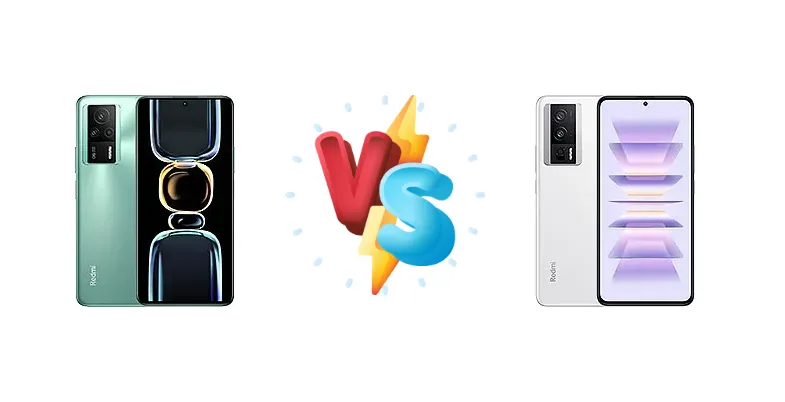
Xiaomi's Redmi series consistently delivers impressive value, and the K60E and K60 Pro are no exception. But with different chipsets and features, choosing between them can be tricky. This comprehensive comparison will help you decide which Redmi phone is right for you.
🏆 Quick Verdict
The Redmi K60 Pro is the clear winner thanks to its Snapdragon 8 Gen 2 chipset, significantly faster charging (120W wired & 30W wireless), and generally superior performance. However, the K60E offers excellent value with its Dimensity 8200 and remains a strong contender for budget-conscious buyers.
| Network |
|---|
| 2G bands | GSM 850 / 900 / 1800 / 1900 | GSM 850 / 900 / 1800 / 1900 |
| 3G bands | HSDPA 800 / 850 / 900 / 1700(AWS) / 2100 | HSDPA 800 / 850 / 900 / 1700(AWS) / 2100 |
| 4G bands | 1, 3, 4, 5, 8, 18, 19, 26, 34, 38, 39, 40, 41, 42 | 1, 3, 4, 5, 8, 18, 19, 26, 34, 38, 39, 40, 41, 42 |
| 5G bands | 1, 3, 5, 8, 28, 38, 41, 77, 78 SA/NSA | 1, 3, 5, 8, 28, 38, 41, 77, 78 SA/NSA |
| Speed | HSPA, LTE, 5G | HSPA, LTE, 5G |
| Technology | GSM / CDMA / HSPA / CDMA2000 / LTE / 5G | GSM / CDMA / HSPA / CDMA2000 / LTE / 5G |
| | CDMA2000 1x | CDMA2000 1x |
| Launch |
|---|
| Announced | 2022, December 27 | 2022, December 27 |
| Status | Available. Released 2022, December 27 | Available. Released 2023, January 01 |
| Body |
|---|
| Dimensions | 163.1 x 76.2 x 8.5 mm (6.42 x 3.00 x 0.33 in) | 162.8 x 75.4 x 8.6 mm or 8.9 mm |
| SIM | Nano-SIM + Nano-SIM | Nano-SIM + Nano-SIM |
| Weight | 202 g (7.13 oz) | 201 g or 205 g (7.09 oz) |
| Display |
|---|
| Protection | Corning Gorilla Glass Victus | - |
| Resolution | 1440 x 3200 pixels, 20:9 ratio (~526 ppi density) | 1440 x 3200 pixels, 20:9 ratio (~526 ppi density) |
| Size | 6.67 inches, 107.4 cm2 (~86.4% screen-to-body ratio) | 6.67 inches, 107.4 cm2 (~87.5% screen-to-body ratio) |
| Type | OLED, 120Hz, Dolby Vision, HDR10+, 1200 nits (peak) | OLED, 68B colors, 120Hz, Dolby Vision, HDR10+, 1400 nits (peak) |
| Platform |
|---|
| CPU | Octa-core (1x3.1 GHz Cortex-A78 & 3x3.0 GHz Cortex-A78 & 4x2.0 GHz Cortex-A55) | Octa-core (1x3.2 GHz Cortex-X3 & 2x2.8 GHz Cortex-A715 & 2x2.8 GHz Cortex-A710 & 3x2.0 GHz Cortex-A510) |
| Chipset | Mediatek Dimensity 8200 (4 nm) | Qualcomm SM8550-AB Snapdragon 8 Gen 2 (4 nm) |
| GPU | Mali-G610 MC6 | Adreno 740 |
| OS | Android 12, MIUI 13 | Android 13, MIUI 14 |
| Memory |
|---|
| Card slot | No | No |
| Internal | 128GB 8GB RAM, 256GB 8GB RAM, 256GB 12GB RAM, 512GB 12GB RAM | 128GB 8GB RAM, 256GB 8GB RAM, 256GB 12GB RAM, 512GB 12GB RAM, 512GB 16GB RAM |
| | UFS 3.1 | UFS 4.0
UFS 3.1 - 128GB only |
| Main Camera |
|---|
| Features | Color spectrum sensor, Dual-LED dual-tone flash, HDR, panorama | Color spectrum sensor, Dual-LED dual-tone flash, HDR, panorama |
| Triple | 48 MP, (wide), 1/2.0", 0.8µm, PDAF, OIS
8 MP, 120˚ (ultrawide), 1/4.0", 1.12µm
2 MP (macro) | 54 MP, f/1.9, (wide), 1/1.49", 1.0µm, PDAF, OIS
8 MP, 118˚ (ultrawide), 1/4.0", 1.12µm
2 MP (macro) |
| Video | 4K@30fps, 1080p@30/60/120fps, 720p@960fps, gyro-EIS | 8K@24fps, 4K@30/60fps, 1080p@30/60/120/240/960fps, 720p@1920fps, gyro-EIS |
| Selfie camera |
|---|
| Features | HDR | HDR |
| Single | 20 MP, (wide), 1/2.0", 0.8µm | 16 MP, (wide), 1/3.06", 1.0µm |
| Video | 1080p@30/60/120fps | 1080p@30/60/120fps |
| Sound |
|---|
| 3.5mm jack | No | No |
| 35mm jack | No | No |
| Loudspeaker | Yes, with stereo speakers | Yes, with stereo speakers |
| | 24-bit/192kHz audio | 24-bit/192kHz audio |
| Comms |
|---|
| Bluetooth | 5.3, A2DP, LE | 5.3, A2DP, LE |
| Infrared port | Yes | Yes |
| NFC | Yes | Yes |
| Positioning | GPS (L1), GLONASS (G1), BDS (B1I+B1c), GALILEO (E1), QZSS (L1) | GPS (L1+L5), GLONASS (G1), BDS (B1I+B2a+Bc), GALILEO (E1+E5a), QZSS (L1+L5), NavIC |
| Radio | Unspecified | Unspecified |
| USB | USB Type-C 2.0, OTG | USB Type-C 2.0, OTG |
| WLAN | Wi-Fi 802.11 a/b/g/n/ac/6e, dual-band, Wi-Fi Direct | Wi-Fi 802.11 a/b/g/n/ac/6e, dual-band, Wi-Fi Direct |
| Features |
|---|
| Sensors | Fingerprint (side-mounted), accelerometer, gyro, proximity, compass | Fingerprint (under display, optical), accelerometer, gyro, proximity, compass |
| Battery |
|---|
| Charging | 67W wired, PD3.0 | 120W wired, PD3.0, QC3+, 100% in 19 min
30W wireless |
| Type | Li-Po 5500 mAh | Li-Po 5000 mAh |
| Misc |
|---|
| Colors | Black, White, Green | Black, White, Mint, Champion Black |
| Models | 22122RK93C | 22127RK46C |
| Price | About 300 EUR | About 460 EUR |
Xiaomi Redmi K60E
- Excellent value for money
- Smooth 120Hz AMOLED display
- Capable Mediatek Dimensity 8200 chipset
- Good battery life
- Slower charging compared to K60 Pro
- Less powerful than the K60 Pro
- Camera may not be as advanced
Xiaomi Redmi K60 Pro
- Flagship Snapdragon 8 Gen 2 performance
- Blazing-fast 120W wired & 30W wireless charging
- Potentially superior camera system
- Premium build quality
- Higher price point
- May be overkill for casual users
Display Comparison
Both phones feature a 6.67-inch AMOLED display with a 120Hz refresh rate and HDR10+ support. However, the K60 Pro might have slightly better color accuracy and brightness due to its higher price point and potential for improved panel technology. Resolution is likely to be FHD+ on both.
Camera Comparison
The K60 Pro is expected to have a more advanced camera system. While both likely feature a 50MP main sensor, the Pro model likely boasts a larger sensor, improved image processing, and potentially a telephoto lens for better zoom capabilities. The K60E will still deliver decent photos, but the Pro will offer a noticeable upgrade.
Performance
The Snapdragon 8 Gen 2 in the K60 Pro provides a substantial performance advantage over the Dimensity 8200 in the K60E. Expect smoother multitasking, faster app loading times, and better gaming performance on the Pro model. The Gen 2 is also more efficient, potentially impacting battery life positively.
Battery Life
The K60 Pro's 120W wired charging is a game-changer, allowing for incredibly fast top-ups. The 30W wireless charging adds further convenience. The K60E's 67W charging is still respectable, but significantly slower. Battery capacity is likely similar (around 5000mAh) on both devices, but the Pro's efficiency could give it a slight edge in real-world usage.
Buying Guide
The Redmi K60E is ideal for users seeking a powerful mid-range phone with a smooth display and good battery life without breaking the bank. The Redmi K60 Pro is for those who demand top-tier performance, blazing-fast charging, and are willing to pay a premium for the flagship experience.
Frequently Asked Questions
❓ Is the Redmi K60 Pro worth the extra money?
If you prioritize performance, fast charging, and a potentially better camera, then yes. The Snapdragon 8 Gen 2 is a significant upgrade. However, if you're on a budget, the K60E offers excellent value.
❓ What is the difference between the Dimensity 8200 and Snapdragon 8 Gen 2?
The Snapdragon 8 Gen 2 is a flagship chipset offering significantly better CPU and GPU performance, improved efficiency, and advanced features compared to the Dimensity 8200, which is a high-end mid-range chip.