
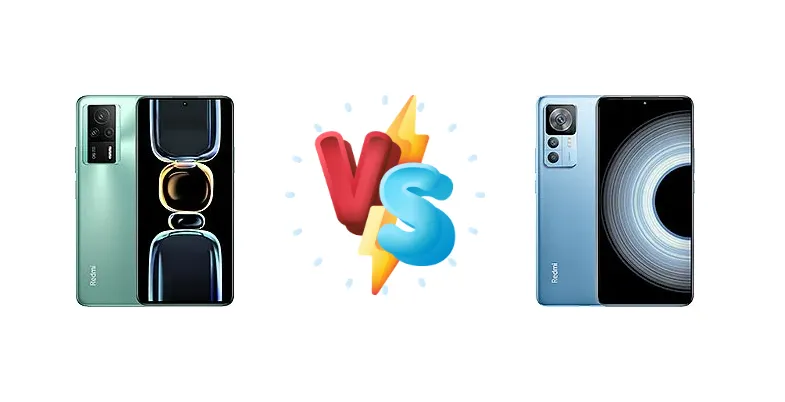
Xiaomi Redmi K60E vs Redmi K50 Ultra: A Detailed Showdown
| Phones Images | |||||
|---|---|---|---|---|---|
|
🏆 Quick Verdict
The Redmi K50 Ultra takes the crown thanks to its significantly faster Snapdragon 8+ Gen 1 chipset and blazing-fast 120W charging. While the K60E offers a competitive Dimensity 8200, the K50 Ultra's raw power and charging speed provide a noticeable edge for demanding users.
| PHONES | ||
|---|---|---|
| Phone Names | Xiaomi Redmi K60E | Xiaomi Redmi K50 Ultra |
| Network | ||
|---|---|---|
| 2G bands | GSM 850 / 900 / 1800 / 1900 | GSM 850 / 900 / 1800 / 1900 |
| 3G bands | HSDPA 800 / 850 / 900 / 1700(AWS) / 2100 | HSDPA 850 / 900 / 1700(AWS) / 1900 / 2100 |
| 4G bands | 1, 3, 4, 5, 8, 18, 19, 26, 34, 38, 39, 40, 41, 42 | 1, 3, 4, 5, 8, 18, 19, 26, 34, 38, 39, 40, 41, 42 |
| 5G bands | 1, 3, 5, 8, 28, 38, 41, 77, 78 SA/NSA | 1, 3, 5, 8, 28, 38, 40, 41, 77, 78 SA/NSA |
| Speed | HSPA, LTE, 5G | HSPA, LTE, 5G |
| Technology | GSM / CDMA / HSPA / CDMA2000 / LTE / 5G | GSM / CDMA / HSPA / CDMA2000 / LTE / 5G |
| CDMA2000 1x | CDMA2000 1x | |
| Launch | ||
|---|---|---|
| Announced | 2022, December 27 | 2022, August 11 |
| Status | Available. Released 2022, December 27 | Available. Released 2022, August 25 |
| Body | ||
|---|---|---|
| Dimensions | 163.1 x 76.2 x 8.5 mm (6.42 x 3.00 x 0.33 in) | 163.1 x 75.9 x 8.6 mm (6.42 x 2.99 x 0.34 in) |
| SIM | Nano-SIM + Nano-SIM | Nano-SIM + Nano-SIM |
| Weight | 202 g (7.13 oz) | 202 g (7.13 oz) |
| Display | ||
|---|---|---|
| Protection | Corning Gorilla Glass Victus | - |
| Resolution | 1440 x 3200 pixels, 20:9 ratio (~526 ppi density) | 1220 x 2712 pixels, 20:9 ratio (~446 ppi density) |
| Size | 6.67 inches, 107.4 cm2 (~86.4% screen-to-body ratio) | 6.67 inches, 107.4 cm2 (~86.7% screen-to-body ratio) |
| Type | OLED, 120Hz, Dolby Vision, HDR10+, 1200 nits (peak) | OLED, 68B colors, 144Hz, HDR10+, Dolby Vision |
| Platform | ||
|---|---|---|
| CPU | Octa-core (1x3.1 GHz Cortex-A78 & 3x3.0 GHz Cortex-A78 & 4x2.0 GHz Cortex-A55) | Octa-core (1x3.19 GHz Cortex-X2 & 3x2.75 GHz Cortex-A710 & 4x1.80 GHz Cortex-A510) |
| Chipset | Mediatek Dimensity 8200 (4 nm) | Qualcomm SM8475 Snapdragon 8+ Gen 1 (4 nm) |
| GPU | Mali-G610 MC6 | Adreno 730 |
| OS | Android 12, MIUI 13 | Android 12, MIUI 13 |
| Memory | ||
|---|---|---|
| Card slot | No | No |
| Internal | 128GB 8GB RAM, 256GB 8GB RAM, 256GB 12GB RAM, 512GB 12GB RAM | 128GB 8GB RAM, 256GB 8GB RAM, 256GB 12GB RAM, 512GB 12GB RAM |
| UFS 3.1 | UFS 3.1 | |
| Main Camera | ||
|---|---|---|
| Features | Color spectrum sensor, Dual-LED dual-tone flash, HDR, panorama | Color spectrum sensor, LED flash, HDR, panorama |
| Triple | 48 MP, (wide), 1/2.0", 0.8µm, PDAF, OIS 8 MP, 120˚ (ultrawide), 1/4.0", 1.12µm 2 MP (macro) | 108 MP, f/1.6, (wide), 1/1.67", PDAF, OIS 8 MP, f/2.2, 120˚, (ultrawide) 2 MP (macro) |
| Video | 4K@30fps, 1080p@30/60/120fps, 720p@960fps, gyro-EIS | 4K@30/60fps, 1080p@30/60/120/240/960fps |
| Selfie camera | ||
|---|---|---|
| Features | HDR | HDR |
| Single | 20 MP, (wide), 1/2.0", 0.8µm | 20 MP, (wide) |
| Video | 1080p@30/60/120fps | 1080p@30/60fps, 720p@120fps |
| Sound | ||
|---|---|---|
| 3.5mm jack | No | No |
| 35mm jack | No | No |
| Loudspeaker | Yes, with stereo speakers | Yes, with stereo speakers |
| 24-bit/192kHz audio | 24-bit/192kHz audio | |
| Comms | ||
|---|---|---|
| Bluetooth | 5.3, A2DP, LE | 5.2, A2DP, LE, aptX HD, aptX Adaptive |
| Infrared port | Yes | Yes |
| NFC | Yes | Yes |
| Positioning | GPS (L1), GLONASS (G1), BDS (B1I+B1c), GALILEO (E1), QZSS (L1) | GPS (L1+L5), GLONASS (L1), BDS (B1I+B1c+B2a), GALILEO (E1+E5a), QZSS (L1+L5), NavIC (L5) |
| Radio | Unspecified | No |
| USB | USB Type-C 2.0, OTG | USB Type-C 2.0, OTG |
| WLAN | Wi-Fi 802.11 a/b/g/n/ac/6e, dual-band, Wi-Fi Direct | Wi-Fi 802.11 a/b/g/n/ac/6e, dual-band, Wi-Fi Direct |
| Features | ||
|---|---|---|
| Sensors | Fingerprint (side-mounted), accelerometer, gyro, proximity, compass | Fingerprint (under display, optical), accelerometer, gyro, proximity, compass |
| Battery | ||
|---|---|---|
| Charging | 67W wired, PD3.0 | 120W wired, PD3.0, 100% in 19 min |
| Type | Li-Po 5500 mAh | Li-Po 5000 mAh |
| Misc | ||
|---|---|---|
| Colors | Black, White, Green | Black, Gray, Blue, Mercedes AMG |
| Models | 22122RK93C | 22081212C |
| Price | About 300 EUR | About 430 EUR |
Xiaomi Redmi K60E
- Excellent value for money
- Smooth performance for everyday tasks
- Good display quality
- Efficient chipset
- Slightly less powerful than the K50 Ultra
- Slower charging speed
- Camera not as versatile as the K50 Ultra
Xiaomi Redmi K50 Ultra
- Top-tier performance with Snapdragon 8+ Gen 1
- Blazing-fast 120W charging
- Versatile camera system
- Premium feel
- Higher price point
- Can run slightly warmer under heavy load
Display Comparison
Both phones feature vibrant AMOLED displays with 120Hz refresh rates, offering a smooth and immersive viewing experience. The K50 Ultra might have slightly better peak brightness, but the difference is likely minimal in everyday use. Both offer excellent color accuracy and support HDR10+.
Camera Comparison
The K50 Ultra generally boasts a more versatile camera system, often featuring a higher resolution main sensor (typically 108MP vs. 64MP on the K60E) and potentially better image processing. While both phones can capture decent photos, the K50 Ultra is likely to produce more detailed and vibrant images, especially in challenging lighting conditions. Both have capable ultrawide and macro lenses.
Performance
The Snapdragon 8+ Gen 1 in the K50 Ultra is undeniably more powerful than the Dimensity 8200 in the K60E. Expect faster app loading times, smoother multitasking, and better performance in graphically intensive games on the K50 Ultra. The Dimensity 8200 is still a very capable chip, but it doesn't match the raw horsepower of the Snapdragon.
Battery Life
The K50 Ultra's 120W charging is a game-changer, allowing for incredibly fast charging times. The K60E's 67W charging is still respectable, but it takes considerably longer to reach a full charge. Battery capacity is similar between the two, so real-world battery life should be comparable, assuming similar usage patterns.
Buying Guide
The Redmi K60E is ideal for gamers and users who prioritize a smooth, efficient experience without breaking the bank. The Redmi K50 Ultra is the better choice for those who demand top-tier performance, ultra-fast charging, and don't mind paying a premium.