
Xiaomi Redmi K60 vs Samsung Galaxy A73 5G: A Performance and Value Showdown
| Phones Images | |||||
|---|---|---|---|---|---|
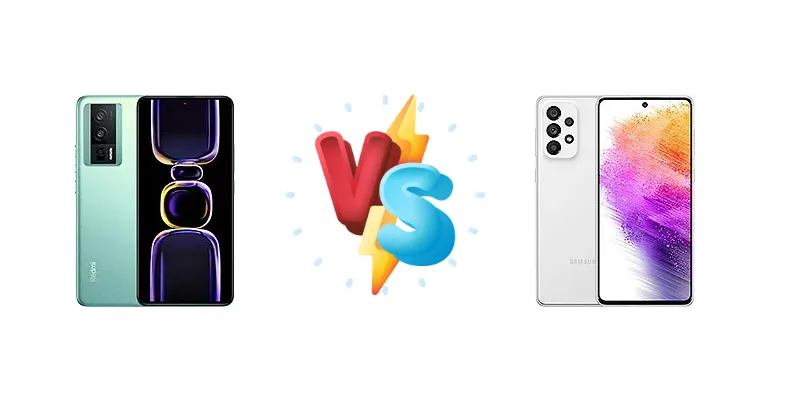
|
🏆 Quick Verdict
For users prioritizing performance and fast charging, the Xiaomi Redmi K60 is the clear winner. Its Snapdragon 8+ Gen 1 delivers significantly more processing power, and the 67W charging is substantially faster than the A73’s 25W. However, the Galaxy A73 5G offers a more refined software experience and potentially better battery optimization for everyday use.
| PHONES | ||
|---|---|---|
| Phone Names | Xiaomi Redmi K60 | Samsung Galaxy A73 5G |
| Network | ||
|---|---|---|
| 2G bands | GSM 850 / 900 / 1800 / 1900 | GSM 850 / 900 / 1800 / 1900 |
| 3G bands | HSDPA 800 / 850 / 900 / 1700(AWS) / 2100 | HSDPA 850 / 900 / 1700(AWS) / 1900 / 2100 |
| 4G bands | 1, 3, 4, 5, 8, 18, 19, 26, 34, 38, 39, 40, 41, 42 | 1, 2, 3, 4, 5, 7, 8, 12, 13, 17, 20, 26, 28, 32, 38, 40, 41, 66 |
| 5G bands | 1, 3, 5, 8, 28, 38, 41, 77, 78 SA/NSA | 1, 3, 5, 7, 28, 40, 41, 66, 78 SA/NSA/Sub6 |
| Speed | HSPA, LTE, 5G | HSPA, LTE, 5G |
| Technology | GSM / CDMA / HSPA / CDMA2000 / LTE / 5G | GSM / HSPA / LTE / 5G |
| CDMA2000 1x | - | |
| Launch | ||
|---|---|---|
| Announced | 2022, December 27 | 2022, March 17 |
| Status | Available. Released 2023, January 01 | Available. Released 2022, April 22 |
| Body | ||
|---|---|---|
| Dimensions | 162.8 x 75.4 x 8.6 mm or 8.8 mm | 163.7 x 76.1 x 7.6 mm (6.44 x 3.00 x 0.30 in) |
| SIM | Nano-SIM + Nano-SIM | · Nano-SIM· Nano-SIM + Nano-SIM |
| Weight | 199 g or 204 g (7.02 oz) | 181 g (6.38 oz) |
| - | IP67 dust/water resistant (up to 1m for 30 min) | |
| Display | ||
|---|---|---|
| Protection | - | Corning Gorilla Glass 5 |
| Resolution | 1440 x 3200 pixels, 20:9 ratio (~526 ppi density) | 1080 x 2400 pixels, 20:9 ratio (~393 ppi density) |
| Size | 6.67 inches, 107.4 cm2 (~87.5% screen-to-body ratio) | 6.7 inches, 108.4 cm2 (~87.0% screen-to-body ratio) |
| Type | OLED, 68B colors, 120Hz, Dolby Vision, HDR10+, 1400 nits (peak) | Super AMOLED Plus, 120Hz, 800 nits (HBM) |
| Platform | ||
|---|---|---|
| CPU | Octa-core (1x3.0 GHz Cortex-X2 & 3x2.5 GHz Cortex-A710 & 4x1.80 GHz Cortex-A510) | Octa-core (1x2.4 GHz Cortex-A78 & 3x2.2 GHz Cortex-A78 & 4x1.9 GHz Cortex-A55) |
| Chipset | Qualcomm SM8475 Snapdragon 8+ Gen 1 (4 nm) | Qualcomm SM7325 Snapdragon 778G 5G (6 nm) |
| GPU | Adreno 730 | Adreno 642L |
| OS | Android 13, MIUI 14 | Android 12, up to 4 major Android upgrades, One UI 6.1 |
| Memory | ||
|---|---|---|
| Card slot | No | microSDXC (uses shared SIM slot) |
| Internal | 128GB 8GB RAM, 256GB 8GB RAM, 256GB 12GB RAM, 256GB 16GB RAM, 512GB 12GB RAM, 512GB 16GB RAM, 1TB 16GB RAM | 128GB 6GB RAM, 128GB 8GB RAM, 256GB 8GB RAM |
| UFS 3.1 | - | |
| Main Camera | ||
|---|---|---|
| Features | Color spectrum sensor, Dual-LED dual-tone flash, HDR, panorama | LED flash, panorama, HDR |
| Quad | - | 108 MP, f/1.8, (wide), PDAF, OIS 12 MP, f/2.2, (ultrawide) 5 MP (macro) Auxiliary lens |
| Single | - | 32 MP, f/2.2, 26mm (wide), 1/2.8", 0.8µm |
| Triple | 64 MP, f/1.8, (wide), 1/2.0", 0.7µm, PDAF, OIS 8 MP, f/2.2, 120˚ (ultrawide), 1/4.0", 1.12µm 2 MP (macro) | - |
| Video | 8K@24fps, 4K@30/60fps, 1080p@30/60/120/240/960fps, 720p@1920fps, gyro-EIS | 4K@30fps, 1080p@30/60fps; gyro-EIS |
| Selfie camera | ||
|---|---|---|
| Features | HDR | HDR |
| Single | 16 MP, f/2.5, (wide), 1/3.06", 1.0µm | 32 MP, f/2.2, 26mm (wide), 1/2.8", 0.8µm |
| Video | 1080p@30/60/120fps | 4K@30fps, 1080p@30fps |
| Sound | ||
|---|---|---|
| 3.5mm jack | No | No |
| 35mm jack | No | No |
| Loudspeaker | Yes, with stereo speakers | Yes, with stereo speakers |
| 24-bit/192kHz audio | - | |
| Comms | ||
|---|---|---|
| Bluetooth | 5.3, A2DP, LE | 5.0, A2DP, LE |
| Infrared port | Yes | - |
| NFC | Yes | Yes (market/region dependent) |
| Positioning | GPS (L1), GLONASS (G1), BDS (B1I+B1c), GALILEO (E1), QZSS (L1) | GPS, GLONASS, GALILEO, BDS, QZSS |
| Radio | Unspecified | Unspecified |
| USB | USB Type-C 2.0, OTG | USB Type-C 2.0, OTG |
| WLAN | Wi-Fi 802.11 a/b/g/n/ac/6e, dual-band, Wi-Fi Direct | Wi-Fi 802.11 a/b/g/n/ac/6, dual-band, Wi-Fi Direct |
| Features | ||
|---|---|---|
| Sensors | Fingerprint (under display, optical), accelerometer, gyro, proximity, compass | Fingerprint (under display, optical), accelerometer, gyro, proximity, compass |
| Battery | ||
|---|---|---|
| Charging | 67W wired, PD3.0, QC3+ 30W wireless | 25W wired |
| Type | Li-Po 5500 mAh | Li-Po 5000 mAh |
| Misc | ||
|---|---|---|
| Colors | Black, White, Blue, Green | Gray, Mint, White |
| Models | - | SM-A736B, SM-A736B/DS |
| Price | About 350 EUR | About 600 EUR |
| SAR | - | 1.14 W/kg (head) |
| SAR EU | - | 1.28 W/kg (head) 1.42 W/kg (body) |
Xiaomi Redmi K60
- Significantly faster processor (Snapdragon 8+ Gen 1)
- Much faster charging (67W wired, 30W wireless)
- Potentially better gaming performance
- Potentially shorter battery life due to power-hungry chipset
- Thermal throttling could be a concern under sustained load
Samsung Galaxy A73 5G
- More efficient processor (Snapdragon 778G 5G)
- Samsung’s refined software experience
- Potentially better battery optimization
- Significantly slower charging (25W wired)
- Lower overall performance compared to the K60
Display Comparison
While both phones likely feature AMOLED panels (based on market segment), the specifics are crucial. The Redmi K60’s display benefits from the processing power of its chipset to drive higher refresh rates and potentially better HDR performance. The Galaxy A73 5G, while offering a vibrant display, is likely to be less responsive in fast-paced scenarios. We lack specific nit brightness data, but Samsung typically excels in outdoor visibility. Bezels are likely comparable, given both phones aim for a modern aesthetic.
Camera Comparison
Without detailed sensor information, we can infer some differences. The Redmi K60, positioned as a performance-focused device, may prioritize computational photography leveraging the 8+ Gen 1’s ISP. The Galaxy A73 5G, benefiting from Samsung’s image processing expertise, likely delivers more consistent and color-accurate photos in various lighting conditions. The A73 5G likely features Optical Image Stabilization (OIS) on its main sensor, a feature that enhances low-light performance and video stabilization. The 778G’s ISP is capable, but the 8+ Gen 1 offers more headroom for complex image processing algorithms. We can assume both phones will include a suite of lenses, but the quality of those secondary sensors is less critical than the main sensor and image processing.
Performance
The core difference lies in the chipsets. The Redmi K60’s Snapdragon 8+ Gen 1 (4nm) is a significant leap over the Galaxy A73 5G’s Snapdragon 778G 5G (6nm). The 8+ Gen 1’s Cortex-X2 prime core, clocked at 3.0 GHz, provides a substantial performance advantage in CPU-intensive tasks. The 778G 5G, while capable, relies on Cortex-A78 cores and a less efficient 6nm process. This translates to faster app loading, smoother multitasking, and superior gaming performance on the K60. The K60 likely supports faster RAM (LPDDR5x vs LPDDR4x on the A73), further enhancing performance. Thermal management will be critical for the K60 to sustain peak performance, a challenge the 778G 5G avoids due to its lower power draw.
Battery Life
The Redmi K60’s 67W wired charging is a game-changer, allowing for a full charge in under 40 minutes. The Galaxy A73 5G’s 25W charging is considerably slower, taking well over an hour for a complete charge. While battery capacity isn’t specified, the more power-hungry Snapdragon 8+ Gen 1 will likely necessitate a larger battery to achieve comparable battery life to the more efficient 778G 5G. The K60 also adds 30W wireless charging, a feature absent on the A73 5G, offering added convenience.
Buying Guide
Buy the Xiaomi Redmi K60 if you need uncompromising performance for gaming, demanding apps, or future-proofing. It’s ideal for power users who value speed and don’t mind potentially shorter battery life. Buy the Samsung Galaxy A73 5G if you prefer a more balanced experience with a focus on software polish, consistent performance for everyday tasks, and a potentially longer-lasting battery, even if it means sacrificing some raw power.