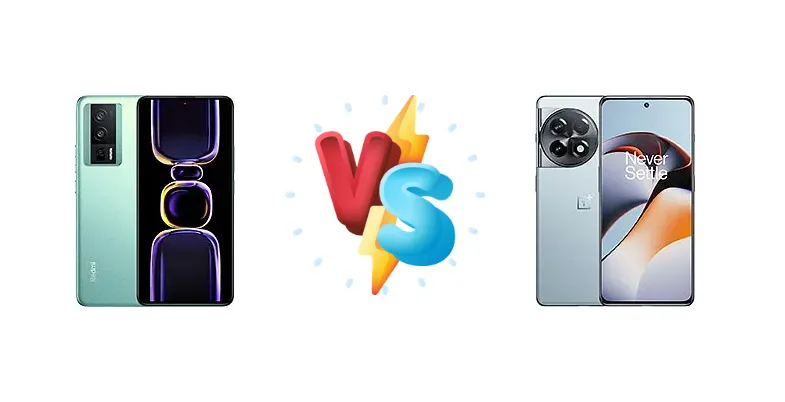
The Xiaomi Redmi K60 and OnePlus 11R represent a fascinating intersection in the smartphone market. Both devices leverage the proven Qualcomm Snapdragon 8+ Gen 1 chipset, offering flagship-level performance at a more accessible price point. However, they diverge significantly in charging speed and feature sets, creating a clear choice for different user priorities.
🏆 Quick Verdict
For most users, the OnePlus 11R emerges as the slightly better choice. Its 100W charging dramatically reduces downtime, a significant advantage over the Redmi K60’s 67W wired and 30W wireless options. While the K60 offers wireless charging, the 11R’s speed advantage is more impactful for daily use.
| Network |
|---|
| 2G bands | GSM 850 / 900 / 1800 / 1900 | GSM 850 / 900 / 1800 / 1900 |
| 3G bands | HSDPA 800 / 850 / 900 / 1700(AWS) / 2100 | HSDPA 850 / 900 / 1700(AWS) / 2100 |
| 4G bands | 1, 3, 4, 5, 8, 18, 19, 26, 34, 38, 39, 40, 41, 42 | 1, 3, 4, 5, 8, 28, 34, 38, 39, 40, 41 |
| 5G bands | 1, 3, 5, 8, 28, 38, 41, 77, 78 SA/NSA | 1, 3, 5, 8, 28, 40, 41, 77, 78 SA/NSA |
| Speed | HSPA, LTE, 5G | HSPA, LTE (3CA), 5G |
| Technology | GSM / CDMA / HSPA / CDMA2000 / LTE / 5G | GSM / CDMA / HSPA / LTE / 5G |
| | CDMA2000 1x | CDMA 800 |
| Launch |
|---|
| Announced | 2022, December 27 | 2023, February 07 |
| Status | Available. Released 2023, January 01 | Available. Released 2023, February 21 |
| Body |
|---|
| Build | - | Glass front, glass back (Gorilla Glass 5), plastic frame |
| Dimensions | 162.8 x 75.4 x 8.6 mm or 8.8 mm | 163.4 x 74.3 x 8.7 mm (6.43 x 2.93 x 0.34 in) |
| SIM | Nano-SIM + Nano-SIM | Nano-SIM + Nano-SIM |
| Weight | 199 g or 204 g (7.02 oz) | 204 g (7.20 oz) |
| Display |
|---|
| Resolution | 1440 x 3200 pixels, 20:9 ratio (~526 ppi density) | 1240 x 2772 pixels, 20:9 ratio (~451 ppi density) |
| Size | 6.67 inches, 107.4 cm2 (~87.5% screen-to-body ratio) | 6.74 inches, 109.2 cm2 (~90.0% screen-to-body ratio) |
| Type | OLED, 68B colors, 120Hz, Dolby Vision, HDR10+, 1400 nits (peak) | Fluid AMOLED, 1B colors, 120Hz, HDR10+, 1450 nits (peak) |
| Platform |
|---|
| CPU | Octa-core (1x3.0 GHz Cortex-X2 & 3x2.5 GHz Cortex-A710 & 4x1.80 GHz Cortex-A510) | Octa-core (1x3.0 GHz Cortex-X2 & 3x2.5 GHz Cortex-A710 & 4x1.80 GHz Cortex-A510) |
| Chipset | Qualcomm SM8475 Snapdragon 8+ Gen 1 (4 nm) | Qualcomm SM8475 Snapdragon 8+ Gen 1 (4 nm) |
| GPU | Adreno 730 | Adreno 730 |
| OS | Android 13, MIUI 14 | Android 13, upgradable to Android 15, OxygenOS 15 |
| Memory |
|---|
| Card slot | No | No |
| Internal | 128GB 8GB RAM, 256GB 8GB RAM, 256GB 12GB RAM, 256GB 16GB RAM, 512GB 12GB RAM, 512GB 16GB RAM, 1TB 16GB RAM | 128GB 8GB RAM, 256GB 16GB RAM, 512GB 18GB RAM |
| | UFS 3.1 | UFS 3.1 |
| Main Camera |
|---|
| Features | Color spectrum sensor, Dual-LED dual-tone flash, HDR, panorama | Color spectrum sensor, LED flash, HDR, panorama |
| Single | - | 16 MP, f/2.4, 24mm (wide), 1/3.09", 1.0µm |
| Triple | 64 MP, f/1.8, (wide), 1/2.0", 0.7µm, PDAF, OIS
8 MP, f/2.2, 120˚ (ultrawide), 1/4.0", 1.12µm
2 MP (macro) | 50 MP, f/1.8, 24mm (wide), 1/1.56", 1.0µm, multi-directional PDAF, OIS
8 MP, f/2.2, 120˚ (ultrawide), 1/4.0", 1.12µm
2 MP (macro) |
| Video | 8K@24fps, 4K@30/60fps, 1080p@30/60/120/240/960fps, 720p@1920fps, gyro-EIS | 4K@30/60fps, 1080p@30/60/240fps, gyro-EIS |
| Selfie camera |
|---|
| Features | HDR | HDR |
| Single | 16 MP, f/2.5, (wide), 1/3.06", 1.0µm | 16 MP, f/2.4, 24mm (wide), 1/3.09", 1.0µm |
| Video | 1080p@30/60/120fps | 1080p@30fps |
| Sound |
|---|
| 3.5mm jack | No | No |
| 35mm jack | No | No |
| Loudspeaker | Yes, with stereo speakers | Yes, with stereo speakers |
| | 24-bit/192kHz audio | 24-bit/192kHz audio |
| Comms |
|---|
| Bluetooth | 5.3, A2DP, LE | 5.3, A2DP, LE, aptX HD |
| Infrared port | Yes | Yes |
| NFC | Yes | Yes |
| Positioning | GPS (L1), GLONASS (G1), BDS (B1I+B1c), GALILEO (E1), QZSS (L1) | GPS (L1+L5), GLONASS (G1), BDS (B1I+B1c+B2a), GALILEO (E1+E5a), QZSS (L1+L5) |
| Radio | Unspecified | No |
| USB | USB Type-C 2.0, OTG | USB Type-C 2.0 |
| WLAN | Wi-Fi 802.11 a/b/g/n/ac/6e, dual-band, Wi-Fi Direct | Wi-Fi 802.11 a/b/g/n/ac/6, dual-band |
| Features |
|---|
| Sensors | Fingerprint (under display, optical), accelerometer, gyro, proximity, compass | Fingerprint (under display, optical), accelerometer, gyro, proximity, compass |
| Battery |
|---|
| Charging | 67W wired, PD3.0, QC3+
30W wireless | 100W wired |
| Type | Li-Po 5500 mAh | Li-Po 5000 mAh |
| Misc |
|---|
| Colors | Black, White, Blue, Green | Galactic Silver, Sonic Black, Solar Red |
| Models | - | CPH2487 |
| Price | About 350 EUR | About 600 EUR |
| SAR | - | 1.16 W/kg (head) 0.61 W/kg (body) |
Xiaomi Redmi K60
- Wireless charging support offers added convenience.
- Potentially optimized software for longer battery life.
- Qualcomm Snapdragon 8+ Gen 1 provides flagship performance.
- Slower charging speeds compared to the OnePlus 11R.
- Missing detailed camera specifications hinder a full assessment.
OnePlus 11R
- 100W SuperVOOC charging delivers incredibly fast charging speeds.
- OxygenOS is known for its clean interface and smooth performance.
- Snapdragon 8+ Gen 1 provides flagship performance.
- Lacks wireless charging functionality.
- Camera performance relies heavily on software processing.
Display Comparison
Both phones share a similar display profile, though detailed specs like panel type and resolution are missing. Given the price bracket, we can assume both utilize AMOLED panels. The key difference lies in charging, not display technology. The absence of LTPO in either device suggests a standard 120Hz refresh rate, which is still smooth for everyday use. Bezels are likely comparable, and color accuracy will depend on software calibration, a known strength of OnePlus’ OxygenOS.
Camera Comparison
Without detailed camera specifications, a direct comparison is difficult. However, the market positioning suggests both phones will feature a multi-camera system with a primary sensor likely around 50MP. The OnePlus 11R benefits from OnePlus’ established image processing algorithms, often prioritizing natural-looking photos. Xiaomi’s software tends towards more vibrant, saturated images. The absence of information on OIS (Optical Image Stabilization) is a key omission; its presence would significantly improve low-light photography and video stabilization on either device.
Performance
The core performance is virtually identical. Both the Redmi K60 and OnePlus 11R are powered by the Qualcomm SM8475 Snapdragon 8+ Gen 1 (4 nm) chipset, featuring the same Octa-core CPU configuration (1x3.0 GHz Cortex-X2, 3x2.5 GHz Cortex-A710, and 4x1.80 GHz Cortex-A510). The 4nm process node ensures good thermal efficiency, but sustained performance will depend on the cooling solutions implemented by each manufacturer. While RAM configurations aren’t specified, both are likely to offer LPDDR5X options for fast memory access, crucial for multitasking and gaming.
Battery Life
This is where the most significant difference lies. The Redmi K60 offers 67W wired charging with PD3.0 and QC3+ support, alongside 30W wireless charging. The OnePlus 11R, however, boasts a much faster 100W wired charging capability. While battery capacity isn’t specified, the 100W charging on the 11R will likely result in a significantly faster 0-100% charge time – potentially under 30 minutes – compared to the K60. The K60’s wireless charging is a convenience feature, but the 11R’s speed advantage is more practical for users who frequently need to top up their battery.
Buying Guide
Buy the Xiaomi Redmi K60 if you prioritize wireless charging convenience and potentially longer battery life due to optimized software. It’s ideal for users who top up their phones overnight or infrequently and value the flexibility of wireless power transfer. Buy the OnePlus 11R if you demand the fastest possible charging speeds and prioritize minimizing downtime. This phone is perfect for power users, gamers, and anyone who frequently finds themselves needing a quick battery boost.
Frequently Asked Questions
❓ Will the Snapdragon 8+ Gen 1 in either phone overheat during prolonged gaming sessions?
The Snapdragon 8+ Gen 1 is a thermally efficient chip, but sustained gaming will generate heat. Both Xiaomi and OnePlus employ cooling solutions, but their effectiveness varies. Expect some throttling after extended periods, but neither phone should exhibit critical overheating issues under normal use. Monitoring temperatures with a third-party app is recommended for heavy gamers.
❓ Does the OnePlus 11R support any video recording features like 8K or 4K at 60fps?
While specific video recording capabilities aren't listed, the Snapdragon 8+ Gen 1 supports 8K recording. However, given the phone's price point, 4K at 60fps is more likely to be the maximum supported resolution and frame rate. OnePlus’ software typically includes stabilization features for smoother video capture.
❓ Is the lack of a microSD card slot a concern on either device?
Neither the Redmi K60 nor the OnePlus 11R are expected to include a microSD card slot. Users should carefully consider their storage needs and choose a model with sufficient internal storage (likely 128GB or 256GB) as expanding storage isn't an option.