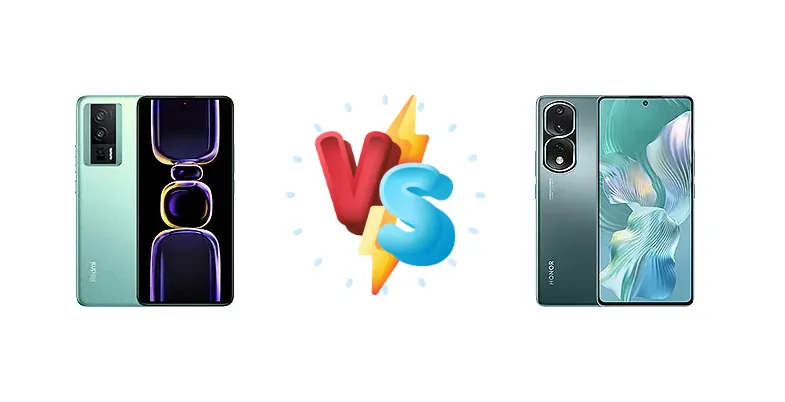
The Xiaomi Redmi K60 and Honor 80 Pro Flat present a fascinating comparison. Both devices are powered by the Qualcomm Snapdragon 8+ Gen 1, a powerhouse chipset. This review focuses on how Honor and Xiaomi differentiate these phones beyond the core processor, specifically in charging speeds, battery optimization, and subtle design choices that impact the user experience.
🏆 Quick Verdict
For the average user prioritizing rapid charging and a slightly more refined software experience, the Honor 80 Pro Flat edges out the Redmi K60. While both offer excellent performance, the Honor’s 66W charging and potential for optimized power management give it a slight advantage, despite the Redmi K60’s wireless charging capability.
| Network |
|---|
| 2G bands | GSM 850 / 900 / 1800 / 1900 | GSM 850 / 900 / 1800 / 1900 |
| 3G bands | HSDPA 800 / 850 / 900 / 1700(AWS) / 2100 | HSDPA 800 / 850 / 900 / 1700(AWS) / 1900 / 2100 |
| 4G bands | 1, 3, 4, 5, 8, 18, 19, 26, 34, 38, 39, 40, 41, 42 | LTE |
| 5G bands | 1, 3, 5, 8, 28, 38, 41, 77, 78 SA/NSA | SA/NSA |
| Speed | HSPA, LTE, 5G | HSPA, LTE, 5G |
| Technology | GSM / CDMA / HSPA / CDMA2000 / LTE / 5G | GSM / CDMA / HSPA / CDMA2000 / LTE / 5G |
| | CDMA2000 1x | CDMA2000 1x |
| Launch |
|---|
| Announced | 2022, December 27 | 2023, January 06 |
| Status | Available. Released 2023, January 01 | Available. Released 2023, January 06 |
| Body |
|---|
| Dimensions | 162.8 x 75.4 x 8.6 mm or 8.8 mm | 162.3 x 75.3 x 7.9 mm (6.39 x 2.96 x 0.31 in) |
| SIM | Nano-SIM + Nano-SIM | Nano-SIM + Nano-SIM |
| Weight | 199 g or 204 g (7.02 oz) | 186 g or 193 g (6.56 oz) |
| Display |
|---|
| Resolution | 1440 x 3200 pixels, 20:9 ratio (~526 ppi density) | 1080 x 2400 pixels, 20:9 ratio (~395 ppi density) |
| Size | 6.67 inches, 107.4 cm2 (~87.5% screen-to-body ratio) | 6.67 inches, 107.4 cm2 (~87.9% screen-to-body ratio) |
| Type | OLED, 68B colors, 120Hz, Dolby Vision, HDR10+, 1400 nits (peak) | OLED, 1B colors, 120Hz, HDR, 1000 nits (peak) |
| Platform |
|---|
| CPU | Octa-core (1x3.0 GHz Cortex-X2 & 3x2.5 GHz Cortex-A710 & 4x1.80 GHz Cortex-A510) | Octa-core (1x3.0 GHz Cortex-X2 & 3x2.5 GHz Cortex-A710 & 4x1.80 GHz Cortex-A510) |
| Chipset | Qualcomm SM8475 Snapdragon 8+ Gen 1 (4 nm) | Qualcomm SM8475 Snapdragon 8+ Gen 1 (4 nm) |
| GPU | Adreno 730 | Adreno 730 |
| OS | Android 13, MIUI 14 | Android 12, MagicOS 7 |
| Memory |
|---|
| Card slot | No | No |
| Internal | 128GB 8GB RAM, 256GB 8GB RAM, 256GB 12GB RAM, 256GB 16GB RAM, 512GB 12GB RAM, 512GB 16GB RAM, 1TB 16GB RAM | 256GB 12GB RAM |
| | UFS 3.1 | - |
| Main Camera |
|---|
| Features | Color spectrum sensor, Dual-LED dual-tone flash, HDR, panorama | LED flash, HDR, panorama |
| Single | - | 32 MP, f/2.4, (wide) |
| Triple | 64 MP, f/1.8, (wide), 1/2.0", 0.7µm, PDAF, OIS
8 MP, f/2.2, 120˚ (ultrawide), 1/4.0", 1.12µm
2 MP (macro) | 160 MP, f/1.8, (wide), 1/1.56", 0.75µm, PDAF
8 MP, f/2.2, (ultrawide)
Auxiliary lens |
| Video | 8K@24fps, 4K@30/60fps, 1080p@30/60/120/240/960fps, 720p@1920fps, gyro-EIS | 4K@30fps, 1080p@30/60fps, gyro-EIS |
| Selfie camera |
|---|
| Features | HDR | HDR |
| Single | 16 MP, f/2.5, (wide), 1/3.06", 1.0µm | 32 MP, f/2.4, (wide) |
| Video | 1080p@30/60/120fps | 1080p@30fps, gyro-EIS |
| Sound |
|---|
| 3.5mm jack | No | No |
| 35mm jack | No | No |
| Loudspeaker | Yes, with stereo speakers | Yes, with stereo speakers |
| | 24-bit/192kHz audio | - |
| Comms |
|---|
| Bluetooth | 5.3, A2DP, LE | 5.2, A2DP, LE, aptX HD |
| Infrared port | Yes | - |
| NFC | Yes | Yes |
| Positioning | GPS (L1), GLONASS (G1), BDS (B1I+B1c), GALILEO (E1), QZSS (L1) | GPS, GALILEO, GLONASS, BDS, QZSS |
| Radio | Unspecified | No |
| USB | USB Type-C 2.0, OTG | USB Type-C 2.0, OTG |
| WLAN | Wi-Fi 802.11 a/b/g/n/ac/6e, dual-band, Wi-Fi Direct | Wi-Fi 802.11 a/b/g/n/ac/6, dual-band, Wi-Fi Direct |
| Features |
|---|
| Sensors | Fingerprint (under display, optical), accelerometer, gyro, proximity, compass | Fingerprint (under display, optical), accelerometer, gyro, compass |
| | - | Virtual proximity sensing |
| Battery |
|---|
| Charging | 67W wired, PD3.0, QC3+
30W wireless | 66W wired, 3-50% in 15 min
5W reverse wired |
| Type | Li-Po 5500 mAh | Li-Po 4800 mAh |
| Misc |
|---|
| Colors | Black, White, Blue, Green | Black, Green, Pink |
| Price | About 350 EUR | About 450 EUR |
Xiaomi Redmi K60
- Includes 30W wireless charging.
- Potentially better thermal management for gaming.
- Competitive 67W wired charging.
- Software experience may be less refined than Honor.
- No information on OIS or camera sensor size.
Honor 80 Pro Flat
- Faster 0-50% charging time (claimed).
- Flat display appeals to some users.
- Potentially more polished software experience.
- Lacks wireless charging.
- Only 5W reverse wired charging.
Display Comparison
Both phones utilize the Snapdragon 8+ Gen 1’s capabilities to drive high-refresh-rate displays, but specific panel details are missing. Given the market positioning, we can assume both employ AMOLED panels. The Honor 80 Pro Flat’s ‘flat’ designation is a key differentiator, appealing to users who dislike curved edges. While neither spec sheet details peak brightness, Honor’s marketing often emphasizes color accuracy, suggesting a focus on display calibration. The Redmi K60, being a gaming-focused device, may prioritize refresh rate over absolute color accuracy.
Camera Comparison
Without detailed camera specifications, a direct comparison is difficult. Both phones likely feature multi-camera systems, but the sensor sizes and lens apertures are unknown. The image processing style will be a key differentiator. Xiaomi typically leans towards vibrant, saturated colors, while Honor often aims for a more natural, realistic look. The absence of information on Optical Image Stabilization (OIS) is a significant omission; its presence would be a major advantage for low-light photography and video recording.
Performance
The core performance is virtually identical, as both the Redmi K60 and Honor 80 Pro Flat are equipped with the Qualcomm SM8475 Snapdragon 8+ Gen 1 (4 nm) chipset and the same CPU configuration: Octa-core (1x3.0 GHz Cortex-X2 & 3x2.5 GHz Cortex-A710 & 4x1.80 GHz Cortex-A510). Performance will largely depend on thermal management and software optimization. The Redmi K60, with its gaming focus, likely has a more aggressive cooling solution, potentially allowing for sustained peak performance during extended gaming sessions. However, without detailed thermal testing, this remains speculative.
Battery Life
The Redmi K60 boasts 67W wired charging, PD3.0, and QC3+, alongside 30W wireless charging. The Honor 80 Pro Flat offers 66W wired charging and 5W reverse wired charging. While the Redmi K60’s wireless charging is a clear advantage, the Honor 80 Pro Flat claims a 3-50% charge in just 15 minutes, suggesting a potentially faster charging curve initially. The actual battery capacity of both devices is not specified, but the combination of charging wattage and software optimization will determine real-world battery life.
Buying Guide
Buy the Xiaomi Redmi K60 if you need wireless charging and prioritize maximizing value for your money. Its 67W wired charging is competitive, and the inclusion of wireless charging is a significant bonus at this price point. Buy the Honor 80 Pro Flat if you prefer a potentially more polished user experience and value faster 0-50% charging times, even if it lacks wireless charging. The Honor’s software and design lean towards a more premium feel.
Frequently Asked Questions
❓ Does the Snapdragon 8+ Gen 1 in either phone exhibit significant thermal throttling during prolonged gaming sessions?
While the Snapdragon 8+ Gen 1 is a powerful chip, it can generate heat under sustained load. The Redmi K60, marketed towards gamers, likely incorporates a more robust cooling system, potentially mitigating throttling better than the Honor 80 Pro Flat. However, real-world performance will depend on ambient temperature and game settings.
❓ How does the software experience differ between Xiaomi's MIUI and Honor's MagicOS on these devices?
MIUI is known for its extensive customization options and feature set, but can sometimes feel bloated. MagicOS, on the other hand, aims for a cleaner, more streamlined experience, closer to stock Android. Honor has been focusing on improving its software, and MagicOS is generally considered more refined than previous iterations of EMUI.
❓ Is the 5W reverse wired charging on the Honor 80 Pro Flat useful for charging accessories like earbuds?
While 5W reverse wired charging is present, it's quite slow. It's suitable for emergency charging of small accessories like earbuds or a smartwatch, but not for quickly topping up a phone or tablet. It's more of a convenience feature than a practical charging solution.