
Xiaomi Redmi K60 vs. Google Pixel 7a: A Deep Dive into Performance and Value
| Phones Images | |||||
|---|---|---|---|---|---|
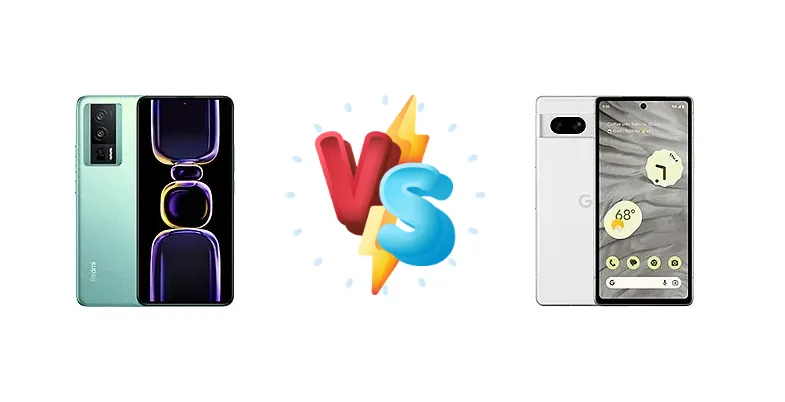
|
🏆 Quick Verdict
For users prioritizing gaming and demanding tasks, the Xiaomi Redmi K60 is the clear winner, offering significantly more processing power. However, the Google Pixel 7a excels in camera quality and software experience, making it the better choice for photography enthusiasts and those deeply integrated into the Google ecosystem.
| PHONES | ||
|---|---|---|
| Phone Names | Xiaomi Redmi K60 | Google Pixel 7a |
| Network | ||
|---|---|---|
| 2G bands | GSM 850 / 900 / 1800 / 1900 | GSM 850 / 900 / 1800 / 1900 |
| 3G bands | HSDPA 800 / 850 / 900 / 1700(AWS) / 2100 | HSDPA 800 / 850 / 900 / 1700(AWS) / 1900 / 2100 |
| 4G bands | 1, 3, 4, 5, 8, 18, 19, 26, 34, 38, 39, 40, 41, 42 | 1, 2, 3, 4, 5, 7, 8, 12, 13, 14, 17, 20, 25, 26, 28, 29, 30, 38, 40, 41, 48, 66, 71 - GWKK3, G0DZQ |
| 5G bands | 1, 3, 5, 8, 28, 38, 41, 77, 78 SA/NSA | 1, 2, 3, 5, 7, 8, 12, 14, 20, 25, 28, 30, 38, 41, 48, 66, 71, 77, 78 SA/NSA/Sub6 - GWKK3 |
| Speed | HSPA, LTE, 5G | HSPA, LTE, 5G |
| Technology | GSM / CDMA / HSPA / CDMA2000 / LTE / 5G | GSM / HSPA / LTE / 5G |
| CDMA2000 1x | 1, 2, 3, 5, 7, 8, 12, 20, 25, 28, 38, 40, 41, 66, 75, 76, 77, 78, 79 SA/NSA/Sub6 - GHL1X, G82U8 | |
| Launch | ||
|---|---|---|
| Announced | 2022, December 27 | 2023, May 10 |
| Status | Available. Released 2023, January 01 | Available. Released 2023, May 10 |
| Body | ||
|---|---|---|
| Build | - | Glass front (Gorilla Glass 3), aluminum frame, plastic back |
| Dimensions | 162.8 x 75.4 x 8.6 mm or 8.8 mm | 152 x 72.9 x 9 mm (5.98 x 2.87 x 0.35 in) |
| SIM | Nano-SIM + Nano-SIM | Nano-SIM + eSIM |
| Weight | 199 g or 204 g (7.02 oz) | 193.5 g (6.84 oz) |
| - | IP67 dust/water resistant (up to 1m for 30 min) | |
| Display | ||
|---|---|---|
| Protection | - | Corning Gorilla Glass 3 |
| Resolution | 1440 x 3200 pixels, 20:9 ratio (~526 ppi density) | 1080 x 2400 pixels, 20:9 ratio (~429 ppi density) |
| Size | 6.67 inches, 107.4 cm2 (~87.5% screen-to-body ratio) | 6.1 inches, 90.7 cm2 (~81.8% screen-to-body ratio) |
| Type | OLED, 68B colors, 120Hz, Dolby Vision, HDR10+, 1400 nits (peak) | OLED, HDR, 90Hz |
| - | Always-on display | |
| Platform | ||
|---|---|---|
| CPU | Octa-core (1x3.0 GHz Cortex-X2 & 3x2.5 GHz Cortex-A710 & 4x1.80 GHz Cortex-A510) | Octa-core (2x2.85 GHz Cortex-X1 & 2x2.35 GHz Cortex-A78 & 4x1.80 GHz Cortex-A55) |
| Chipset | Qualcomm SM8475 Snapdragon 8+ Gen 1 (4 nm) | Google Tensor G2 (5 nm) |
| GPU | Adreno 730 | Mali-G710 MP7 |
| OS | Android 13, MIUI 14 | Android 13, upgradable to Android 15, up to 5 major Android upgrades |
| Memory | ||
|---|---|---|
| Card slot | No | No |
| Internal | 128GB 8GB RAM, 256GB 8GB RAM, 256GB 12GB RAM, 256GB 16GB RAM, 512GB 12GB RAM, 512GB 16GB RAM, 1TB 16GB RAM | 128GB 8GB RAM |
| UFS 3.1 | UFS 3.1 | |
| Main Camera | ||
|---|---|---|
| Dual | - | 64 MP, f/1.9, 26mm (wide), 1/1.73", 0.8µm, dual pixel PDAF, OIS 13 MP, f/2.2, 120˚ (ultrawide), 1.12µm |
| Features | Color spectrum sensor, Dual-LED dual-tone flash, HDR, panorama | Dual-LED flash, Pixel Shift, Auto-HDR, panorama |
| Triple | 64 MP, f/1.8, (wide), 1/2.0", 0.7µm, PDAF, OIS 8 MP, f/2.2, 120˚ (ultrawide), 1/4.0", 1.12µm 2 MP (macro) | - |
| Video | 8K@24fps, 4K@30/60fps, 1080p@30/60/120/240/960fps, 720p@1920fps, gyro-EIS | 4K@30/60fps, 1080p@30/60/120/240fps, OIS |
| Selfie camera | ||
|---|---|---|
| Features | HDR | HDR, panorama |
| Single | 16 MP, f/2.5, (wide), 1/3.06", 1.0µm | 13 MP, f/2.2, 20mm (ultrawide), 1.12µm |
| Video | 1080p@30/60/120fps | 4K@30fps, 1080p@30fps |
| Sound | ||
|---|---|---|
| 3.5mm jack | No | No |
| 35mm jack | No | No |
| Loudspeaker | Yes, with stereo speakers | Yes, with stereo speakers |
| 24-bit/192kHz audio | - | |
| Comms | ||
|---|---|---|
| Bluetooth | 5.3, A2DP, LE | 5.3, A2DP, LE |
| Infrared port | Yes | - |
| NFC | Yes | Yes |
| Positioning | GPS (L1), GLONASS (G1), BDS (B1I+B1c), GALILEO (E1), QZSS (L1) | GPS, GLONASS, GALILEO, BDS, QZSS, NavIC |
| Radio | Unspecified | No |
| USB | USB Type-C 2.0, OTG | USB Type-C 3.2 |
| WLAN | Wi-Fi 802.11 a/b/g/n/ac/6e, dual-band, Wi-Fi Direct | Wi-Fi 802.11 a/b/g/n/ac/6e, tri-band |
| Features | ||
|---|---|---|
| Sensors | Fingerprint (under display, optical), accelerometer, gyro, proximity, compass | Fingerprint (under display, optical), accelerometer, gyro, proximity, compass, barometer |
| Battery | ||
|---|---|---|
| Charging | 67W wired, PD3.0, QC3+ 30W wireless | 18W wired, PD3.0 7.5W wireless |
| Type | Li-Po 5500 mAh | Li-Po 4385 mAh |
| Misc | ||
|---|---|---|
| Colors | Black, White, Blue, Green | Charcoal, Snow, Sea, Coral |
| Models | - | GWKK3, GHL1X, G0DZQ, G82U8 |
| Price | About 350 EUR | € 179.90 / $ 150.00 / £ 170.00 / ₹ 25,980 |
Xiaomi Redmi K60
- Superior processing power with Snapdragon 8+ Gen 1
- Significantly faster charging speeds (67W wired, 30W wireless)
- Potentially better thermal management due to 4nm process
- Camera performance likely trails behind the Pixel 7a
- Software experience may not be as refined as Google’s Pixel UI
Google Pixel 7a
- Exceptional camera quality and computational photography
- Clean and consistently updated Android experience
- Strong AI-powered features (Magic Eraser, Call Screen)
- Slower charging speeds (18W wired, 7.5W wireless)
- Less powerful processor compared to the Snapdragon 8+ Gen 1
Display Comparison
The Pixel 7a boasts a measured peak brightness of 1070 nits, ensuring excellent visibility outdoors. While the Redmi K60’s display specs aren’t provided, Xiaomi typically equips its K-series with high-refresh-rate OLED panels. The Pixel 7a’s brightness advantage is notable, especially for HDR content consumption. The absence of LTPO technology in either phone means refresh rate scaling isn’t as dynamic as on flagship devices, but both likely offer 120Hz refresh rates for smooth scrolling. Bezels appear comparable based on available imagery, and color accuracy is expected to be excellent on both, though the Pixel benefits from Google’s color calibration.
Camera Comparison
The Pixel 7a is renowned for its computational photography prowess, leveraging Google’s image processing algorithms to deliver exceptional image quality, particularly in challenging lighting conditions. While sensor sizes aren’t specified, the Pixel’s focus is on software optimization. The Redmi K60’s camera specs are unknown, but Xiaomi often prioritizes high megapixel counts. The Pixel 7a’s video capabilities are also strong, with excellent stabilization and dynamic range. The Tensor G2’s dedicated image signal processor (ISP) plays a crucial role in the Pixel’s camera performance, offering features like Magic Eraser and Photo Unblur. The Redmi K60 will likely offer more versatility with potential for multiple lenses, but the Pixel 7a’s consistent image quality is a significant advantage.
Performance
The Redmi K60’s Qualcomm Snapdragon 8+ Gen 1 (4nm) is a powerhouse, featuring a Cortex-X2 prime core clocked at 3.0 GHz. This contrasts with the Pixel 7a’s Google Tensor G2 (5nm) which utilizes a Cortex-X1 prime core at 2.85 GHz. The 4nm process of the Snapdragon 8+ Gen 1 generally offers better thermal efficiency than the 5nm Tensor G2, potentially leading to less throttling during sustained workloads. The K60’s Adreno 730 GPU is also a step up from the Tensor G2’s GPU, making it the superior choice for mobile gaming. While the Tensor G2 excels in AI tasks, the Snapdragon 8+ Gen 1 provides a more substantial boost in raw CPU and GPU performance.
Battery Life
The Pixel 7a has an endurance rating of 76 hours, indicating solid battery life. The Redmi K60 compensates for potentially lower mAh with its significantly faster 67W wired charging (PD3.0, QC3+) and 30W wireless charging. The Pixel 7a is limited to 18W wired charging and 7.5W wireless charging. This means the Redmi K60 can achieve a full charge in a fraction of the time, a crucial benefit for users who frequently need to top up their battery. While the Pixel 7a’s endurance is respectable, the K60’s charging speed offers a more convenient experience.
Buying Guide
Buy the Xiaomi Redmi K60 if you need uncompromising performance for gaming, video editing, or multitasking, and value fast charging speeds. Buy the Google Pixel 7a if you prefer a superior camera experience, a clean and consistently updated Android interface, and benefit from Google’s AI-powered features like Magic Eraser and Call Screen.