
Xiaomi Redmi K60 Pro vs Xiaomi 12T Pro: The Ultimate Showdown
| Phones Images | |||||
|---|---|---|---|---|---|
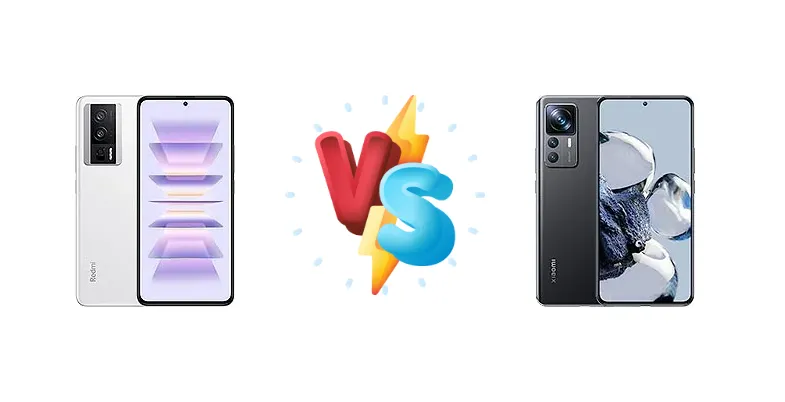
|
🏆 Quick Verdict
The Redmi K60 Pro edges out the 12T Pro thanks to its newer Snapdragon 8 Gen 2 chipset, offering superior performance and efficiency. While the 12T Pro has a bright display and excellent battery life, the K60 Pro's overall package makes it the slightly better choice for most users.
| PHONES | ||
|---|---|---|
| Phone Names | Xiaomi Redmi K60 Pro | Xiaomi 12T Pro |
| Network | ||
|---|---|---|
| 2G bands | GSM 850 / 900 / 1800 / 1900 | GSM 850 / 900 / 1800 / 1900 |
| 3G bands | HSDPA 800 / 850 / 900 / 1700(AWS) / 2100 | HSDPA 800 / 850 / 900 / 1700(AWS) / 1900 / 2100 |
| 4G bands | 1, 3, 4, 5, 8, 18, 19, 26, 34, 38, 39, 40, 41, 42 | 1, 2, 3, 4, 5, 7, 8, 12, 13, 17, 18, 19, 20, 25, 26, 28, 32, 38, 39, 40, 41, 42, 48, 66 |
| 5G bands | 1, 3, 5, 8, 28, 38, 41, 77, 78 SA/NSA | 1, 3, 5, 7, 8, 20, 28, 38, 40, 41, 66, 77, 78, 75 SA/NSA |
| Speed | HSPA, LTE, 5G | HSPA, LTE, 5G |
| Technology | GSM / CDMA / HSPA / CDMA2000 / LTE / 5G | GSM / HSPA / LTE / 5G |
| CDMA2000 1x | - | |
| Launch | ||
|---|---|---|
| Announced | 2022, December 27 | 2022, October 04 |
| Status | Available. Released 2023, January 01 | Available. Released 2022, October 06 |
| Body | ||
|---|---|---|
| Dimensions | 162.8 x 75.4 x 8.6 mm or 8.9 mm | 163.1 x 75.9 x 8.6 mm (6.42 x 2.99 x 0.34 in) |
| SIM | Nano-SIM + Nano-SIM | · Nano-SIM + eSIM· Nano-SIM + Nano-SIM |
| Weight | 201 g or 205 g (7.09 oz) | 205 g (7.23 oz) |
| - | IP53, dust and splash resistant | |
| Display | ||
|---|---|---|
| Protection | - | Corning Gorilla Glass 5 |
| Resolution | 1440 x 3200 pixels, 20:9 ratio (~526 ppi density) | 1220 x 2712 pixels, 20:9 ratio (~446 ppi density) |
| Size | 6.67 inches, 107.4 cm2 (~87.5% screen-to-body ratio) | 6.67 inches, 107.4 cm2 (~86.7% screen-to-body ratio) |
| Type | OLED, 68B colors, 120Hz, Dolby Vision, HDR10+, 1400 nits (peak) | AMOLED, 68B colors, 120Hz, Dolby Vision, HDR10+, 500 nits (typ), 900 nits (peak) |
| Platform | ||
|---|---|---|
| CPU | Octa-core (1x3.2 GHz Cortex-X3 & 2x2.8 GHz Cortex-A715 & 2x2.8 GHz Cortex-A710 & 3x2.0 GHz Cortex-A510) | Octa-core (1x3.19 GHz Cortex-X2 & 3x2.75 GHz Cortex-A710 & 4x2.0 GHz Cortex-A510) |
| Chipset | Qualcomm SM8550-AB Snapdragon 8 Gen 2 (4 nm) | Qualcomm SM8475 Snapdragon 8+ Gen 1 (4 nm) |
| GPU | Adreno 740 | Adreno 730 |
| OS | Android 13, MIUI 14 | Android 12, upgradable to Android 14, HyperOS |
| Memory | ||
|---|---|---|
| Card slot | No | No |
| Internal | 128GB 8GB RAM, 256GB 8GB RAM, 256GB 12GB RAM, 512GB 12GB RAM, 512GB 16GB RAM | 128GB 8GB RAM, 256GB 8GB RAM, 256GB 12GB RAM |
| UFS 4.0 UFS 3.1 - 128GB only | UFS 3.1 | |
| Main Camera | ||
|---|---|---|
| Features | Color spectrum sensor, Dual-LED dual-tone flash, HDR, panorama | Color spectrum sensor, Dual-LED dual-tone flash, HDR, panorama |
| Triple | 54 MP, f/1.9, (wide), 1/1.49", 1.0µm, PDAF, OIS 8 MP, 118˚ (ultrawide), 1/4.0", 1.12µm 2 MP (macro) | 200 MP, f/1.7, (wide), 1/1.22", 0.64µm, PDAF, OIS 8 MP, f/2.2, 120˚ (ultrawide), 1/4.0", 1.12µm 2 MP (macro) |
| Video | 8K@24fps, 4K@30/60fps, 1080p@30/60/120/240/960fps, 720p@1920fps, gyro-EIS | 8K@24fps, 4K@30/60fps, 1080p@30/60/120/240fps, HDR10+ |
| Selfie camera | ||
|---|---|---|
| Features | HDR | HDR, panorama |
| Single | 16 MP, (wide), 1/3.06", 1.0µm | 20 MP, f/2.2, (wide), 1/3.47", 0.8µm |
| Video | 1080p@30/60/120fps | 1080p@30/60fps, HDR |
| Sound | ||
|---|---|---|
| 3.5mm jack | No | No |
| 35mm jack | No | No |
| Loudspeaker | Yes, with stereo speakers | Yes, with stereo speakers |
| 24-bit/192kHz audio | Tuned by Harman Kardon 24-bit/192kHz audio | |
| Comms | ||
|---|---|---|
| Bluetooth | 5.3, A2DP, LE | 5.2, A2DP, LE, aptX HD |
| Infrared port | Yes | Yes |
| NFC | Yes | Yes (market/region dependent) |
| Positioning | GPS (L1+L5), GLONASS (G1), BDS (B1I+B2a+Bc), GALILEO (E1+E5a), QZSS (L1+L5), NavIC | GPS (L1+L5), GLONASS (L1), BDS (B1I+B1c+B2a), GALILEO (E1+E5a), QZSS (L1+L5), NavIC (L5) |
| Radio | Unspecified | No |
| USB | USB Type-C 2.0, OTG | USB Type-C 2.0, OTG |
| WLAN | Wi-Fi 802.11 a/b/g/n/ac/6e, dual-band, Wi-Fi Direct | Wi-Fi 802.11 a/b/g/n/ac/6, dual-band, Wi-Fi Direct |
| Features | ||
|---|---|---|
| Sensors | Fingerprint (under display, optical), accelerometer, gyro, proximity, compass | Fingerprint (under display, optical), accelerometer, gyro, proximity, compass |
| Battery | ||
|---|---|---|
| Charging | 120W wired, PD3.0, QC3+, 100% in 19 min 30W wireless | 120W wired, 100% in 19 min |
| Type | Li-Po 5000 mAh | Li-Po 5000 mAh |
| Misc | ||
|---|---|---|
| Colors | Black, White, Mint, Champion Black | Black, Silver, Blue |
| Models | 22127RK46C | 22081212UG, 22081212G |
| Price | About 460 EUR | $ 208.76 / € 167.62 |
| SAR | - | 1.08 W/kg (head) 1.07 W/kg (body) |
| SAR EU | - | 1.00 W/kg (head) 1.00 W/kg (body) |
| Tests | ||
|---|---|---|
| Battery life | - | Endurance rating 91h |
| Camera | - | Photo / Video |
| Display | - | Contrast ratio: Infinite (nominal) |
| Loudspeaker | - | -24.1 LUFS (Very good) |
| Performance | - | AnTuTu: 1032185 (v9) GeekBench: 4081 (v5.1) GFXBench: 65fps (ES 3.1 onscreen) |
Xiaomi Redmi K60 Pro
- Newer Snapdragon 8 Gen 2 chipset
- Faster charging (120W)
- Excellent performance
- Good value for money
- Camera slightly behind 12T Pro
- May not have the absolute brightest display
Xiaomi 12T Pro
- Brighter display (913 nits)
- Excellent battery life (91h endurance)
- Slightly better camera in some scenarios
- Good overall balance of features
- Older Snapdragon 8+ Gen 1 chipset
- Slightly more expensive than K60 Pro
Display Comparison
Both phones feature AMOLED displays with 120Hz refresh rates, offering smooth visuals. The Xiaomi 12T Pro boasts a measured peak brightness of 913 nits, making it slightly brighter in outdoor conditions. The K60 Pro's display is excellent, but may not reach the same peak brightness. Color accuracy is generally good on both.
Camera Comparison
The Xiaomi 12T Pro is generally considered to have a slightly better camera system, particularly in well-lit conditions. While both phones offer versatile camera setups, the 12T Pro's image processing often produces more vibrant and detailed photos. The K60 Pro's camera is still very good, but may not match the 12T Pro's consistency.
Performance
The Redmi K60 Pro's Snapdragon 8 Gen 2 is a significant upgrade over the 12T Pro's Snapdragon 8+ Gen 1. Expect noticeably faster app loading times, smoother multitasking, and better gaming performance on the K60 Pro. The 8+ Gen 1 is still a capable chip, but the Gen 2 offers a clear advantage in efficiency and raw power.
Battery Life
The Xiaomi 12T Pro boasts an impressive endurance rating of 91 hours, suggesting exceptional battery life. The Redmi K60 Pro's battery life is also good, but likely won't match the 12T Pro's longevity. Both phones offer 120W wired charging, allowing for incredibly fast charging times (around 19 minutes to 100%).
Buying Guide
The Xiaomi Redmi K60 Pro is ideal for gamers and power users who prioritize performance and fast charging. The Xiaomi 12T Pro is a great option for those seeking a balance of features, a vibrant display, and long battery life, especially if camera quality is a key consideration.