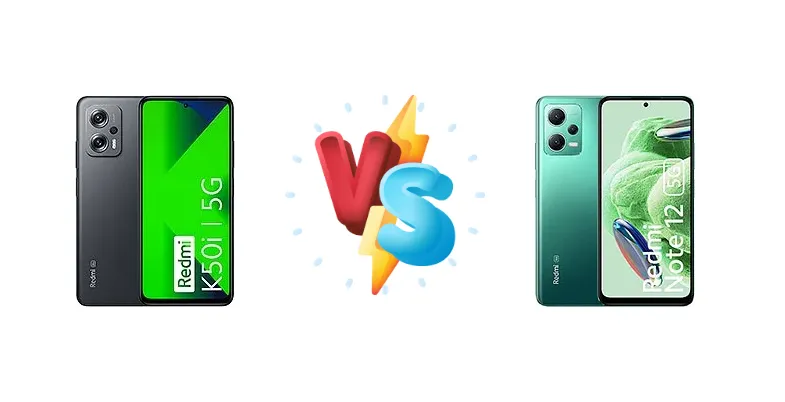
Xiaomi's Redmi series consistently delivers excellent value, but choosing between models can be tricky. The Redmi K50i and Redmi Note 12 both offer compelling features, but cater to slightly different users. Let's dive into a comprehensive comparison to help you decide which one is right for you.
🏆 Quick Verdict
The Redmi K50i takes the performance crown with its significantly faster Dimensity 8100 chipset and 67W charging. However, the Redmi Note 12 boasts exceptional battery life and a potentially better display experience. It depends on your priorities: power vs. endurance.
| Network |
|---|
| 2G bands | GSM 850 / 900 / 1800 / 1900 | GSM 850 / 900 / 1800 / 1900 |
| 3G bands | HSDPA 850 / 900 / 1700(AWS) / 1900 / 2100 | HSDPA 850 / 900 / 2100 |
| 4G bands | 1, 2, 3, 4, 5, 7, 8, 20, 28, 38, 40, 41 | 1, 3, 5, 8, 40, 41 |
| 5G bands | 1, 3, 5, 7, 8, 20, 28, 38, 40, 41, 77, 78 SA/NSA | 1, 3, 5, 8, 28, 40, 78 SA/NSA |
| Speed | HSPA, LTE, 5G | HSPA, LTE, 5G |
| Technology | GSM / HSPA / LTE / 5G | GSM / HSPA / LTE / 5G |
| Launch |
|---|
| Announced | 2022, July 20 | 2022, October 27 |
| Status | Available. Released 2022, July 23 | Available. Released 2023, January 11 |
| Body |
|---|
| Dimensions | 163.6 x 74.3 x 8.9 mm (6.44 x 2.93 x 0.35 in) | 165.9 x 76.2 x 8 mm (6.53 x 3.00 x 0.31 in) |
| SIM | Nano-SIM + Nano-SIM | Nano-SIM + Nano-SIM |
| Weight | 200 g (7.05 oz) | 188 g (6.63 oz) |
| | - | IP53, dust and splash resistant |
| Display |
|---|
| Protection | Corning Gorilla Glass 5 | Corning Gorilla Glass 3 |
| Resolution | 1080 x 2460 pixels (~407 ppi density) | 1080 x 2400 pixels, 20:9 ratio (~395 ppi density) |
| Size | 6.6 inches, 103.4 cm2 (~85.1% screen-to-body ratio) | 6.67 inches, 107.4 cm2 (~85.0% screen-to-body ratio) |
| Type | FFS LCD, 144Hz, HDR10, Dolby Vision, 500 nits (typ), 650 nits (HBM) | AMOLED, 120Hz, 1200 nits (peak) |
| Platform |
|---|
| CPU | Octa-core (4x2.85 GHz Cortex-A78 & 4x2.0 GHz Cortex-A55) | Octa-core (2x2.0 GHz Cortex-A78 & 6x1.8 GHz Cortex-A55) |
| Chipset | Mediatek Dimensity 8100 (5 nm) | Qualcomm SM4375 Snapdragon 4 Gen 1 (6 nm) |
| GPU | Mali-G610 MC6 | Adreno 619 |
| OS | Android 12, upgradable to Android 13, MIUI 14 | Android 12, MIUI 14 (International), MIUI 13 (India) |
| Memory |
|---|
| Card slot | No | microSDXC (uses shared SIM slot) |
| Internal | 128GB 6GB RAM, 128GB 8GB RAM, 256GB 8GB RAM | 128GB 4GB RAM, 128GB 6GB RAM, 256GB 8GB RAM |
| | - | UFS 2.2 |
| Main Camera |
|---|
| Features | Color spectrum sensor, LED flash, HDR, panorama | Dual-LED dual-tone flash, HDR, panorama |
| Triple | 64 MP, f/1.9, (wide), 1/1.72", 0.8µm, PDAF
8 MP, f/2.2, 120˚, (ultrawide)
2 MP (macro) | 48 MP, f/1.8, (wide), PDAF
8 MP, f/2.2, 120˚ (ultrawide), 1/4.0", 1.12µm
2 MP (macro) |
| Video | 4K@30fps, 1080p@30/60fps | 1080p@30fps |
| Selfie camera |
|---|
| Features | - | HDR |
| Single | 16 MP, f/2.5, (wide) | 13 MP, f/2.5, (wide), 1/3.0" |
| Video | 1080p@30fps | 1080p@30fps |
| Sound |
|---|
| 3.5mm jack | - | Yes |
| 35mm jack | Yes | Yes |
| Loudspeaker | Yes, with stereo speakers | Yes |
| | - | 24-bit/192kHz audio |
| Comms |
|---|
| Bluetooth | 5.3, A2DP, LE | 5.1, A2DP, LE |
| Infrared port | Yes | Yes |
| NFC | No | Yes (market/region dependent) |
| Positioning | GPS (L1), GLONASS (L1), BDS (B1I+B1c), GALILEO (E1), QZSS (L1) | GPS, GLONASS |
| Radio | No | Unspecified |
| USB | USB Type-C 2.0, OTG | USB Type-C 2.0, OTG |
| WLAN | Wi-Fi 802.11 a/b/g/n/ac/6, dual-band, Wi-Fi Direct | Wi-Fi 802.11 a/b/g/n/ac, dual-band |
| Features |
|---|
| Sensors | Fingerprint (side-mounted), accelerometer, proximity, gyro, compass | Fingerprint (side-mounted), accelerometer, gyro, proximity, compass |
| Battery |
|---|
| Charging | 67W wired, 50% in 15 min, 100% in 46 min | 33W wired, 50% in 22 min |
| Type | Li-Po 5080 mAh | Li-Po 5000 mAh |
| Misc |
|---|
| Colors | Phantom Blue, Stealth Black, Quick Silver | Frosted Green, Matte Black, Mystique Blue |
| Models | 22041216I | 22111317I, 22111317G |
| Price | About 320 EUR | € 151.99 / $ 219.99 / ₹ 11,999 |
| SAR | - | 1.09 W/kg (head) 1.05 W/kg (body) |
| SAR EU | - | 0.68 W/kg (head) 0.91 W/kg (body) |
| Tests |
|---|
| Battery life | - |
Endurance rating 101h
|
| Camera | - |
Photo / Video |
| Display | - |
Contrast ratio: Infinite (nominal) |
| Loudspeaker | - |
-28.0 LUFS (Good)
|
| Performance | - |
AnTuTu: 360745 (v9)
GeekBench: 1998 (v5.1), 2017 (v6) |
Xiaomi Redmi K50i
- Superior Performance (Dimensity 8100)
- Faster 67W Charging
- Likely better gaming experience
- Modern Chipset
- Battery life not as impressive as Note 12
- Display specs less clear
- Potentially higher price
Xiaomi Redmi Note 12
- Exceptional Battery Life
- Bright Display (706 nits)
- Potentially better image processing
- More affordable
- Slower Performance (Snapdragon 4 Gen 1)
- Slower 33W Charging
- Less powerful for gaming
Display Comparison
The Redmi Note 12 appears to have an edge with a measured 706 nits max brightness and an infinite contrast ratio (though this is nominal). While the K50i's display is likely good, specific brightness and contrast figures are unavailable. The Note 12's display should offer better outdoor visibility and potentially richer colors.
Camera Comparison
Both phones feature 'Photo / Video' capabilities, but detailed camera specs are missing. Based on general Redmi trends, the Note 12 might offer slightly better image processing due to Xiaomi's software optimization, but the K50i's hardware could potentially capture more detail. A direct camera comparison would require more data.
Performance
Here, the Redmi K50i dominates. The Mediatek Dimensity 8100 is a significantly more powerful chipset than the Snapdragon 4 Gen 1 found in the Note 12. Expect smoother multitasking, faster app loading, and significantly better gaming performance on the K50i.
Battery Life
The Redmi Note 12 shines in this category. Its endurance rating of 101h is outstanding, and active use lasting 10 hours and 58 minutes is impressive. The K50i's battery life is likely good, but not in the same league as the Note 12. However, the K50i's 67W charging offers significantly faster top-ups.
Buying Guide
The Redmi K50i is ideal for gamers and power users who prioritize performance and fast charging. The Redmi Note 12 is a great choice for those who value long battery life, a bright display, and a more budget-friendly price point.
Frequently Asked Questions
❓ Is the Redmi K50i good for gaming?
Yes, the Redmi K50i's Dimensity 8100 chipset makes it a very capable gaming phone, offering smoother frame rates and better overall performance compared to the Note 12.
❓ Which phone has better battery life?
The Redmi Note 12 has significantly better battery life, with an endurance rating of 101 hours and active use lasting over 10 hours.
❓ Is the Redmi Note 12 worth buying if I don't game?
Absolutely! The Note 12's excellent battery life, bright display, and affordable price make it a great choice for everyday users who prioritize longevity and value.