
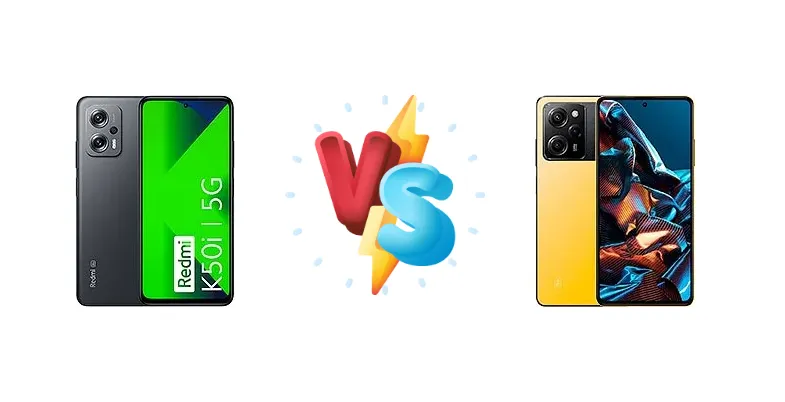
Xiaomi Redmi K50i vs Poco X5 Pro: A Head-to-Head Showdown
| Phones Images | |||||
|---|---|---|---|---|---|
|
🏆 Quick Verdict
The Redmi K50i boasts a more powerful chipset for demanding tasks and gaming, while the Poco X5 Pro shines with its vibrant display and excellent battery life. If performance is your priority, the K50i wins. For everyday use and media consumption, the X5 Pro is a strong contender.
| PHONES | ||
|---|---|---|
| Phone Names | Xiaomi Redmi K50i | Xiaomi Poco X5 Pro |
| Network | ||
|---|---|---|
| 2G bands | GSM 850 / 900 / 1800 / 1900 | GSM 850 / 900 / 1800 / 1900 |
| 3G bands | HSDPA 850 / 900 / 1700(AWS) / 1900 / 2100 | HSDPA 800 / 850 / 900 / 1700(AWS) / 1900 / 2100 - International |
| 4G bands | 1, 2, 3, 4, 5, 7, 8, 20, 28, 38, 40, 41 | 1, 2, 3, 4, 5, 7, 8, 20, 28, 38, 40, 41, 66 - International |
| 5G bands | 1, 3, 5, 7, 8, 20, 28, 38, 40, 41, 77, 78 SA/NSA | 1, 3, 5, 7, 8, 20, 28, 38, 40, 41, 77, 78 SA/NSA/Sub6 - International |
| Speed | HSPA, LTE, 5G | HSPA, LTE, 5G |
| Technology | GSM / HSPA / LTE / 5G | GSM / HSPA / LTE / 5G |
| - | 1, 3, 5, 8, 28, 40, 78 SA/NSA - India | |
| Launch | ||
|---|---|---|
| Announced | 2022, July 20 | 2023, February 06 |
| Status | Available. Released 2022, July 23 | Available. Released 2023, February 07 |
| Body | ||
|---|---|---|
| Build | - | Glass front (Gorilla Glass 5), plastic back, plastic frame |
| Dimensions | 163.6 x 74.3 x 8.9 mm (6.44 x 2.93 x 0.35 in) | 162.9 x 76 x 7.9 mm (6.41 x 2.99 x 0.31 in) |
| SIM | Nano-SIM + Nano-SIM | Nano-SIM + Nano-SIM |
| Weight | 200 g (7.05 oz) | 181 g (6.38 oz) |
| - | IP53, dust and splash resistant | |
| Display | ||
|---|---|---|
| Protection | Corning Gorilla Glass 5 | Corning Gorilla Glass 5 |
| Resolution | 1080 x 2460 pixels (~407 ppi density) | 1080 x 2400 pixels, 20:9 ratio (~395 ppi density) |
| Size | 6.6 inches, 103.4 cm2 (~85.1% screen-to-body ratio) | 6.67 inches, 107.4 cm2 (~86.8% screen-to-body ratio) |
| Type | FFS LCD, 144Hz, HDR10, Dolby Vision, 500 nits (typ), 650 nits (HBM) | AMOLED, 1B colors, 120Hz, Dolby Vision, HDR10+, 500 nits (typ), 900 nits (HBM) |
| Platform | ||
|---|---|---|
| CPU | Octa-core (4x2.85 GHz Cortex-A78 & 4x2.0 GHz Cortex-A55) | Octa-core (1x2.4 GHz Cortex-A78 & 3x2.2 GHz Cortex-A78 & 4x1.9 GHz Cortex-A55) |
| Chipset | Mediatek Dimensity 8100 (5 nm) | Qualcomm SM7325 Snapdragon 778G 5G (6 nm) |
| GPU | Mali-G610 MC6 | Adreno 642L |
| OS | Android 12, upgradable to Android 13, MIUI 14 | Android 12, upgradable to Android 13, MIUI 14 for POCO |
| Memory | ||
|---|---|---|
| Card slot | No | No |
| Internal | 128GB 6GB RAM, 128GB 8GB RAM, 256GB 8GB RAM | 128GB 6GB RAM, 256GB 8GB RAM |
| - | UFS 2.2 | |
| Main Camera | ||
|---|---|---|
| Features | Color spectrum sensor, LED flash, HDR, panorama | LED flash, HDR, panorama |
| Triple | 64 MP, f/1.9, (wide), 1/1.72", 0.8µm, PDAF 8 MP, f/2.2, 120˚, (ultrawide) 2 MP (macro) | 108 MP, f/1.9, (wide), 1/1.52", 0.7µm, PDAF 8 MP, f/2.2, 120˚ (ultrawide), 1/4.0", 1.12µm 2 MP (macro) |
| Video | 4K@30fps, 1080p@30/60fps | 4K@30fps, 1080p@30/60/120fps, gyro-EIS |
| Selfie camera | ||
|---|---|---|
| Features | - | HDR, panorama |
| Single | 16 MP, f/2.5, (wide) | 16 MP, f/2.4, (wide), 1/3.06" 1.0µm |
| Video | 1080p@30fps | 1080p@30/60fps |
| Sound | ||
|---|---|---|
| 3.5mm jack | - | Yes |
| 35mm jack | Yes | Yes |
| Loudspeaker | Yes, with stereo speakers | Yes, with stereo speakers |
| - | 24-bit/192kHz audio | |
| Comms | ||
|---|---|---|
| Bluetooth | 5.3, A2DP, LE | 5.2 (Intl), 5.1 (India), A2DP, LE |
| Infrared port | Yes | Yes |
| NFC | No | Yes (market/region dependent) |
| Positioning | GPS (L1), GLONASS (L1), BDS (B1I+B1c), GALILEO (E1), QZSS (L1) | GPS, GLONASS, BDS, GALILEO |
| Radio | No | No |
| USB | USB Type-C 2.0, OTG | USB Type-C 2.0, OTG |
| WLAN | Wi-Fi 802.11 a/b/g/n/ac/6, dual-band, Wi-Fi Direct | Wi-Fi 802.11 a/b/g/n/ac/6, dual-band, Wi-Fi DirectWi-Fi 802.11 a/b/g/n/ac, dual-band - India |
| Features | ||
|---|---|---|
| Sensors | Fingerprint (side-mounted), accelerometer, proximity, gyro, compass | Fingerprint (side-mounted), accelerometer, gyro, proximity, compass |
| Battery | ||
|---|---|---|
| Charging | 67W wired, 50% in 15 min, 100% in 46 min | 67W wired, PD3.0, QC4, 100% in 45 min 5W reverse wired |
| Type | Li-Po 5080 mAh | Li-Po 5000 mAh |
| Misc | ||
|---|---|---|
| Colors | Phantom Blue, Stealth Black, Quick Silver | Astral Black, Horizon Blue, Poco Yellow |
| Models | 22041216I | 22101320G, 22101320I |
| Price | About 320 EUR | € 156.00 / $ 221.33 / ₹ 22,490 |
| Tests | ||
|---|---|---|
| Battery life | - | Endurance rating 113h |
| Camera | - | Photo / Video |
| Display | - | Contrast ratio: Infinite (nominal) |
| Loudspeaker | - | -24.9 LUFS (Very good) |
| Performance | - | AnTuTu: 531398 (v9) GeekBench: 2930 (v5.1) GFXBench: 28fps (ES 3.1 onscreen) |
Xiaomi Redmi K50i
- Superior Performance (Dimensity 8100)
- Fast 67W Charging
- Good Value for Performance
- 5nm Process for Efficiency
- Display not as bright as Poco X5 Pro
- Camera may not be as refined
Xiaomi Poco X5 Pro
- Excellent Battery Life (113h Endurance)
- Bright and Vibrant Display (912 nits)
- Good Value
- 5W Reverse Wired Charging
- Less Powerful Chipset (Snapdragon 778G)
- Performance not as strong for gaming
Display Comparison
The Poco X5 Pro takes the display crown with its measured 912 nits peak brightness, offering a significantly more vibrant and visible experience, especially outdoors. While the Redmi K50i has a good display, it doesn't match the X5 Pro's brightness and contrast. The X5 Pro's 'Infinite' contrast ratio (nominal) suggests excellent black levels.
Camera Comparison
Both phones offer capable camera systems, but the Poco X5 Pro likely has a slight edge in image processing and overall consistency. While specific camera specs are not detailed, the Poco series often prioritizes camera optimization. The K50i's camera is still good, but may not offer the same level of refinement.
Performance
Here, the Redmi K50i pulls ahead. The Mediatek Dimensity 8100 is a considerably more powerful chipset than the Snapdragon 778G found in the Poco X5 Pro. This translates to smoother gaming, faster app loading times, and better overall responsiveness, particularly in demanding applications. The K50i's 5nm process also contributes to better efficiency.
Battery Life
The Poco X5 Pro demonstrates exceptional battery endurance, boasting an impressive 113h endurance rating. While the Redmi K50i's 67W charging is fast (50% in 15 min), the X5 Pro's longevity gives it a clear advantage for users who need all-day (and beyond) battery life.
Buying Guide
The Xiaomi Redmi K50i is ideal for gamers and users who prioritize raw processing power. The Poco X5 Pro is a better choice for those who value a stunning display, long battery life, and a more balanced overall experience.