
Xiaomi Redmi K50i vs Poco X4 Pro 5G: A Deep Dive into Mid-Range Power
| Phones Images | |||||
|---|---|---|---|---|---|
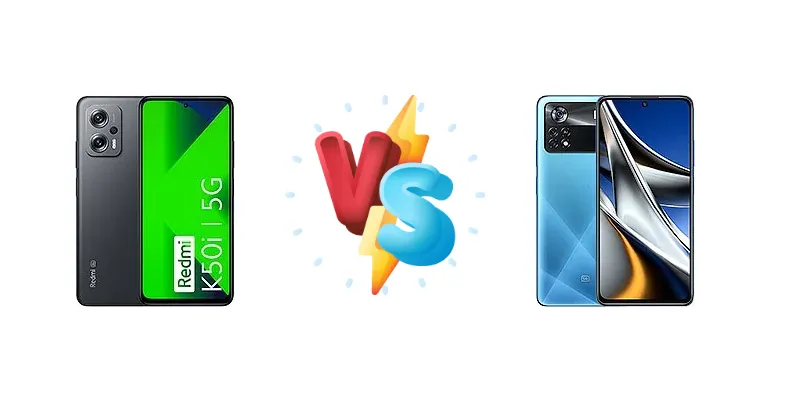
|
🏆 Quick Verdict
For users prioritizing performance and gaming, the Xiaomi Redmi K50i is the clear winner. Its Dimensity 8100 chipset delivers significantly faster processing speeds. However, the Poco X4 Pro 5G offers comparable battery life with slightly faster charging and may be a better choice for everyday tasks and budget-conscious buyers.
| PHONES | ||
|---|---|---|
| Phone Names | Xiaomi Redmi K50i | Xiaomi Poco X4 Pro 5G |
| Network | ||
|---|---|---|
| 2G bands | GSM 850 / 900 / 1800 / 1900 | GSM 850 / 900 / 1800 / 1900 |
| 3G bands | HSDPA 850 / 900 / 1700(AWS) / 1900 / 2100 | HSDPA 800 / 850 / 900 / 1700(AWS) / 1900 / 2100 - Global |
| 4G bands | 1, 2, 3, 4, 5, 7, 8, 20, 28, 38, 40, 41 | 1, 2, 3, 4, 5, 7, 8, 12, 17, 18, 19, 20, 26, 28, 38, 40, 41 - Global |
| 5G bands | 1, 3, 5, 7, 8, 20, 28, 38, 40, 41, 77, 78 SA/NSA | 1, 3, 5, 7, 8, 20, 28, 38, 40, 41, 77, 78 SA/NSA - Global |
| Speed | HSPA, LTE, 5G | HSPA, LTE, 5G |
| Technology | GSM / HSPA / LTE / 5G | GSM / HSPA / LTE / 5G |
| - | 1, 3, 5, 8, 28, 40, 78 SA/NSA - India | |
| Launch | ||
|---|---|---|
| Announced | 2022, July 20 | 2022, February 28 |
| Status | Available. Released 2022, July 23 | Available. Released 2022, March 23 |
| Body | ||
|---|---|---|
| Build | - | Glass front (Gorilla Glass 5), glass back, plastic frame |
| Dimensions | 163.6 x 74.3 x 8.9 mm (6.44 x 2.93 x 0.35 in) | 164.2 x 76.1 x 8.1 mm (6.46 x 3.00 x 0.32 in) |
| SIM | Nano-SIM + Nano-SIM | Nano-SIM + Nano-SIM |
| Weight | 200 g (7.05 oz) | 205 g (7.23 oz) |
| - | IP53, dust and splash resistant | |
| Display | ||
|---|---|---|
| Protection | Corning Gorilla Glass 5 | Corning Gorilla Glass 5 |
| Resolution | 1080 x 2460 pixels (~407 ppi density) | 1080 x 2400 pixels, 20:9 ratio (~395 ppi density) |
| Size | 6.6 inches, 103.4 cm2 (~85.1% screen-to-body ratio) | 6.67 inches, 107.4 cm2 (~86.0% screen-to-body ratio) |
| Type | FFS LCD, 144Hz, HDR10, Dolby Vision, 500 nits (typ), 650 nits (HBM) | Super AMOLED, 120Hz, 700 nits, 1200 nits (peak) |
| Platform | ||
|---|---|---|
| CPU | Octa-core (4x2.85 GHz Cortex-A78 & 4x2.0 GHz Cortex-A55) | Octa-core (2x2.2 GHz Kryo 660 Gold & 6x1.7 GHz Kryo 660 Silver) |
| Chipset | Mediatek Dimensity 8100 (5 nm) | Qualcomm SM6375 Snapdragon 695 5G (6 nm) |
| GPU | Mali-G610 MC6 | Adreno 619 |
| OS | Android 12, upgradable to Android 13, MIUI 14 | Android 11, MIUI 13 for POCO |
| Memory | ||
|---|---|---|
| Card slot | No | microSDXC (uses shared SIM slot) |
| Internal | 128GB 6GB RAM, 128GB 8GB RAM, 256GB 8GB RAM | 64GB 6GB RAM, 128GB 6GB RAM, 128GB 8GB RAM, 256GB 6GB RAM, 256GB 8GB RAM |
| - | UFS 2.2 | |
| Main Camera | ||
|---|---|---|
| Features | Color spectrum sensor, LED flash, HDR, panorama | LED flash, HDR, panorama |
| Single | - | 16 MP, f/2.5, (wide), 1/3.06" 1.0µm |
| Triple | 64 MP, f/1.9, (wide), 1/1.72", 0.8µm, PDAF 8 MP, f/2.2, 120˚, (ultrawide) 2 MP (macro) | 108 MP, f/1.9, 26mm (wide), 1/1.52", 0.7µm, PDAF - Global version 64 MP, f/1.8, 26mm (wide), 0.7µm, PDAF - India version 8 MP, f/2.2, 118˚ (ultrawide), 1/4.0", 1.12µm 2 MP (macro) |
| Video | 4K@30fps, 1080p@30/60fps | 1080p@30fps |
| Selfie camera | ||
|---|---|---|
| Features | - | HDR, panorama |
| Single | 16 MP, f/2.5, (wide) | 16 MP, f/2.5, (wide), 1/3.06" 1.0µm |
| Video | 1080p@30fps | 1080p@30fps |
| Sound | ||
|---|---|---|
| 3.5mm jack | - | Yes |
| 35mm jack | Yes | Yes |
| Loudspeaker | Yes, with stereo speakers | Yes, with stereo speakers |
| - | 24-bit/192kHz audio | |
| Comms | ||
|---|---|---|
| Bluetooth | 5.3, A2DP, LE | 5.1, A2DP, LE |
| Infrared port | Yes | Yes |
| NFC | No | Yes (market/region dependent) |
| Positioning | GPS (L1), GLONASS (L1), BDS (B1I+B1c), GALILEO (E1), QZSS (L1) | GPS, GLONASS, BDS, GALILEO |
| Radio | No | FM radio |
| USB | USB Type-C 2.0, OTG | USB Type-C 2.0, OTG |
| WLAN | Wi-Fi 802.11 a/b/g/n/ac/6, dual-band, Wi-Fi Direct | Wi-Fi 802.11 a/b/g/n/ac, dual-band, Wi-Fi Direct |
| Features | ||
|---|---|---|
| Sensors | Fingerprint (side-mounted), accelerometer, proximity, gyro, compass | Fingerprint (side-mounted), accelerometer, gyro, proximity, compass |
| Battery | ||
|---|---|---|
| Charging | 67W wired, 50% in 15 min, 100% in 46 min | 67W wired, PD3.0, QC3, 70% in 22 min, 100% in 41 min |
| Type | Li-Po 5080 mAh | Li-Po 5000 mAh |
| Misc | ||
|---|---|---|
| Colors | Phantom Blue, Stealth Black, Quick Silver | Laser Black, Laser Blue, Poco Yellow |
| Models | 22041216I | 2201116PG |
| Price | About 320 EUR | € 160.40 / $ 419.99 / £ 255.00 / ₹ 12,940 |
| SAR | - | 1.06 W/kg (head) 1.09 W/kg (body) |
| SAR EU | - | 0.60 W/kg (head) 0.96 W/kg (body) |
| Tests | ||
|---|---|---|
| Battery life | - | Endurance rating 119h |
| Camera | - | Photo / Video |
| Display | - | Contrast ratio: Infinite (nominal) |
| Loudspeaker | - | -26.8 LUFS (Good) |
| Performance | - | AnTuTu: 335353 (v8), 384646 (v9) GeekBench: 2063 (v5.1) GFXBench: 17fps (ES 3.1 onscreen) |
Xiaomi Redmi K50i
- Significantly faster processor for gaming and multitasking
- More efficient 5nm chipset for better thermal management
- Faster overall system responsiveness
- Potentially shorter battery life under heavy load
- May be more expensive than the Poco X4 Pro 5G
Xiaomi Poco X4 Pro 5G
- Excellent battery life and endurance
- Slightly faster initial charging speed
- More affordable price point
- Noticeably slower processor for demanding tasks
- Less capable GPU for gaming
Display Comparison
Both devices share an 'Infinite' contrast ratio, suggesting they utilize AMOLED panels, though specific panel characteristics aren't detailed. Without knowing peak brightness or color gamut coverage, it’s difficult to definitively declare a winner. However, the lack of LTPO technology on either device suggests refresh rate scaling won't be as efficient as on higher-end models. The focus here is likely on cost optimization rather than display excellence.
Camera Comparison
Both phones feature 'Photo / Video' capabilities, but detailed sensor information is absent. Without knowing megapixel counts, sensor sizes, or aperture values, a meaningful comparison is impossible. The presence of a 2MP macro camera on either device is unlikely to significantly impact image quality, serving primarily as a marketing feature. Image processing algorithms will play a crucial role, but without sample images, it’s difficult to assess which phone produces more pleasing results. We can assume both will perform adequately in good lighting conditions, but low-light performance is a key area where differences would emerge.
Performance
The core difference lies in the chipsets. The Redmi K50i’s Mediatek Dimensity 8100 (5nm) is a substantial upgrade over the Poco X4 Pro 5G’s Qualcomm Snapdragon 695 (6nm). The Dimensity 8100’s octa-core configuration, with four Cortex-A78 cores clocked at 2.85 GHz, provides significantly more processing power than the Snapdragon 695’s 2.2 GHz Kryo 660 Gold cores. This translates to faster app loading, smoother multitasking, and a far superior gaming experience. The 5nm process node of the Dimensity 8100 also contributes to better thermal efficiency, potentially mitigating throttling during sustained workloads. While the Snapdragon 695 is adequate for everyday tasks, it will struggle with graphically intensive games and demanding applications.
Battery Life
Both devices boast a 67W wired charging capability, with the Poco X4 Pro 5G achieving 70% charge in 22 minutes and 100% in 41 minutes, while the K50i reaches 50% in 15 minutes and 100% in 46 minutes. Despite having the same endurance rating of 119 hours, the K50i’s more powerful chipset will likely consume more power during intensive use. The X4 Pro 5G’s slightly faster initial charging speed is a minor advantage, but both offer respectable charging times. The similar endurance ratings suggest comparable battery optimization, but real-world usage will vary based on individual habits and app usage.
Buying Guide
Buy the Xiaomi Redmi K50i if you need a phone capable of handling demanding games, video editing, or multitasking without slowdowns. Its superior chipset unlocks a smoother, more responsive experience. Buy the Xiaomi Poco X4 Pro 5G if you prefer a phone with excellent battery life, reliable performance for everyday tasks, and a more affordable price tag. It’s ideal for users who prioritize longevity and value over peak performance.