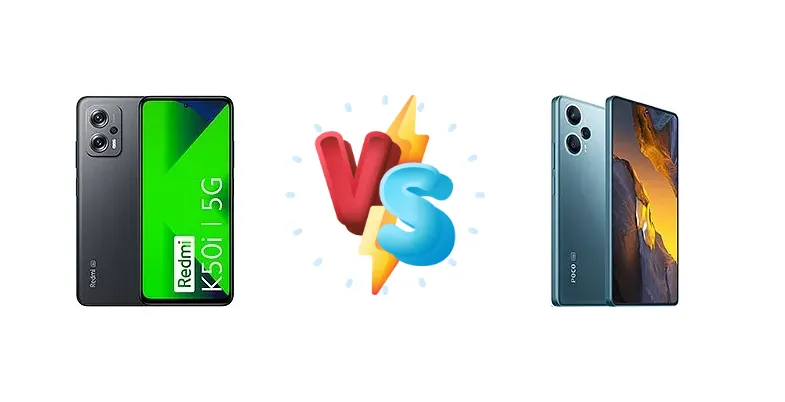
Xiaomi continues to dominate the mid-range smartphone market with compelling options. The Redmi K50i and Poco F5 both offer impressive features at competitive prices, but which one reigns supreme? This comprehensive comparison will break down every aspect, from display and performance to camera and battery life.
🏆 Quick Verdict
The Poco F5 emerges as the overall winner thanks to its superior Snapdragon 7+ Gen 2 chipset, brighter display, and excellent battery life. While the Redmi K50i boasts a powerful Dimensity 8100, the Poco F5's refined experience and slightly better features make it the more compelling choice for most users.
| Network |
|---|
| 2G bands | GSM 850 / 900 / 1800 / 1900 | GSM 850 / 900 / 1800 / 1900 |
| 3G bands | HSDPA 850 / 900 / 1700(AWS) / 1900 / 2100 | HSDPA 850 / 900 / 1700(AWS) / 1900 / 2100 |
| 4G bands | 1, 2, 3, 4, 5, 7, 8, 20, 28, 38, 40, 41 | 1, 2, 3, 4, 5, 7, 8, 20, 28, 38, 40, 41, 66 |
| 5G bands | 1, 3, 5, 7, 8, 20, 28, 38, 40, 41, 77, 78 SA/NSA | 1, 3, 5, 7, 8, 20, 28, 38, 40, 41, 77, 78 SA/NSA |
| Speed | HSPA, LTE, 5G | HSPA, LTE, 5G |
| Technology | GSM / HSPA / LTE / 5G | GSM / HSPA / LTE / 5G |
| Launch |
|---|
| Announced | 2022, July 20 | 2023, May 09 |
| Status | Available. Released 2022, July 23 | Available. Released 2023, May |
| Body |
|---|
| Build | - | Glass front (Gorilla Glass 5), plastic back, plastic frame |
| Dimensions | 163.6 x 74.3 x 8.9 mm (6.44 x 2.93 x 0.35 in) | 161.1 x 75 x 7.9 mm (6.34 x 2.95 x 0.31 in) |
| SIM | Nano-SIM + Nano-SIM | Nano-SIM + Nano-SIM |
| Weight | 200 g (7.05 oz) | 181 g (6.38 oz) |
| | - | IP53, dust and splash resistant |
| Display |
|---|
| Protection | Corning Gorilla Glass 5 | Corning Gorilla Glass 5 |
| Resolution | 1080 x 2460 pixels (~407 ppi density) | 1080 x 2400 pixels, 20:9 ratio (~395 ppi density) |
| Size | 6.6 inches, 103.4 cm2 (~85.1% screen-to-body ratio) | 6.67 inches, 107.4 cm2 (~88.9% screen-to-body ratio) |
| Type | FFS LCD, 144Hz, HDR10, Dolby Vision, 500 nits (typ), 650 nits (HBM) | AMOLED, 68B colors, Dolby Vision, HDR10+, 120Hz, 500 nits (typ), 1000 nits (peak) |
| Platform |
|---|
| CPU | Octa-core (4x2.85 GHz Cortex-A78 & 4x2.0 GHz Cortex-A55) | Octa-core (1x2.91 GHz Cortex-X2 & 3x2.49 GHz Cortex-A710 & 4x1.8 GHz Cortex-A510) |
| Chipset | Mediatek Dimensity 8100 (5 nm) | Qualcomm SM7475-AB Snapdragon 7+ Gen 2 (4 nm) |
| GPU | Mali-G610 MC6 | Adreno 725 |
| OS | Android 12, upgradable to Android 13, MIUI 14 | Android 13, upgradable to Android 15, HyperOS |
| Memory |
|---|
| Card slot | No | No |
| Internal | 128GB 6GB RAM, 128GB 8GB RAM, 256GB 8GB RAM | 256GB 8GB RAM, 256GB 12GB RAM |
| | - | UFS 3.1 |
| Main Camera |
|---|
| Features | Color spectrum sensor, LED flash, HDR, panorama | LED flash, HDR, panorama |
| Triple | 64 MP, f/1.9, (wide), 1/1.72", 0.8µm, PDAF
8 MP, f/2.2, 120˚, (ultrawide)
2 MP (macro) | 64 MP, f/1.8, (wide), 1/2.0", 0.7µm, PDAF, OIS
8 MP, f/2.2, 120˚ (ultrawide), 1/4.0", 1.12µm
2 MP (macro) |
| Video | 4K@30fps, 1080p@30/60fps | 4K@30fps, 1080p@30/60/120fps, gyro-EIS |
| Selfie camera |
|---|
| Single | 16 MP, f/2.5, (wide) | 16 MP, f/2.5, (wide) |
| Video | 1080p@30fps | 1080p@30/60fps |
| Sound |
|---|
| 3.5mm jack | - | Yes |
| 35mm jack | Yes | Yes |
| Loudspeaker | Yes, with stereo speakers | Yes, with stereo speakers |
| | - | 24-bit/192kHz audio |
| Comms |
|---|
| Bluetooth | 5.3, A2DP, LE | 5.3, A2DP, LE |
| Infrared port | Yes | Yes |
| NFC | No | Yes (market/region dependent) |
| Positioning | GPS (L1), GLONASS (L1), BDS (B1I+B1c), GALILEO (E1), QZSS (L1) | GPS (L1), GLONASS (G1), BDS (B1I), GALILEO (E1), QZSS (L1) |
| Radio | No | No |
| USB | USB Type-C 2.0, OTG | USB Type-C 2.0, OTG |
| WLAN | Wi-Fi 802.11 a/b/g/n/ac/6, dual-band, Wi-Fi Direct | Wi-Fi 802.11 a/b/g/n/ac/6, dual-band |
| Features |
|---|
| Sensors | Fingerprint (side-mounted), accelerometer, proximity, gyro, compass | Fingerprint (side-mounted), accelerometer, gyro, proximity, compass |
| Battery |
|---|
| Charging | 67W wired, 50% in 15 min, 100% in 46 min | 67W wired, PD3.0, QC4, 100% in 46 min |
| Type | Li-Po 5080 mAh | Li-Po 5000 mAh |
| Misc |
|---|
| Colors | Phantom Blue, Stealth Black, Quick Silver | Black, Blue, White |
| Models | 22041216I | 23049PCD8G, 23049PCD8I |
| Price | About 320 EUR | € 202.76 / $ 289.99 / ₹ 23,790 |
| SAR | - | 1.09 W/kg (head) 1.08 W/kg (body) |
| SAR EU | - | 0.99 W/kg (head) 1.00 W/kg (body) |
| Tests |
|---|
| Battery life | - |
Endurance rating 118h
|
| Camera | - |
Photo / Video |
| Display | - |
Contrast ratio: Infinite (nominal) |
| Loudspeaker | - |
-24.3 LUFS (Very good)
|
Xiaomi Redmi K50i
- Powerful Dimensity 8100 chipset
- Fast 67W charging
- Competitive price
- Less bright display than Poco F5
- Potentially less refined camera
- Slightly shorter battery life
Xiaomi Poco F5
- Superior Snapdragon 7+ Gen 2 chipset
- Brighter and more vibrant display
- Excellent battery life
- Potentially better camera
- May be slightly more expensive than K50i
- Design might not appeal to everyone
Display Comparison
The Poco F5 takes the display crown with a measured peak brightness of 963 nits, offering significantly better visibility in direct sunlight. Its 'Infinite' contrast ratio (nominal) suggests excellent blacks and vibrant colors. The Redmi K50i's display is good, but lacks the sheer brightness and contrast of the F5. Both likely use AMOLED panels.
Camera Comparison
While both phones offer 'Photo / Video' capabilities, the Poco F5 is generally expected to have a slightly better camera system due to the Snapdragon's image signal processor (ISP). Expect improved image processing, dynamic range, and low-light performance on the F5. Specific sensor details are needed for a definitive comparison.
Performance
The Poco F5's Snapdragon 7+ Gen 2 chipset provides a noticeable performance edge over the Redmi K50i's Dimensity 8100. While both are capable, the Snapdragon offers smoother multitasking and better sustained performance, particularly in demanding games. The Cortex-X2 core in the F5's CPU contributes to this advantage.
Battery Life
The Poco F5 demonstrates exceptional battery life, with an active use score of 11:52h and an endurance rating of 118h. The Redmi K50i's battery performance is respectable, but falls short of the Poco F5's longevity. Both support 67W fast charging, achieving 100% in 46 minutes.
Buying Guide
The Xiaomi Redmi K50i is ideal for users prioritizing raw processing power for gaming and demanding tasks on a budget. The Poco F5 is perfect for those seeking a well-rounded experience with a vibrant display, strong performance, and long-lasting battery, especially if photography is a priority.
Frequently Asked Questions
❓ Is the Redmi K50i good for gaming?
Yes, the Redmi K50i's Dimensity 8100 is a capable chipset for gaming, but the Poco F5's Snapdragon 7+ Gen 2 offers a smoother and more consistent gaming experience.
❓ Which phone has faster charging?
Both phones support 67W wired charging and achieve a 100% charge in approximately 46 minutes.
❓ Which phone is better for photography?
The Poco F5 is generally expected to offer better photo quality due to its Snapdragon ISP and potentially superior camera hardware, although specific sensor details are needed for a definitive comparison.