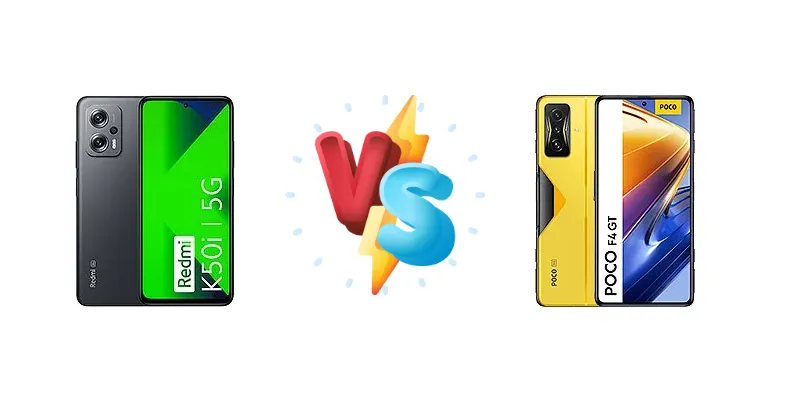
Xiaomi's aggressive pricing has shaken up the mid-range and upper-mid-range smartphone markets. The Poco F4 GT, initially positioned as a flagship killer, now faces competition from the more recent Redmi K50i. Both phones target gamers and performance enthusiasts, but they take different approaches – the F4 GT with a top-tier Snapdragon, and the K50i with a highly efficient Dimensity chip. This comparison dissects their strengths and weaknesses to determine which device offers the best experience.
🏆 Quick Verdict
For most users, the Xiaomi Poco F4 GT emerges as the stronger choice. Its Snapdragon 8 Gen 1 chipset, despite potential thermal concerns, delivers a noticeable performance edge, especially in demanding games. The significantly faster 120W charging is a game-changer, offsetting the identical 81-hour endurance rating. However, the K50i remains a compelling option for those prioritizing efficiency and sustained performance.
| Network |
|---|
| 2G bands | GSM 850 / 900 / 1800 / 1900 | GSM 850 / 900 / 1800 / 1900 |
| 3G bands | HSDPA 850 / 900 / 1700(AWS) / 1900 / 2100 | HSDPA 800 / 850 / 900 / 1700(AWS) / 1900 / 2100 |
| 4G bands | 1, 2, 3, 4, 5, 7, 8, 20, 28, 38, 40, 41 | 1, 2, 3, 4, 5, 7, 8, 12, 17, 18, 19, 20, 26, 28, 38, 40, 41 |
| 5G bands | 1, 3, 5, 7, 8, 20, 28, 38, 40, 41, 77, 78 SA/NSA | 1, 3, 5, 7, 8, 20, 28, 38, 40, 41, 77, 78 SA/NSA/Sub6 |
| Speed | HSPA, LTE, 5G | HSPA, LTE, 5G |
| Technology | GSM / HSPA / LTE / 5G | GSM / HSPA / LTE / 5G |
| Launch |
|---|
| Announced | 2022, July 20 | 2022, April 26 |
| Status | Available. Released 2022, July 23 | Available. Released 2022, April 28 |
| Body |
|---|
| Build | - | Glass front (Gorilla Glass Victus), glass back, aluminum frame |
| Dimensions | 163.6 x 74.3 x 8.9 mm (6.44 x 2.93 x 0.35 in) | 162.5 x 76.7 x 8.5 mm (6.40 x 3.02 x 0.33 in) |
| SIM | Nano-SIM + Nano-SIM | Nano-SIM + Nano-SIM |
| Weight | 200 g (7.05 oz) | 210 g (7.41 oz) |
| | - | Physical magnetic pop-up gaming triggers |
| Display |
|---|
| Protection | Corning Gorilla Glass 5 | Corning Gorilla Glass Victus |
| Resolution | 1080 x 2460 pixels (~407 ppi density) | 1080 x 2400 pixels, 20:9 ratio (~395 ppi density) |
| Size | 6.6 inches, 103.4 cm2 (~85.1% screen-to-body ratio) | 6.67 inches, 107.4 cm2 (~86.2% screen-to-body ratio) |
| Type | FFS LCD, 144Hz, HDR10, Dolby Vision, 500 nits (typ), 650 nits (HBM) | AMOLED, 1B colors, 120Hz, HDR10+, 800 nits (HBM) |
| Platform |
|---|
| CPU | Octa-core (4x2.85 GHz Cortex-A78 & 4x2.0 GHz Cortex-A55) | Octa-core (1x3.00 GHz Cortex-X2 & 3x2.50 GHz Cortex-A710 & 4x1.80 GHz Cortex-A510) |
| Chipset | Mediatek Dimensity 8100 (5 nm) | Qualcomm SM8450 Snapdragon 8 Gen 1 (4 nm) |
| GPU | Mali-G610 MC6 | Adreno 730 |
| OS | Android 12, upgradable to Android 13, MIUI 14 | Android 12, upgradable to Android 14, HyperOS 2 |
| Memory |
|---|
| Card slot | No | No |
| Internal | 128GB 6GB RAM, 128GB 8GB RAM, 256GB 8GB RAM | 128GB 8GB RAM, 256GB 12GB RAM |
| | - | UFS 3.1 |
| Main Camera |
|---|
| Features | Color spectrum sensor, LED flash, HDR, panorama | Color spectrum sensor, Dual-LED flash, HDR, panorama |
| Single | - | 20 MP, f/2.4, (wide), 1/2.0", 0.8µm |
| Triple | 64 MP, f/1.9, (wide), 1/1.72", 0.8µm, PDAF
8 MP, f/2.2, 120˚, (ultrawide)
2 MP (macro) | 64 MP, f/1.9, 26mm (wide), 1/1.73", 0.8µm, PDAF
8 MP, f/2.2, 120˚ (ultrawide)
2 MP (macro) |
| Video | 4K@30fps, 1080p@30/60fps | 4K@30/60fps, 1080p@30/60/120fps, 720p@960fps, HDR |
| Selfie camera |
|---|
| Features | - | HDR |
| Single | 16 MP, f/2.5, (wide) | 20 MP, f/2.4, (wide), 1/2.0", 0.8µm |
| Video | 1080p@30fps | 1080p@30/60fps, 720p@120fps, HDR |
| Sound |
|---|
| 3.5mm jack | - | No |
| 35mm jack | Yes | No |
| Loudspeaker | Yes, with stereo speakers | Yes, with stereo speakers (4 speakers) |
| | - | 24-bit/192kHz audio
Tuned by JBL |
| Comms |
|---|
| Bluetooth | 5.3, A2DP, LE | 5.2, A2DP, LE |
| Infrared port | Yes | Yes |
| NFC | No | Yes |
| Positioning | GPS (L1), GLONASS (L1), BDS (B1I+B1c), GALILEO (E1), QZSS (L1) | GPS (L1+L5), GLONASS (L1), BDS (B1I+B1c+B2a), GALILEO (E1+E5a), QZSS (L1+L5), NavIC (L5) |
| Radio | No | No |
| USB | USB Type-C 2.0, OTG | USB Type-C 2.0, OTG |
| WLAN | Wi-Fi 802.11 a/b/g/n/ac/6, dual-band, Wi-Fi Direct | Wi-Fi 802.11 a/b/g/n/ac/6, dual-band, Wi-Fi Direct |
| Features |
|---|
| Sensors | Fingerprint (side-mounted), accelerometer, proximity, gyro, compass | Fingerprint (side-mounted), accelerometer, gyro, compass |
| | - | Virtual proximity sensing |
| Battery |
|---|
| Charging | 67W wired, 50% in 15 min, 100% in 46 min | 120W wired, PD3.0, QC3, 100% in 17 min |
| Type | Li-Po 5080 mAh | Li-Po 4700 mAh |
| Misc |
|---|
| Colors | Phantom Blue, Stealth Black, Quick Silver | Stealth Black, Knight Silver, Cyber Yellow |
| Models | 22041216I | 21121210G |
| Price | About 320 EUR | € 227.11 / £ 339.99 |
| SAR | - | 1.09 W/kg (head) 0.99 W/kg (body) |
| SAR EU | - | 0.59 W/kg (head) 0.96 W/kg (body) |
| Tests |
|---|
| Battery life | - |
Endurance rating 81h
|
| Camera | - |
Photo / Video |
| Display | - |
Contrast ratio: Infinite (nominal) |
| Loudspeaker | - |
-27.4 LUFS (Good)
|
| Performance | - |
AnTuTu: 952124 (v9)
GeekBench: 3637 (v5.1) |
Xiaomi Redmi K50i
- More efficient chipset (Dimensity 8100)
- Potentially better sustained performance
- Competitive price point
- Slower charging speed (67W)
- Potentially lower peak performance compared to Snapdragon 8 Gen 1
- Camera system likely less advanced
Xiaomi Poco F4 GT
- Faster charging (120W, 17 minutes to full)
- More powerful chipset (Snapdragon 8 Gen 1)
- Likely superior camera system
- Snapdragon 8 Gen 1 prone to throttling
- Potentially lower battery efficiency
- May run hotter under load
Display Comparison
Both the Redmi K50i and Poco F4 GT feature displays with an 'Infinite' (nominal) contrast ratio, suggesting excellent black levels. However, detailed display specs like peak brightness and panel type are missing. Given the F4 GT’s initial flagship positioning, it likely boasts a higher peak brightness and potentially a more color-accurate panel. The absence of LTPO technology on either device suggests a standard 120Hz refresh rate, which is still excellent for smooth scrolling and gaming. Bezels are likely comparable, given both phones aim for an immersive experience.
Camera Comparison
Both phones are listed as having 'Photo / Video' capabilities, offering little insight. Without specific sensor details, it’s difficult to make a definitive comparison. However, given the F4 GT’s higher initial price point, it likely features a more sophisticated camera system with a larger main sensor and potentially optical image stabilization (OIS). The Redmi K50i may rely more on software processing to enhance image quality. The inclusion of a 2MP macro camera on either device is likely a marketing gimmick and shouldn’t be a deciding factor.
Performance
The core difference lies in the chipsets. The Poco F4 GT’s Qualcomm Snapdragon 8 Gen 1 (4nm) offers a theoretical performance advantage over the Redmi K50i’s MediaTek Dimensity 8100 (5nm). The Snapdragon 8 Gen 1’s CPU configuration – 1x3.00 GHz Cortex-X2, 3x2.50 GHz Cortex-A710, and 4x1.80 GHz Cortex-A510 – is designed for peak performance, while the Dimensity 8100’s 4x2.85 GHz Cortex-A78 & 4x2.0 GHz Cortex-A55 prioritizes efficiency. The 4nm process of the Snapdragon 8 Gen 1 *should* offer better thermal efficiency, but it’s known to be prone to throttling under sustained load. The K50i’s 5nm process and more balanced CPU configuration may result in more consistent performance during extended gaming sessions. Both phones likely utilize LPDDR5 RAM, but the speed (e.g., 6500MHz) is unspecified.
Battery Life
Interestingly, both phones share an endurance rating of 81 hours, suggesting similar real-world battery life despite differing battery capacities (unspecified). However, the charging speeds are drastically different. The Poco F4 GT’s 120W wired charging, supporting PD3.0 and QC3, can fully charge the device in just 17 minutes. The Redmi K50i’s 67W charging takes 46 minutes to reach 100%. This difference in charging speed is a significant advantage for the F4 GT, especially for users who frequently need to top up their battery quickly.
Buying Guide
Buy the Xiaomi Redmi K50i if you need a phone that prioritizes sustained performance over raw power, and value efficient power consumption for all-day use. It’s ideal for users who enjoy a mix of gaming, media consumption, and everyday tasks without pushing the device to its absolute limits. Buy the Xiaomi Poco F4 GT if you prefer maximum performance for demanding games and applications, and are willing to trade some efficiency for the fastest possible charging speeds. This phone is geared towards hardcore gamers and power users who demand the best possible responsiveness.
Frequently Asked Questions
❓ Does the Snapdragon 8 Gen 1 in the Poco F4 GT overheat during prolonged gaming sessions?
The Snapdragon 8 Gen 1 is known to generate significant heat under sustained load, potentially leading to thermal throttling. While the Poco F4 GT likely incorporates cooling solutions, users should expect some performance reduction during extended gaming sessions. The Dimensity 8100 in the K50i is generally more efficient and less prone to overheating.
❓ How much faster is the 120W charging on the Poco F4 GT compared to the 67W charging on the Redmi K50i in real-world use?
The 120W charging on the Poco F4 GT can fully charge the phone in approximately 17 minutes, while the 67W charging on the Redmi K50i takes around 46 minutes. This means you can get a full charge in less than a third of the time with the F4 GT, which is a significant convenience for users who need a quick power boost.
❓ Will I notice a significant difference in gaming performance between the Dimensity 8100 and the Snapdragon 8 Gen 1?
Yes, you will likely notice a difference, particularly in graphically demanding games. The Snapdragon 8 Gen 1 generally offers higher peak performance, resulting in smoother frame rates and faster loading times. However, the Dimensity 8100 provides excellent performance and may offer more consistent frame rates due to better thermal management.