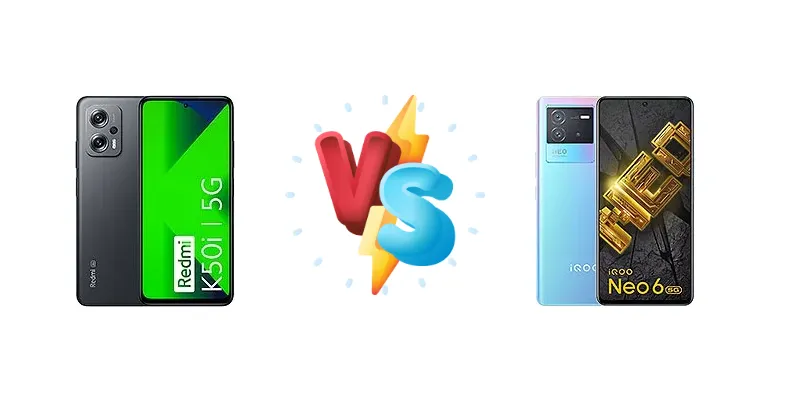
The mid-range smartphone market is fiercely competitive, and the Xiaomi Redmi K50i and vivo iQOO Neo 6 are two strong contenders. Both offer impressive features at attractive price points, but which one truly delivers the best overall experience? Let's dive into a detailed comparison to help you decide.
🏆 Quick Verdict
The iQOO Neo 6 edges out the Redmi K50i thanks to its faster charging, brighter display, and the proven Snapdragon 870 chipset. However, the K50i offers excellent value and a capable Dimensity 8100, making it a compelling alternative for budget-conscious buyers.
| Network |
|---|
| 2G bands | GSM 850 / 900 / 1800 / 1900 | GSM 850 / 900 / 1800 / 1900 |
| 3G bands | HSDPA 850 / 900 / 1700(AWS) / 1900 / 2100 | HSDPA 850 / 900 / 1700(AWS) / 2100 |
| 4G bands | 1, 2, 3, 4, 5, 7, 8, 20, 28, 38, 40, 41 | 1, 3, 4, 5, 8, 38, 40, 41 |
| 5G bands | 1, 3, 5, 7, 8, 20, 28, 38, 40, 41, 77, 78 SA/NSA | 1, 41, 77, 78 SA/NSA |
| Speed | HSPA, LTE, 5G | HSPA, LTE, 5G |
| Technology | GSM / HSPA / LTE / 5G | GSM / HSPA / LTE / 5G |
| Launch |
|---|
| Announced | 2022, July 20 | 2022, May 31 |
| Status | Available. Released 2022, July 23 | Available. Released 2022, May 31 |
| Body |
|---|
| Build | - | Glass front, plastic frame, plastic back |
| Dimensions | 163.6 x 74.3 x 8.9 mm (6.44 x 2.93 x 0.35 in) | 163 x 76.2 x 8.5 mm (6.42 x 3.00 x 0.33 in) |
| SIM | Nano-SIM + Nano-SIM | Nano-SIM + Nano-SIM |
| Weight | 200 g (7.05 oz) | 190 g (6.70 oz) |
| Display |
|---|
| Protection | Corning Gorilla Glass 5 | - |
| Resolution | 1080 x 2460 pixels (~407 ppi density) | 1080 x 2400 pixels, 20:9 ratio (~398 ppi density) |
| Size | 6.6 inches, 103.4 cm2 (~85.1% screen-to-body ratio) | 6.62 inches, 105.8 cm2 (~85.2% screen-to-body ratio) |
| Type | FFS LCD, 144Hz, HDR10, Dolby Vision, 500 nits (typ), 650 nits (HBM) | AMOLED, 120Hz, HDR10+, 500 nits (typ), 800 nits (HBM), 1300 nits (peak) |
| Platform |
|---|
| CPU | Octa-core (4x2.85 GHz Cortex-A78 & 4x2.0 GHz Cortex-A55) | Octa-core (1x3.2 GHz Kryo 585 & 3x2.42 GHz Kryo 585 & 4x1.80 GHz Kryo 585) |
| Chipset | Mediatek Dimensity 8100 (5 nm) | Qualcomm SM8250-AC Snapdragon 870 5G (7 nm) |
| GPU | Mali-G610 MC6 | Adreno 650 |
| OS | Android 12, upgradable to Android 13, MIUI 14 | Android 12, Funtouch 12 |
| Memory |
|---|
| Card slot | No | No |
| Internal | 128GB 6GB RAM, 128GB 8GB RAM, 256GB 8GB RAM | 128GB 8GB RAM, 256GB 12GB RAM |
| | - | UFS 3.1 |
| Main Camera |
|---|
| Features | Color spectrum sensor, LED flash, HDR, panorama | LED flash, HDR, panorama |
| Single | - | 16 MP, f/2.0, (wide), 1/3.1", 1.0µm |
| Triple | 64 MP, f/1.9, (wide), 1/1.72", 0.8µm, PDAF
8 MP, f/2.2, 120˚, (ultrawide)
2 MP (macro) | 64 MP, f/1.9, (wide), 1/1.72", 0.8µm, PDAF, OIS
8 MP, f/2.2, 116˚ (ultrawide), 1/4.0", 1.12µm
2 MP (macro) |
| Video | 4K@30fps, 1080p@30/60fps | 4K@30/60fps, 1080p@30/60fps |
| Selfie camera |
|---|
| Features | - | HDR |
| Single | 16 MP, f/2.5, (wide) | 16 MP, f/2.0, (wide), 1/3.1", 1.0µm |
| Video | 1080p@30fps | 1080p@30fps |
| Sound |
|---|
| 3.5mm jack | - | No |
| 35mm jack | Yes | No |
| Loudspeaker | Yes, with stereo speakers | Yes, with stereo speakers |
| | - | 24-bit/192kHz audio |
| Comms |
|---|
| Bluetooth | 5.3, A2DP, LE | 5.2, A2DP, LE, aptX HD, aptX Adaptive, aptX Lossless |
| Infrared port | Yes | Yes |
| NFC | No | No |
| Positioning | GPS (L1), GLONASS (L1), BDS (B1I+B1c), GALILEO (E1), QZSS (L1) | GPS, GLONASS, GALILEO, BDS, QZSS |
| Radio | No | No |
| USB | USB Type-C 2.0, OTG | USB Type-C 2.0, OTG |
| WLAN | Wi-Fi 802.11 a/b/g/n/ac/6, dual-band, Wi-Fi Direct | Wi-Fi 802.11 a/b/g/n/ac, dual-band, Wi-Fi Direct |
| Features |
|---|
| Sensors | Fingerprint (side-mounted), accelerometer, proximity, gyro, compass | Fingerprint (under display, optical), accelerometer, gyro, proximity, compass |
| Battery |
|---|
| Charging | 67W wired, 50% in 15 min, 100% in 46 min | 80W wired, 50% in 12 min, 100% in 32 min |
| Type | Li-Po 5080 mAh | 4700 mAh |
| Misc |
|---|
| Colors | Phantom Blue, Stealth Black, Quick Silver | Dark Nova, Cyber Rage |
| Models | 22041216I | I2126 |
| Price | About 320 EUR | About 360 EUR |
| Tests |
|---|
| Battery life | - |
Endurance rating 97h
|
| Camera | - |
Photo / Video |
| Display | - |
Contrast ratio: Infinite (nominal) |
| Loudspeaker | - |
-25.0 LUFS (Very good)
|
| Performance | - |
AnTuTu: 627246 (v8), 730223 (v9)
GeekBench: 3076 (v5.1)
GFXBench: 50fps (ES 3.1 onscreen) |
Xiaomi Redmi K50i
- Excellent value for money
- Smooth gaming performance
- Efficient Dimensity 8100 chipset
- Fast 67W charging
- Display brightness likely lower than iQOO Neo 6
- Camera potentially less refined
- Charging speed slightly slower
vivo iQOO Neo 6
- Faster 80W charging
- Brighter and higher contrast display
- Powerful Snapdragon 870 chipset
- Excellent battery life
- Potentially higher price
- Design might not appeal to everyone
Display Comparison
The iQOO Neo 6 boasts a significantly brighter display (772 nits vs unspecified for K50i), offering better visibility in sunlight. While the K50i's display is likely good, the Neo 6's contrast ratio (Infinite) suggests excellent image quality. The Neo 6 likely has an AMOLED panel, while the K50i is likely LCD.
Camera Comparison
Both phones feature 'Photo / Video' capabilities, but specific details are missing. Based on general knowledge, the iQOO Neo 6 likely has a more refined camera system with better image processing, potentially offering slightly better image quality, especially in challenging lighting conditions. The K50i's camera is expected to be competent but not exceptional.
Performance
The vivo iQOO Neo 6's Snapdragon 870 is a well-established and powerful chipset, known for its efficiency and gaming prowess. The Redmi K50i's Dimensity 8100 is also a strong performer, but the Snapdragon 870 generally holds a slight edge in sustained performance and optimization. Both offer smooth multitasking and handle demanding apps with ease.
Battery Life
The iQOO Neo 6 shines in this category with 80W charging, allowing it to reach 100% in just 32 minutes. The Redmi K50i's 67W charging is still fast, but not as impressive. Both phones boast excellent endurance ratings (97h), suggesting long battery life under typical usage.
Buying Guide
The Xiaomi Redmi K50i is ideal for users prioritizing a smooth gaming experience and efficient performance without breaking the bank. The vivo iQOO Neo 6 is a better choice for those who demand rapid charging, a vibrant display, and a slightly more powerful processor for demanding tasks.
Frequently Asked Questions
❓ Which phone is better for gaming?
Both are good for gaming, but the iQOO Neo 6's Snapdragon 870 generally offers slightly better sustained performance.
❓ Is the Redmi K50i worth buying if I'm on a budget?
Absolutely! The Redmi K50i provides excellent value and a smooth experience for its price point.