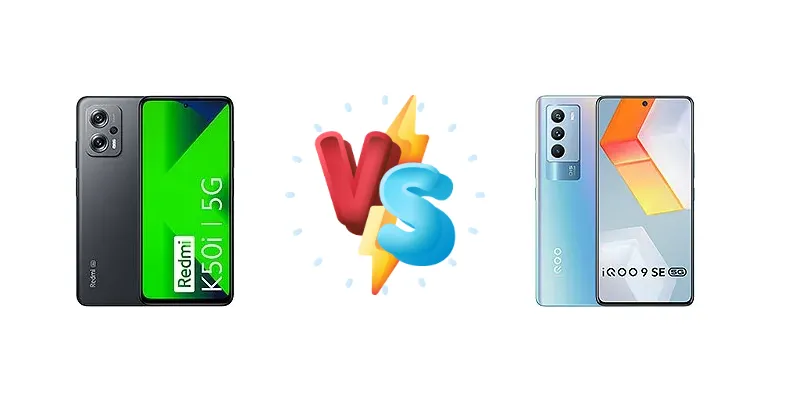
The Xiaomi Redmi K50i and vivo iQOO 9 SE represent compelling options in the increasingly competitive mid-range smartphone market. The K50i brings a newer Mediatek Dimensity 8100 chipset to the table, while the iQOO 9 SE relies on the established Qualcomm Snapdragon 888. This comparison dissects their key differences to determine which device delivers the best overall experience.
🏆 Quick Verdict
For most users, the Xiaomi Redmi K50i emerges as the stronger choice. Its Dimensity 8100 offers a more efficient architecture and potentially better sustained performance than the Snapdragon 888 in the iQOO 9 SE, despite the latter's slightly faster charging. The K50i represents a more future-proof investment.
| Network |
|---|
| 2G bands | GSM 850 / 900 / 1800 / 1900 | GSM 850 / 900 / 1800 / 1900 |
| 3G bands | HSDPA 850 / 900 / 1700(AWS) / 1900 / 2100 | HSDPA 850 / 900 / 1900 / 2100 |
| 4G bands | 1, 2, 3, 4, 5, 7, 8, 20, 28, 38, 40, 41 | 1, 3, 4, 5, 8, 28, 34, 38, 39, 40, 41 |
| 5G bands | 1, 3, 5, 7, 8, 20, 28, 38, 40, 41, 77, 78 SA/NSA | 1, 3, 5, 8, 28, 41, 77, 78 SA/NSA |
| Speed | HSPA, LTE, 5G | HSPA, LTE, 5G |
| Technology | GSM / HSPA / LTE / 5G | GSM / HSPA / LTE / 5G |
| Launch |
|---|
| Announced | 2022, July 20 | 2022, February 23 |
| Status | Available. Released 2022, July 23 | Available. Released 2022, March 02 |
| Body |
|---|
| Dimensions | 163.6 x 74.3 x 8.9 mm (6.44 x 2.93 x 0.35 in) | 163.2 x 76.4 x 8.4 mm (6.43 x 3.01 x 0.33 in) |
| SIM | Nano-SIM + Nano-SIM | Nano-SIM + Nano-SIM |
| Weight | 200 g (7.05 oz) | 199 g (7.02 oz) |
| | - | Splash and dust resistant |
| Display |
|---|
| Protection | Corning Gorilla Glass 5 | Panda Glass |
| Resolution | 1080 x 2460 pixels (~407 ppi density) | 1080 x 2400 pixels, 20:9 ratio (~398 ppi density) |
| Size | 6.6 inches, 103.4 cm2 (~85.1% screen-to-body ratio) | 6.62 inches, 105.8 cm2 (~84.9% screen-to-body ratio) |
| Type | FFS LCD, 144Hz, HDR10, Dolby Vision, 500 nits (typ), 650 nits (HBM) | Super AMOLED, 120Hz, HDR10+, 1200 nits (peak) |
| Platform |
|---|
| CPU | Octa-core (4x2.85 GHz Cortex-A78 & 4x2.0 GHz Cortex-A55) | Octa-core (1x2.84 GHz Cortex-X1 & 3x2.42 GHz Cortex-A78 & 4x1.80 GHz Cortex-A55) |
| Chipset | Mediatek Dimensity 8100 (5 nm) | Qualcomm SM8350 Snapdragon 888 5G (5 nm) |
| GPU | Mali-G610 MC6 | Adreno 660 |
| OS | Android 12, upgradable to Android 13, MIUI 14 | Android 12, Funtouch 12 |
| Memory |
|---|
| Card slot | No | No |
| Internal | 128GB 6GB RAM, 128GB 8GB RAM, 256GB 8GB RAM | 128GB 8GB RAM, 256GB 12GB RAM |
| | - | UFS 3.1 |
| Main Camera |
|---|
| Dual | - | 48 MP, f/1.8, 25mm (wide), 1/2.0", 0.8µm, PDAF, OIS
13 MP, f/2.2, 16mm, 120˚ (ultrawide), 1/3.1", 1.12µm, AF
Auxiliary lens |
| Features | Color spectrum sensor, LED flash, HDR, panorama | Dual-LED dual-tone flash, HDR, panorama |
| Single | - | 16 MP, f/2.0, (wide), 1/3.0", 1.0µm |
| Triple | 64 MP, f/1.9, (wide), 1/1.72", 0.8µm, PDAF
8 MP, f/2.2, 120˚, (ultrawide)
2 MP (macro) | - |
| Video | 4K@30fps, 1080p@30/60fps | 4K@24/30/60fps, 1080p@30/60fps |
| Selfie camera |
|---|
| Features | - | HDR |
| Single | 16 MP, f/2.5, (wide) | 16 MP, f/2.0, (wide), 1/3.0", 1.0µm |
| Video | 1080p@30fps | 1080p@30fps |
| Sound |
|---|
| 3.5mm jack | - | No |
| 35mm jack | Yes | No |
| Loudspeaker | Yes, with stereo speakers | Yes, with stereo speakers |
| Comms |
|---|
| Bluetooth | 5.3, A2DP, LE | 5.2, A2DP, LE |
| Infrared port | Yes | - |
| NFC | No | Yes |
| Positioning | GPS (L1), GLONASS (L1), BDS (B1I+B1c), GALILEO (E1), QZSS (L1) | GPS, GLONASS, GALILEO, BDS |
| Radio | No | No |
| USB | USB Type-C 2.0, OTG | USB Type-C 2.0, OTG |
| WLAN | Wi-Fi 802.11 a/b/g/n/ac/6, dual-band, Wi-Fi Direct | Wi-Fi 802.11 a/b/g/n/ac, dual-band, Wi-Fi Direct |
| Features |
|---|
| Sensors | Fingerprint (side-mounted), accelerometer, proximity, gyro, compass | Fingerprint (under display, optical), accelerometer, gyro, proximity, compass |
| Battery |
|---|
| Charging | 67W wired, 50% in 15 min, 100% in 46 min | 66W wired, 50% in 14 min, 100% in 39 min |
| Type | Li-Po 5080 mAh | 4500 mAh |
| Misc |
|---|
| Colors | Phantom Blue, Stealth Black, Quick Silver | Space Fusion, Sunset Sierra |
| Models | 22041216I | - |
| Price | About 320 EUR | About 400 EUR |
| Tests |
|---|
| Battery life | - |
Endurance rating 87h
|
| Camera | - |
Photo / Video |
| Display | - |
Contrast ratio: Infinite (nominal) |
| Loudspeaker | - |
-26.1 LUFS (Good)
|
| Performance | - |
AnTuTu: 727771 (v8), 846231 (v9)
GeekBench: 3442 (v5.1)
GFXBench: 64fps (ES 3.1 onscreen) |
Xiaomi Redmi K50i
- More efficient Dimensity 8100 chipset
- Potentially better sustained performance
- Modern architecture for future-proofing
- Display specifications currently unknown
- Camera details are lacking
vivo iQOO 9 SE
- Faster full charge time (39 minutes)
- Established Snapdragon 888 platform
- Known peak display brightness (863 nits)
- Snapdragon 888 prone to thermal throttling
- Older chipset architecture
Display Comparison
The iQOO 9 SE boasts a measured peak brightness of 863 nits, a respectable figure, but the Redmi K50i’s display specifications are currently unavailable for direct comparison. However, given the K50i’s positioning, we anticipate a similarly bright panel. Both displays feature an infinite (nominal) contrast ratio, typical for AMOLED technology. Without knowing the K50i’s panel type or refresh rate, it’s difficult to definitively declare a winner, but the iQOO 9 SE’s brightness is a known quantity.
Camera Comparison
Both devices are listed as having Photo/Video capabilities, but specific details are lacking. Without sensor size, aperture information, or image processing details, a meaningful comparison is impossible. We can assume both will offer acceptable image quality for their price points, but the iQOO 9 SE’s brand reputation suggests a slightly more refined camera experience, though this is speculative. The absence of details on OIS or advanced features makes it difficult to assess their photographic capabilities.
Performance
This is where the core difference lies. The Redmi K50i’s Mediatek Dimensity 8100 (5nm) utilizes a more modern architecture than the iQOO 9 SE’s Qualcomm Snapdragon 888 (5nm). The Dimensity 8100’s octa-core CPU, with its 4x2.85 GHz Cortex-A78 cores, is designed for peak performance, while the Snapdragon 888’s configuration (1x2.84 GHz Cortex-X1, 3x2.42 GHz Cortex-A78, 4x1.80 GHz Cortex-A55) prioritizes a different balance. Crucially, the 5nm process node of both chips is similar, but the Dimensity 8100’s architecture generally leads to better thermal efficiency, potentially mitigating throttling during extended gaming sessions. The K50i should offer a smoother experience in demanding titles.
Battery Life
Both phones achieve a respectable 87-hour endurance rating, suggesting similar real-world battery life despite potentially different battery capacities (not specified). However, charging speeds differ. The iQOO 9 SE charges from 0-50% in 14 minutes and reaches 100% in 39 minutes with its 66W wired charging. The Redmi K50i, with 67W charging, takes 15 minutes to reach 50% and 46 minutes for a full charge. While the difference isn’t massive, the iQOO 9 SE is marginally faster to fully charge.
Buying Guide
Buy the Xiaomi Redmi K50i if you prioritize sustained gaming performance, efficient power consumption, and a more modern chipset. It’s ideal for users who frequently multitask or enjoy demanding mobile games. Buy the vivo iQOO 9 SE if you value slightly faster charging speeds and are comfortable with a chipset known to exhibit thermal throttling under prolonged heavy load. It’s a good option for casual gamers and everyday users.
Frequently Asked Questions
❓ Will the Snapdragon 888 in the iQOO 9 SE overheat during extended gaming sessions?
The Snapdragon 888 is known to generate significant heat under sustained load. While iQOO likely implemented thermal management solutions, users should expect some degree of throttling during prolonged gaming, potentially leading to frame rate drops. The Redmi K50i’s Dimensity 8100 is generally more thermally efficient.
❓ How does the Dimensity 8100 compare to the Snapdragon 888 in real-world app loading and multitasking?
The Dimensity 8100’s newer architecture and optimized core configuration should result in snappier app loading times and smoother multitasking compared to the Snapdragon 888. While both chips are powerful, the 8100’s efficiency gains translate to a more responsive user experience.
❓ Is the difference in charging speed (39 mins vs 46 mins) noticeable in everyday use?
While a 7-minute difference might seem small, it can be noticeable for users who frequently top up their phones throughout the day. The iQOO 9 SE’s faster charging provides a quicker boost when you’re short on time, but the K50i’s charging speed is still very respectable.