
Xiaomi Redmi K50i vs Samsung Galaxy A53 5G: A Deep Dive Comparison
| Phones Images | |||||
|---|---|---|---|---|---|
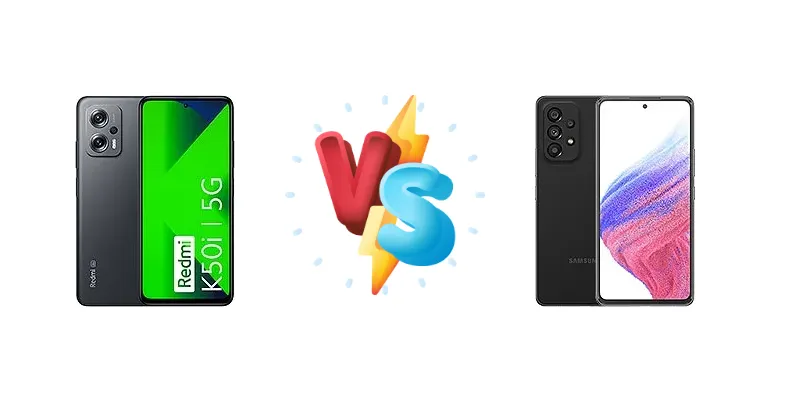
|
🏆 Quick Verdict
For users prioritizing raw performance and fast charging, the Xiaomi Redmi K50i is the clear winner. Its Dimensity 8100 chipset offers a significant advantage in gaming and demanding tasks. However, the Samsung Galaxy A53 5G provides a more polished software experience and a brighter display, making it a strong contender for those valuing refinement over sheer power.
| PHONES | ||
|---|---|---|
| Phone Names | Xiaomi Redmi K50i | Samsung Galaxy A53 5G |
| Network | ||
|---|---|---|
| 2G bands | GSM 850 / 900 / 1800 / 1900 | GSM 850 / 900 / 1800 / 1900 |
| 3G bands | HSDPA 850 / 900 / 1700(AWS) / 1900 / 2100 | HSDPA 850 / 900 / 1700(AWS) / 1900 / 2100 |
| 4G bands | 1, 2, 3, 4, 5, 7, 8, 20, 28, 38, 40, 41 | 1, 2, 3, 4, 5, 7, 12, 14, 20, 29, 30, 38, 39, 40, 41, 46, 48, 66 - SM-A536U |
| 5G bands | 1, 3, 5, 7, 8, 20, 28, 38, 40, 41, 77, 78 SA/NSA | 2, 5, 41, 66, 77, 78 SA/NSA/Sub6/mmWave - SM-A536U |
| Speed | HSPA, LTE, 5G | HSPA, LTE, 5G |
| Technology | GSM / HSPA / LTE / 5G | GSM / HSPA / LTE / 5G |
| - | 2, 5, 48, 66, 77, 78, 260, 261 SA/NSA/Sub6/mmWave - SM-A536V | |
| Launch | ||
|---|---|---|
| Announced | 2022, July 20 | 2022, March 17 |
| Status | Available. Released 2022, July 23 | Available. Released 2022, March 24 |
| Body | ||
|---|---|---|
| Build | - | Glass front (Gorilla Glass 5), plastic frame, plastic back |
| Dimensions | 163.6 x 74.3 x 8.9 mm (6.44 x 2.93 x 0.35 in) | 159.6 x 74.8 x 8.1 mm (6.28 x 2.94 x 0.32 in) |
| SIM | Nano-SIM + Nano-SIM | · Nano-SIM· Nano-SIM + Nano-SIM |
| Weight | 200 g (7.05 oz) | 189 g (6.67 oz) |
| - | IP67 dust/water resistant (up to 1m for 30 min) | |
| Display | ||
|---|---|---|
| Protection | Corning Gorilla Glass 5 | Corning Gorilla Glass 5 |
| Resolution | 1080 x 2460 pixels (~407 ppi density) | 1080 x 2400 pixels, 20:9 ratio (~405 ppi density) |
| Size | 6.6 inches, 103.4 cm2 (~85.1% screen-to-body ratio) | 6.5 inches, 102.0 cm2 (~85.4% screen-to-body ratio) |
| Type | FFS LCD, 144Hz, HDR10, Dolby Vision, 500 nits (typ), 650 nits (HBM) | Super AMOLED, 120Hz, 800 nits (HBM) |
| Platform | ||
|---|---|---|
| CPU | Octa-core (4x2.85 GHz Cortex-A78 & 4x2.0 GHz Cortex-A55) | Octa-core (2x2.4 GHz Cortex-A78 & 6x2.0 GHz Cortex-A55) |
| Chipset | Mediatek Dimensity 8100 (5 nm) | Exynos 1280 (5 nm) |
| GPU | Mali-G610 MC6 | Mali-G68 |
| OS | Android 12, upgradable to Android 13, MIUI 14 | Android 12, up to 4 major Android upgrades, One UI 8 |
| Memory | ||
|---|---|---|
| Card slot | No | microSDXC (uses shared SIM slot) |
| Internal | 128GB 6GB RAM, 128GB 8GB RAM, 256GB 8GB RAM | 128GB 4GB RAM, 128GB 6GB RAM, 128GB 8GB RAM, 256GB 6GB RAM, 256GB 8GB RAM |
| Main Camera | ||
|---|---|---|
| Features | Color spectrum sensor, LED flash, HDR, panorama | LED flash, panorama, HDR |
| Quad | - | 64 MP, f/1.8, 26mm (wide), 1/1.7X", 0.8µm, PDAF, OIS 12 MP, f/2.2, 123˚ (ultrawide), 1.12µm 5 MP (macro) Auxiliary lens |
| Single | - | 32 MP, f/2.2, 26mm (wide), 1/2.8", 0.8µm |
| Triple | 64 MP, f/1.9, (wide), 1/1.72", 0.8µm, PDAF 8 MP, f/2.2, 120˚, (ultrawide) 2 MP (macro) | - |
| Video | 4K@30fps, 1080p@30/60fps | 4K@30fps, 1080p@30/60fps; gyro-EIS |
| Selfie camera | ||
|---|---|---|
| Features | - | HDR |
| Single | 16 MP, f/2.5, (wide) | 32 MP, f/2.2, 26mm (wide), 1/2.8", 0.8µm |
| Video | 1080p@30fps | 4K@30fps, 1080p@30fps |
| Sound | ||
|---|---|---|
| 3.5mm jack | - | No |
| 35mm jack | Yes | No |
| Loudspeaker | Yes, with stereo speakers | Yes, with stereo speakers |
| Comms | ||
|---|---|---|
| Bluetooth | 5.3, A2DP, LE | 5.1, A2DP, LE |
| Infrared port | Yes | - |
| NFC | No | Yes (market/region dependent) |
| Positioning | GPS (L1), GLONASS (L1), BDS (B1I+B1c), GALILEO (E1), QZSS (L1) | GPS, GLONASS, GALILEO, BDS |
| Radio | No | No |
| USB | USB Type-C 2.0, OTG | USB Type-C 2.0, OTG |
| WLAN | Wi-Fi 802.11 a/b/g/n/ac/6, dual-band, Wi-Fi Direct | Wi-Fi 802.11 a/b/g/n/ac, dual-band, Wi-Fi Direct |
| Features | ||
|---|---|---|
| Sensors | Fingerprint (side-mounted), accelerometer, proximity, gyro, compass | Fingerprint (under display, optical), accelerometer, gyro, compass, barometer (market/region dependent) |
| - | Virtual proximity sensing | |
| Battery | ||
|---|---|---|
| Charging | 67W wired, 50% in 15 min, 100% in 46 min | 25W wired |
| Type | Li-Po 5080 mAh | Li-Po 5000 mAh |
| Misc | ||
|---|---|---|
| Colors | Phantom Blue, Stealth Black, Quick Silver | Black, White, Blue, Peach |
| Models | 22041216I | SM-A536B, SM-A536B/DS, SM-A536U, SM-A536U1, SM-A5360, SM-A536E, SM-A536E/DS, SM-A536V, SM-A536W, SM-A536N, SM-S536DL |
| Price | About 320 EUR | $ 151.42 / £ 185.00 / € 169.14 |
| SAR | - | 0.75 W/kg (head) 1.58 W/kg (body) |
| SAR EU | - | 0.89 W/kg (head) 1.60 W/kg (body) |
| Tests | ||
|---|---|---|
| Battery life | - | Endurance rating 113h |
| Camera | - | Photo / Video |
| Display | - | Contrast ratio: Infinite (nominal) |
| Loudspeaker | - | -26.5 LUFS (Good) |
| Performance | - | AnTuTu: 329802 (v8), 379313 (v9) GeekBench: 1891 (v5.1) GFXBench: 19fps (ES 3.1 onscreen) |
Xiaomi Redmi K50i
- Significantly faster charging (67W)
- More powerful processor (Dimensity 8100)
- Potentially better gaming performance
- Display brightness likely lower than A53
- Camera details are unknown, potential for inconsistent results
Samsung Galaxy A53 5G
- Brighter display for outdoor visibility
- Refined Samsung software experience
- Established brand reputation and support
- Slower processor (Exynos 1280)
- Significantly slower charging (25W)
Display Comparison
The Samsung Galaxy A53 5G boasts a notably brighter display, reaching a measured peak of 830 nits, crucial for comfortable outdoor viewing. While the K50i’s display specs aren’t provided, Samsung’s Super AMOLED panel offers vibrant colors and an 'Infinite' contrast ratio. The A53’s brightness advantage is significant, especially considering the K50i likely utilizes an LCD panel. Both devices likely feature a 120Hz refresh rate, common in this segment, but the A53’s superior brightness gives it an edge for everyday usability.
Camera Comparison
Both devices offer photo and video capabilities, but detailed sensor information is lacking for the K50i. The A53 5G likely features a primary sensor around 64MP, common for Samsung’s A-series. The K50i’s camera performance will heavily depend on its sensor size and image processing algorithms. Without specifics, it’s difficult to definitively declare a winner. However, Samsung’s established camera software and image processing pipeline often deliver consistent results, while the K50i may prioritize different aesthetic choices. The presence of a 2MP macro camera on the A53 is largely a marketing feature with limited practical utility.
Performance
The Xiaomi Redmi K50i’s Mediatek Dimensity 8100 (5nm) is the performance champion here. Its octa-core CPU, featuring four Cortex-A78 cores clocked at 2.85 GHz, significantly outperforms the Samsung Galaxy A53 5G’s Exynos 1280 (5nm). The Exynos 1280’s CPU configuration of 2x2.4 GHz Cortex-A78 and 6x2.0 GHz Cortex-A55 cores is less aggressive. The Dimensity 8100’s superior architecture translates to faster app loading times, smoother multitasking, and a more enjoyable gaming experience. While both are 5nm chips, the Dimensity 8100’s design is more focused on peak performance, potentially at the cost of some thermal efficiency, though the 5nm process helps mitigate this.
Battery Life
Both the Redmi K50i and Galaxy A53 5G achieve an endurance rating of 113 hours, suggesting comparable overall battery life. However, the charging speeds differ dramatically. The K50i’s 67W wired charging is a game-changer, achieving 50% charge in just 15 minutes and a full charge in 46 minutes. The A53 5G’s 25W charging is significantly slower, requiring considerably more time to reach 100%. This difference in charging speed is a major advantage for the K50i, especially for users who frequently need to top up their battery quickly.
Buying Guide
Buy the Xiaomi Redmi K50i if you need uncompromising performance for gaming, video editing, or multitasking, and value incredibly fast 67W charging. Buy the Samsung Galaxy A53 5G if you prefer a more refined software experience, a brighter display for outdoor visibility, and the peace of mind that comes with Samsung’s established ecosystem and longer software support commitment.