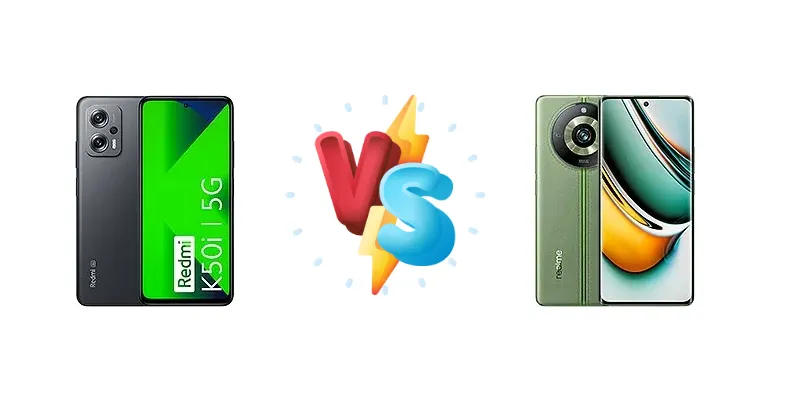
The mid-range smartphone market is fiercely competitive, and the Xiaomi Redmi K50i and Realme 11 Pro are two strong contenders. Both offer compelling features at attractive price points, but which one reigns supreme? This comprehensive comparison will break down every aspect, helping you make the right choice.
🏆 Quick Verdict
The Redmi K50i takes the performance crown with its Dimensity 8100 chipset, offering noticeably faster speeds. However, the Realme 11 Pro shines with its exceptional battery life and brighter display. Ultimately, the best choice depends on your priorities: performance or endurance.
| Network |
|---|
| 2G bands | GSM 850 / 900 / 1800 / 1900 | GSM 850 / 900 / 1800 / 1900 |
| 3G bands | HSDPA 850 / 900 / 1700(AWS) / 1900 / 2100 | HSDPA 850 / 900 / 2100 |
| 4G bands | 1, 2, 3, 4, 5, 7, 8, 20, 28, 38, 40, 41 | 1, 3, 5, 7, 8, 28, 40, 41 - International |
| 5G bands | 1, 3, 5, 7, 8, 20, 28, 38, 40, 41, 77, 78 SA/NSA | 1, 3, 5, 8, 28, 40, 41, 77, 78 SA/NSA - International |
| Speed | HSPA, LTE, 5G | HSPA, LTE, 5G |
| Technology | GSM / HSPA / LTE / 5G | GSM / CDMA / HSPA / CDMA2000 / LTE / 5G |
| | - | CDMA2000 1x |
| Launch |
|---|
| Announced | 2022, July 20 | 2023, May 10 |
| Status | Available. Released 2022, July 23 | Available. Released 2023, May 15 |
| Body |
|---|
| Build | - | Glass front, leather or plastic back, plastic frame |
| Dimensions | 163.6 x 74.3 x 8.9 mm (6.44 x 2.93 x 0.35 in) | 161.7 x 73.9 x 8.2 mm or 8.8 mm |
| SIM | Nano-SIM + Nano-SIM | Nano-SIM + Nano-SIM |
| Weight | 200 g (7.05 oz) | 183 g or 189 g (6.46 oz) |
| Display |
|---|
| Protection | Corning Gorilla Glass 5 | - |
| Resolution | 1080 x 2460 pixels (~407 ppi density) | 1080 x 2412 pixels, 20:9 ratio (~394 ppi density) |
| Size | 6.6 inches, 103.4 cm2 (~85.1% screen-to-body ratio) | 6.7 inches, 108.0 cm2 (~90.4% screen-to-body ratio) |
| Type | FFS LCD, 144Hz, HDR10, Dolby Vision, 500 nits (typ), 650 nits (HBM) | AMOLED, 1B colors, HDR10+, 120Hz, 950 nits (peak) |
| Platform |
|---|
| CPU | Octa-core (4x2.85 GHz Cortex-A78 & 4x2.0 GHz Cortex-A55) | Octa-core (2x2.6 GHz Cortex-A78 & 6x2.0 GHz Cortex-A55) |
| Chipset | Mediatek Dimensity 8100 (5 nm) | Mediatek Dimensity 7050 (6 nm) |
| GPU | Mali-G610 MC6 | Mali-G68 MC4 |
| OS | Android 12, upgradable to Android 13, MIUI 14 | Android 13, up to 2 major Android upgrades, Realme UI 5.0 |
| Memory |
|---|
| Card slot | No | No |
| Internal | 128GB 6GB RAM, 128GB 8GB RAM, 256GB 8GB RAM | 128GB 8GB RAM, 256GB 8GB RAM, 256GB 12GB RAM, 512GB 12GB RAM |
| Main Camera |
|---|
| Dual | - | 100 MP, f/1.8, 26mm (wide), PDAF, OIS
Auxiliary lens |
| Features | Color spectrum sensor, LED flash, HDR, panorama | LED flash, HDR, panorama |
| Triple | 64 MP, f/1.9, (wide), 1/1.72", 0.8µm, PDAF
8 MP, f/2.2, 120˚, (ultrawide)
2 MP (macro) | - |
| Video | 4K@30fps, 1080p@30/60fps | 4K@30fps, 1080p@30/60/120/480fps, 720p@960fps, gyro-EIS |
| Selfie camera |
|---|
| Features | - | Panorama |
| Single | 16 MP, f/2.5, (wide) | 16 MP, f/2.5, 25mm (wide) |
| Video | 1080p@30fps | 1080p@30fps |
| Sound |
|---|
| 3.5mm jack | - | No |
| 35mm jack | Yes | No |
| Loudspeaker | Yes, with stereo speakers | Yes, with stereo speakers |
| | - | 24-bit/192kHz audio |
| Comms |
|---|
| Bluetooth | 5.3, A2DP, LE | 5.2, A2DP, LE, aptX HD |
| Infrared port | Yes | - |
| NFC | No | Yes (market/region dependent) |
| Positioning | GPS (L1), GLONASS (L1), BDS (B1I+B1c), GALILEO (E1), QZSS (L1) | GPS, GALILEO, GLONASS, BDS, QZSS |
| Radio | No | No |
| USB | USB Type-C 2.0, OTG | USB Type-C 2.0 |
| WLAN | Wi-Fi 802.11 a/b/g/n/ac/6, dual-band, Wi-Fi Direct | Wi-Fi 802.11 a/b/g/n/ac/6, dual-band |
| Features |
|---|
| Sensors | Fingerprint (side-mounted), accelerometer, proximity, gyro, compass | Fingerprint (under display, optical), accelerometer, gyro, proximity, compass |
| Battery |
|---|
| Charging | 67W wired, 50% in 15 min, 100% in 46 min | 67W wired |
| Type | Li-Po 5080 mAh | 5000 mAh |
| Misc |
|---|
| Colors | Phantom Blue, Stealth Black, Quick Silver | Astral Black, Sunrise Beige, Oasis Green |
| Models | 22041216I | RMX3771 |
| Price | About 320 EUR | € 294.90 / ₹ 21,999 |
Xiaomi Redmi K50i
- Superior Performance (Dimensity 8100)
- Fast 67W Charging
- Good Value for Money
- Solid Build Quality
- Average Camera Performance
- Less Bright Display
- Potentially Less Optimized Software
Realme 11 Pro
- Exceptional Battery Life
- Bright and Vibrant Display
- Sleek Design
- Potentially Better Software Experience
- Less Powerful Chipset
- Camera Performance May Vary
- Price Slightly Higher
Display Comparison
The Realme 11 Pro boasts a significantly brighter display, reaching 790 nits peak brightness, making it easier to view content outdoors. While the Redmi K50i has a good display, it lacks the same level of brightness. Both likely feature similar resolution and refresh rates (likely FHD+ and 120Hz), but the Realme's brightness gives it an edge.
Camera Comparison
Both phones feature capable camera systems, but specifics are limited. The Realme 11 Pro likely emphasizes image processing and potentially offers more camera features. The Redmi K50i's camera is expected to be solid, but not a standout feature. Real-world testing would be needed to determine a clear winner.
Performance
Here, the Redmi K50i clearly wins. The Dimensity 8100 is a more powerful chipset than the Dimensity 7050, translating to faster app loading times, smoother multitasking, and better gaming performance. Expect noticeable differences in demanding tasks.
Battery Life
The Realme 11 Pro excels in battery life, boasting an impressive active use score of 13:14h and an endurance rating of 112h. The Redmi K50i, while having a decent battery, doesn't match the Realme's longevity. The 67W charging is similar on both, offering relatively fast top-ups.
Buying Guide
The Xiaomi Redmi K50i is ideal for gamers and power users who prioritize raw performance and fast charging. The Realme 11 Pro is a better fit for users who value long battery life, a vibrant display for media consumption, and a more streamlined user experience.
Frequently Asked Questions
❓ Which phone is better for gaming?
The Xiaomi Redmi K50i is the better choice for gaming due to its more powerful Dimensity 8100 chipset.
❓ Which phone has better battery life?
The Realme 11 Pro offers significantly better battery life, lasting much longer on a single charge.
❓ Is the Realme 11 Pro's display worth the extra cost?
If you prioritize a bright and vibrant display for media consumption, the Realme 11 Pro's display is a worthwhile upgrade.
❓ Which phone offers better value for money?
The Xiaomi Redmi K50i generally offers better value for money, providing strong performance at a competitive price.